

















To track approval handoff delays, record four timestamps for every post (submitted, first opened, decided, scheduled) and look at the gaps between them. The longest gap is where your campaign is losing time, and it's rarely the one you expect. This scorecard turns that into six numbers you can pull in about ten minutes.
TLDR: Score your last 10 posts on six measures: wait before first look, time to decision, revision rounds, stalled posts, handoffs per post, and approved-but-not-scheduled gaps. Fix the biggest gap first. Then score again after two weeks.
Mydrop data, September 2026: in the 30 days to 16 September 2026, 98.5% of posts published through Mydrop went live at the first attempt. The most common warning was a YouTube custom thumbnail rejected because the channel wasn't phone-verified; the most common hard failure was an expired platform connection. Method in the Mydrop social media benchmarks.
The six numbers
Pull your last 10 published posts and fill in the table below for each one. A spreadsheet is enough.
| Measure | How to read it | A red flag |
|---|---|---|
| 1. Wait before first look | Submitted until the approver first opens it | More than one working day |
| 2. Time to decision | First look until approve or "changes needed" | Decisions that take longer than the first wait |
| 3. Revision rounds | How many times the post went back to the creator | Three or more rounds on routine posts |
| 4. Stalled posts | Posts sitting in review longer than 48 hours | More than 1 in 10 |
| 5. Handoffs per post | People or tools the post passes through | Any step where the post leaves the tool (email, chat, shared drive) |
| 6. Approved-to-scheduled gap | Approval until the post is actually queued | A gap longer than one working day |
The red-flag lines are our rules of thumb, not industry standards. Adjust them to your cadence.
Read the gaps in this order
Wait before first look is a notification problem. The approver didn't know the post was there. A direct link and a reminder fix most of it. In Mydrop's data, the median time from submission to approval was 6 hours, so a first wait of several days usually points to routing, not to slow reviewers.
Time to decision is a clarity problem. The reviewer opened it but couldn't decide. Common causes: no preview of the real post, unclear what they're being asked, or two reviewers who disagree.
Revision rounds are a brief problem. Lots of rounds on routine posts mean the brief and the first draft don't match. Add the three things reviewers keep asking for (audience, goal, the one claim that needs proof) to the draft template.
Stalled posts are an ownership problem. Someone is waiting on someone, and nobody owns the nudge. Give every post one named owner for the next step.
Handoffs per post are a tooling problem. Every time a post leaves the system, context is lost. Count the exits, then remove the worst one first.
The approved-to-scheduled gap is the one most teams forget. Approval is not publishing. The data above shows 98.5% of posts went live at the first attempt, so the remaining 1.5% is where an approved post still needs a person. The scorecard should end at "went live", not at "approved".
Assessing a new tool before it breaks your handoffs
If you're deciding whether a new production or scheduling tool will disturb your review flow, don't judge it from a feature list. Run the scorecard twice:
- Baseline: score one current campaign.
- Pilot: run the next comparable campaign in the new tool and score it with the same six measures.
Switch only if the biggest gap shrinks and no gap grows. A tool that speeds up drafting but adds a handoff will show up in measure 5 straight away.
When the usual coordinator is out
Campaign handoffs between teams turn into a mess when the process lives in one person's head. Add two columns to the scorecard: owner and backup. If a handoff has no backup, write the name in before the coordinator takes holiday, not after.
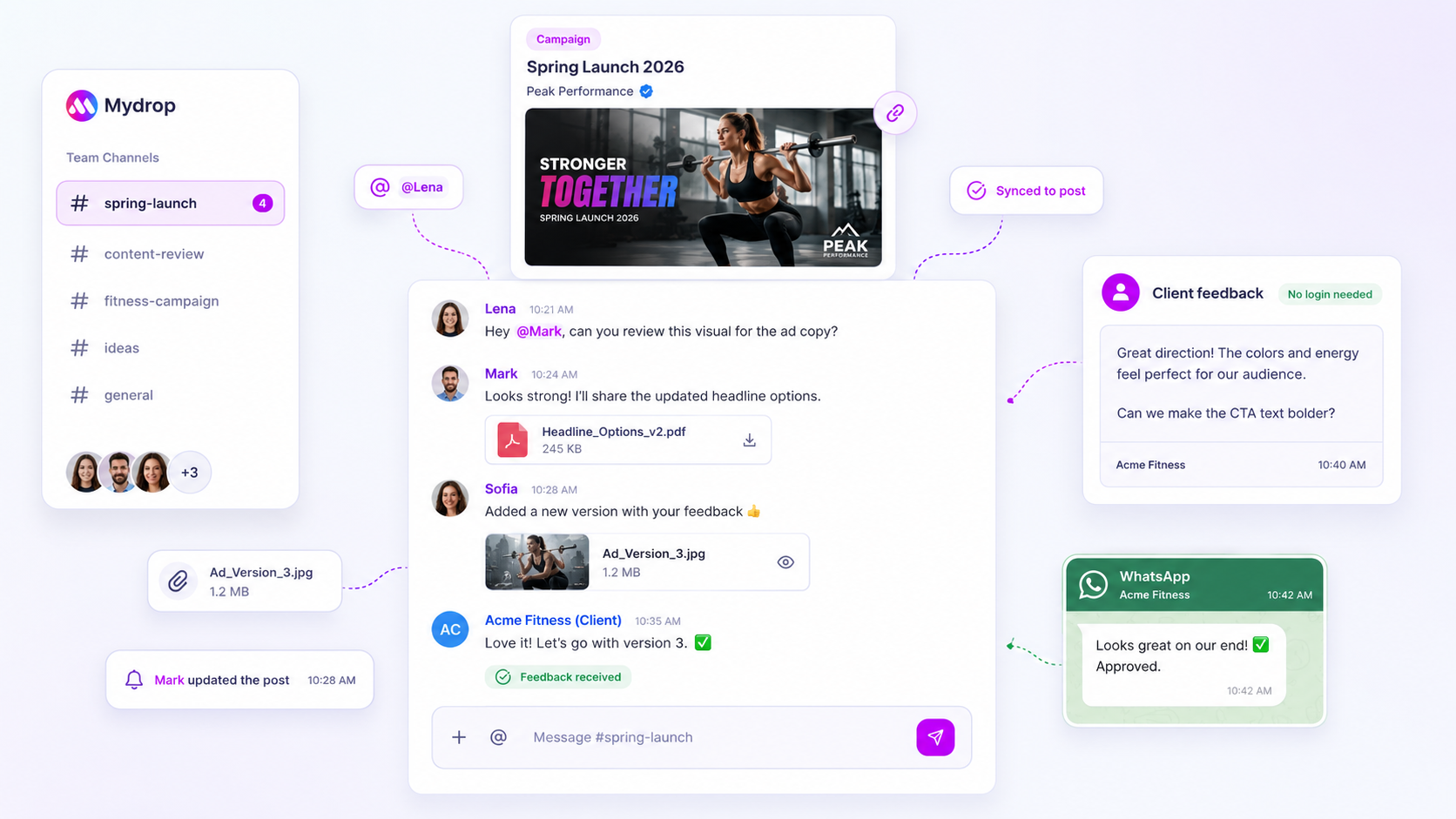
In Mydrop's approvals, the status, approver and comments sit on the post itself, so anyone covering can see who is holding the baton. The client portal shows clients their own pending posts, which removes one more "where is this" message.
Next step: take your last 10 posts, fill in the table today, and circle the biggest number. Fix that one gap for two weeks, then score again. For the deeper version, see the approval debt audit.


 Google review
 Trustpilot review
 Product Hunt comment