
















Stop using AI for a caption when the post depends on something the model cannot know: a real event, a real person, a number someone will hold you to, or a voice you have never written down. AI is a fast first draft. It is a poor final author wherever a wrong sentence costs more than a slow one. Below are six situations, the signal that you are in one, and what to do instead.
TLDR: Keep AI for volume work like variants, first drafts and repurposing. Take it off the keyboard for sensitive, first-person, number-heavy and launch posts, and whenever you fix the same thing in every draft. In Mydrop's data, caption length barely matters past 80 characters, so padding an AI draft is not a fix either.
Mydrop data, September 2026: across accounts connected to Mydrop, which manages 55,000+ posts, captions under 80 characters ran 9% below their account's typical post. From 80 characters up, length made no measurable difference: every bucket from 80 to 600+ characters sat within 3% of the median. Method and full tables in the Mydrop social media benchmarks.
Six situations where a human writes the first line
| Situation | The signal you are in it | Do this instead |
|---|---|---|
| Sensitive or breaking news | A tragedy, outage, recall or public argument is on the feed today | Pause scheduled AI posts, write one human statement |
| First-person stories | The caption says "I", "we" or quotes a customer | Write it from the real notes, use AI only to trim |
| Numbers, prices, dates, legal wording | The caption contains a claim someone could screenshot | Paste the facts in yourself and ask AI to format only |
| Replies to angry customers | The post is a response, not a broadcast | Human reply, always |
| Launch and hero posts | The post will carry a paid push or a pinned slot | Draft by hand, use AI for three alternative first lines |
| The same edit, every week | You delete the same phrase or add the same sentence each time | Fix the instructions, not the caption |
Numbers and promises: AI writes them confidently and wrongly
A model has no way to check that your sale ends Sunday, that the discount is 20% or that the product ships to Canada. It will still write the sentence smoothly. A smooth wrong date is worse than a clumsy right one.
The rule is simple. Any caption with a figure, a deadline or a guarantee gets those facts typed by a person, and the AI only shapes the wording around them. Then a second person reads the numbers before the post is scheduled.
First-person posts lose the one thing that works
Founder stories, behind-the-scenes posts and customer quotes work because they sound like a specific person. An AI draft averages thousands of voices into one. Readers cannot name the problem but they scroll past it.
For these posts, write three rough lines yourself, then let AI tighten them. If the result no longer sounds like you, throw it out.
If you fix the same thing every week, the problem is upstream
Keep a tally for two weeks. Every time you rewrite an AI caption, note what you changed: tone, length, hashtags, a banned word, a missing call to action.
If one fix shows up in more than a few drafts, do not keep editing captions. Put the fix into the instruction once ("never open with a question", "always end with one concrete action"). In our experience, a team that does this finds most of its edit pile disappears. If edits do not shrink after two rounds of better instructions, that content type belongs to a human.
Do not stop for the wrong reason
Short captions are not the sign of AI trouble. Mydrop's data shows only captions under 80 characters ran below the account's typical post, and everything from 80 characters up sat within 3% of the median. If your AI captions are long and flat, trimming them to a sharper 120 characters is a style choice, not a rescue.
AI is still the right tool for work where a miss is cheap:
- three or four versions of one hook to choose from,
- cutting a caption to fit a platform limit,
- turning one post into a version per platform,
- first drafts of routine posts like "new on the blog".
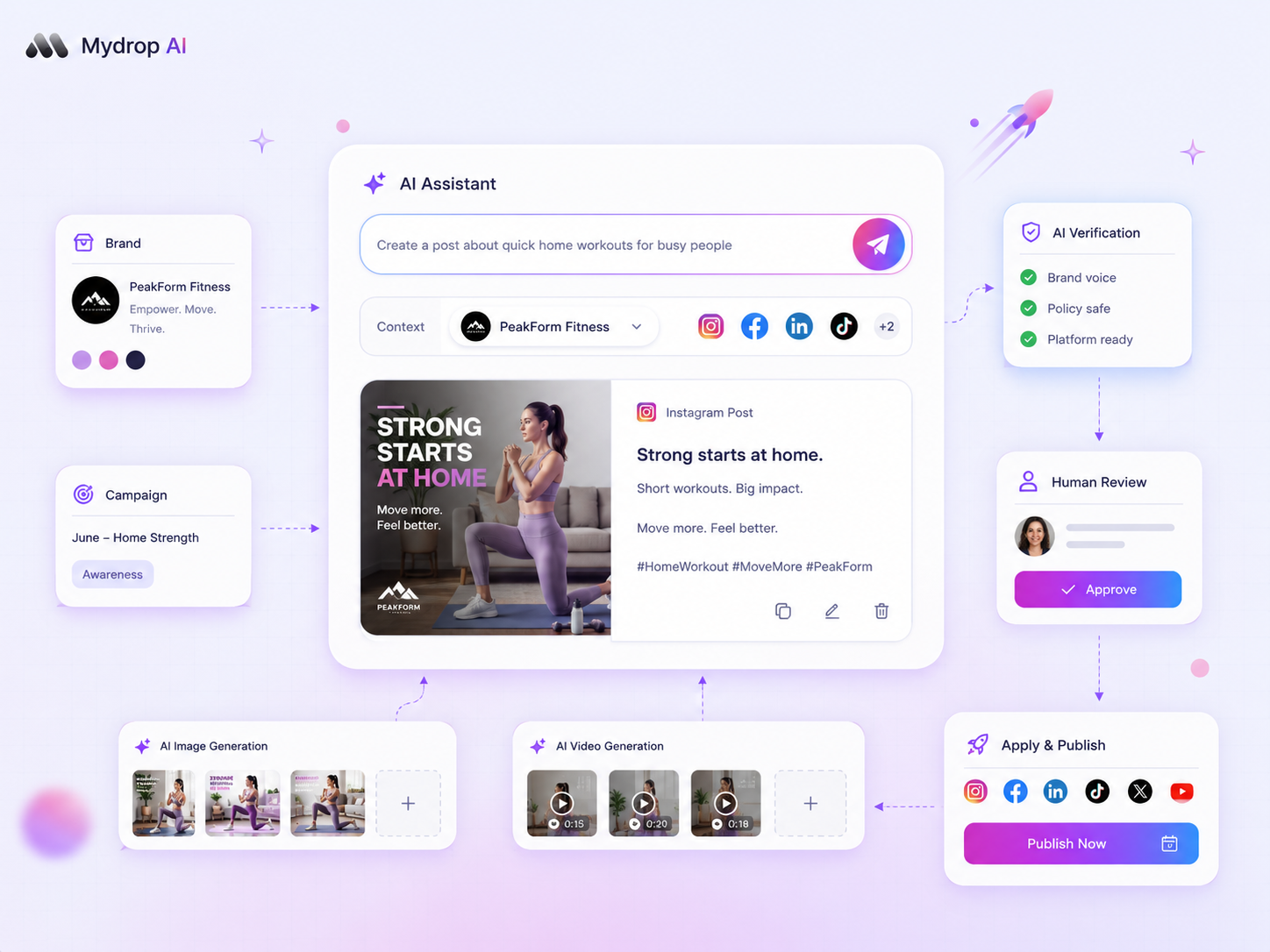
In Mydrop's AI content tools the draft is only the start: put an approval step after it so a person signs off on anything from the table above. Our guide to trusting AI caption generation covers the opposite question, where AI is safe to run on its own.
Run a one-week stop test
For one week, mark every caption you were about to generate with one of the six situations. Write those by hand. Let AI draft the rest. At the end of the week, compare how many captions you rewrote and how long review took.
If you want drafting and sign-off in one place, start free with Mydrop and send AI drafts through approval before they publish.

 Google review
 Trustpilot review
 Product Hunt comment