
















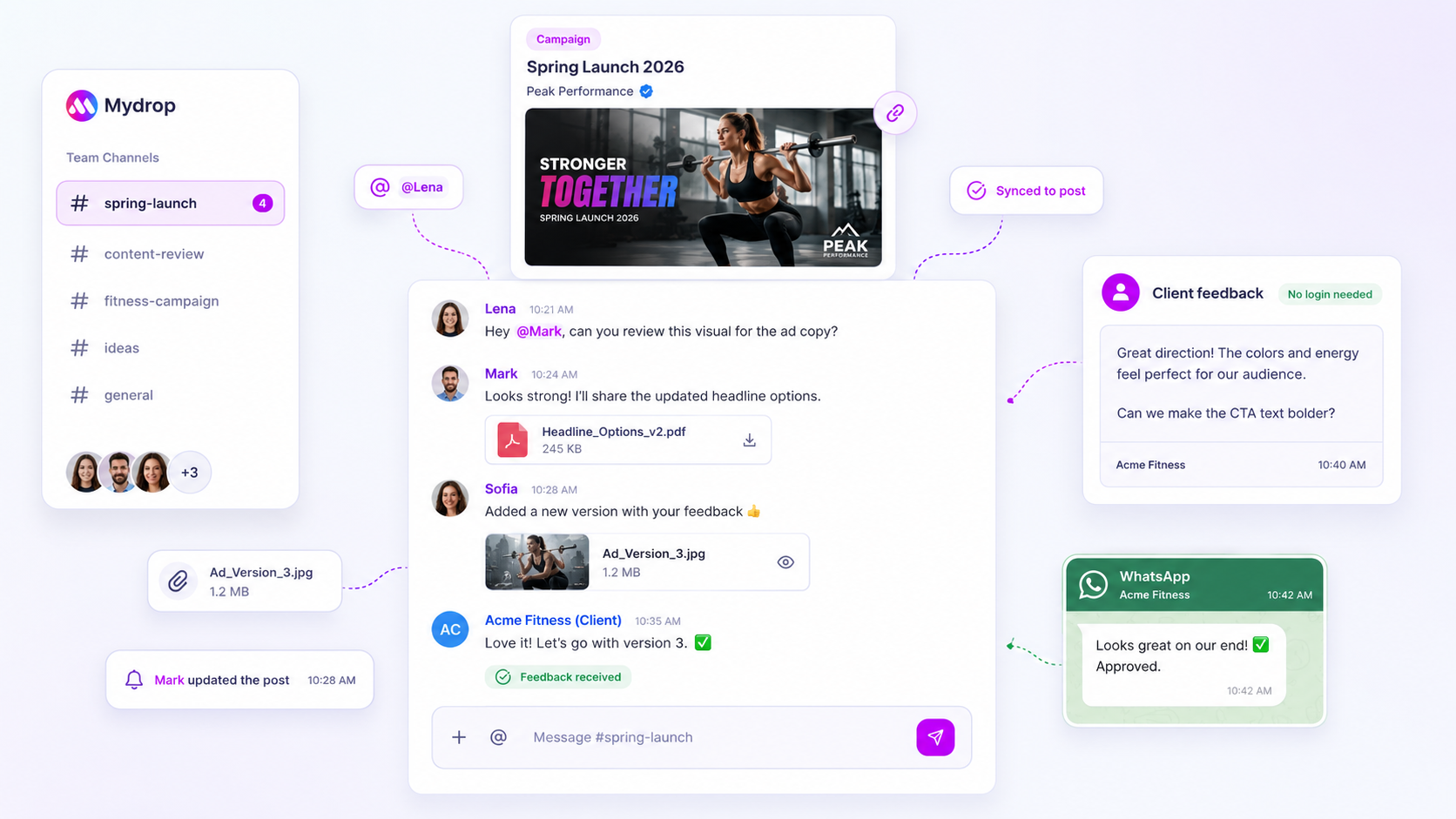
You're not losing your best ideas because your team lacks creativity. You're losing them because your setup is too clunky to catch the small stuff, so your team ends up dumping brilliant concepts into fleeting chat threads where they vanish within hours. To stop this, stop treating every spark of an idea like a formal project request. Instead, treat capture as a low-friction reflex that keeps your creative capital in a shared, permanent space where it stays visible and ready to act on.
We've all been in that Friday afternoon Slack huddle where someone drops a genius hook or a fresh angle on a campaign. By Monday morning, that message is buried under fifty other threads. It feels like a minor annoyance, but this is the quiet erosion of your team's creative confidence. When you treat ideas as throwaway, you train your team to stop sharing them.
What changed before the numbers moved

From our work with enterprise marketing teams managing hundreds of social profiles, the drop-off in performance rarely starts with a bad creative strategy. It starts with a coordination failure. You see the numbers dip (lower engagement on launch days, repetitive content, a scramble to fill the calendar) and assume it's an execution problem.
But if you look at the weeks before the slide, you'll usually find the "Idea Leak." That's when your communication channels get so noisy that intent gets separated from action.
| Feature | Ad-Hoc Communication | Persistent Workspace Notes |
|---|---|---|
| Visibility | Fades as threads push down | Always accessible in Home |
| Searchability | Poor (requires scrolling history) | Native (instant recall) |
| Context | Detached from the calendar | Surfaced near planning workflows |
| Ownership | Often lost in private DMs | Linked to the team environment |
This is where teams usually get stuck. They try to bridge the gap by forcing every stray thought into a rigid, formal task management system. That's a mistake. When you demand a full brief, a deadline and a priority tag just to capture an idea, you kill the spark before it has a chance to breathe.
The result is inevitable: the team stops writing down the "maybe" ideas. They only log the "must-do" tasks. Your pipeline shrinks, your calendar becomes a collection of safe, predictable filler, and your creative equity evaporates.
Operator rule: If an idea is too unformed for a formal ticket, it's a perfect candidate for a persistent note. Capture it as a raw thought now so you can promote it to a campaign later.
When you allow for a middle ground, a place to park unformed thoughts that isn't a graveyard of chat messages, you start seeing the signal through the noise again. The goal is to make capturing an idea feel as fast as sending a message, but as permanent as a project brief.
The failure patterns to check first

To stop the bleeding, you need to pinpoint exactly where your team's mental load peaks. We see the same four "idea leaks" across enterprise teams managing dozens of brands:
- The Slack Void: Your team treats chat channels as temporary storage. Because these tools are built for speed and linear updates, ideas disappear after a few days of activity. If a concept isn't moved to a permanent home, it's effectively deleted.
- The Fragmented Desktop: Your most senior strategists are probably hoarding "gold" in local text files, browser bookmarks or personal note apps. When that person is out of office or busy, that intellectual property is invisible to the rest of the team in practice.
- The Heavy-Process Wall: You might have a solid project management system, but if you force a raw, half-formed thought into a formal task ticket, you create friction. People stop capturing ideas because the "admin tax" of creating a ticket is too high for a loose, creative spark.
- The Disconnected Context: Ideas often strike when you're reviewing a calendar or analysing performance. If the capture tool is a separate tab or a different app, the mental switch kills the flow.
Check how your team behaves right now against this scorecard to find where you're losing the most equity.
| Leak Type | Visibility | Recovery Speed | Primary Cost |
|---|---|---|---|
| Chat Threads | Low (Lost in history) | Slow (Searching back weeks) | Lost creative nuance |
| Local Files | Zero (Siloed) | Impossible (Non-accessible) | Duplicate effort |
| Formal Tickets | High (Structured) | High (Admin-heavy) | Kills creative momentum |
| Mydrop Notes | High (Integrated) | Immediate (Pinned to workflow) | Zero-friction capture |
Common mistake: Treating "quick capture" as a low-priority task. If you don't make it effortless to drop an idea into a shared space, your team will keep defaulting to the "Slack Void," where ideas go to be forgotten.
The proof that separates signal from noise
The difference between a high-performing team and one drowning in coordination debt is persistent visibility. When your team can move an idea from a vague thought to a persistent note that lives inside their planning environment, the whole dynamic changes.
At Mydrop, we see that teams don't actually have a "lack of ideas." They have a "retrieval problem." When you use a persistent note-taking system, one that surfaces ideas right next to your calendar, you turn noisy, ad-hoc chatter into searchable, actionable assets.
Think of it as your creative safety net. Instead of hoping someone remembers that brilliant angle mentioned in a Tuesday status meeting, you treat that note as a first-class citizen of your workspace. It sits in your home view or right on the calendar, ready for when capacity opens up.
This isn't about adding another tool; it's about narrowing the gap between inspiration and execution. When an idea is captured as a shared, persistent note rather than a hidden chat message, you stop burning intellectual capital. You gain the ability to sort, theme and eventually turn those "maybes" into "must-haves" without ever leaving the context of your production pipeline.
A simple rule helps: If an idea is worth saying, it's worth anchoring to your workspace. If it isn't worth a note, you shouldn't be spending time discussing it in the first place.
What to fix this week
To stop the leak, stop treating ideas like debris and start treating them like capital. You don't need a new software suite or a three-day strategy retreat; you just need to change where the "low-hanging" creative energy lands.
Here's a 3-step audit to run with your team this Friday:
- Declare "No-Chat Zones": Identify the specific channels where creative concepts go to die. If an idea is more than a quick reaction, it's banned from Slack. It must live in a permanent home where it's searchable next week.
- Install the Capture Habit: Give your team a "landing strip." At Mydrop, we often see teams use our Notes feature as this dedicated layer. Because these notes sit right inside the calendar workspace, nobody has to toggle between a chat app and their actual planning environment to drop an idea.
- The "Morning Refresh" Review: Start Monday morning by pulling up your recent notes. If a note is still there after two weeks, either commit to it as a project or delete it. Clear the mental clutter to keep the workspace sharp.
Decision check: If an idea isn't captured in a shared, persistent workspace, it effectively doesn't exist.
When to stop diagnosing and change the workflow
There comes a point where "better discipline" isn't the solution, because your underlying setup is simply at war with your goal. If you're managing multiple brands or large-scale social operations, you'll hit a ceiling where manual collation fails no matter how hard you try.
You should consider moving to a more integrated workflow when you notice these three signs:
| Signal | Threshold for Action |
|---|---|
| Search Time | You spend more than 15 minutes searching for a previously discussed asset or idea. |
| Context Switching | Your team bounces between 3+ different tools just to get a single concept approved. |
| Approval Lag | Creative feedback cycles consistently take >48 hours because stakeholders lose track of the thread. |
If you hit any of these, stop trying to train your team to work faster. You've outgrown a "loose" system. You need a platform that pulls your notes, calendar and assets into a single loop. When your capture tool is integrated with your publishing tool, you eliminate the gap between thinking about a post and scheduling it.
Conclusion
The difference between a frantic team and a high-performing one often comes down to who controls their creative pipeline. If your ideas are trapped in the noise of daily operations, you're burning your most valuable assets.
Take back your team's creative equity by moving ideas out of the void and into a permanent, visible space. Once you normalise the habit of capturing and surfacing those thoughts alongside your calendar, you'll find that your biggest problem is no longer losing great ideas, it's having too many excellent ones ready to publish.
Stop the leak today. Your next big campaign is already sitting in someone's head; give it a place to land.



 Google review
 Trustpilot review
 Product Hunt comment