

















A content operating system is five weekly rituals, each with one owner and one output: intake, plan, produce, approve, review. If every post you publish goes through those five stops, you have a system. If posts reach the feed through DMs and "can you just quickly...", you have a habit of heroics.
TLDR: Run five rituals every week (intake Monday, plan Monday, produce Tue to Thu, approve Thu, review Friday). Give each one an owner and a single written output. Everything else in "content ops" is detail on top of that loop.
The five rituals and what each one must produce
Each ritual ends in something you can point to. If you can't point to it, the ritual didn't happen.
| Ritual | When | Owner | Output |
|---|---|---|---|
| Intake | Monday morning | Channel lead | One list of every request, with brand, deadline and goal |
| Plan | Monday afternoon | Content planner | Calendar slots filled for the next 7 to 14 days |
| Produce | Tuesday to Thursday | Creators | Drafts attached to calendar slots, not to chat threads |
| Approve | Thursday | Brand or client approver | Approved or changed, with comments in one place |
| Review | Friday | Analyst or lead | Three numbers and one decision for next week |
The rhythm matters more than the exact days. Pick days that fit your team and stick with them for a quarter.
Intake: close every side door
Most chaos starts before anyone writes a caption. Requests come in by email, chat, in the corridor and in meetings.
Set one door. A shared form or a single channel is fine. The rule is simple: a request that isn't on the list doesn't get a slot. Each entry needs a brand, a goal, a deadline and a link to any assets.
Plan and produce: the calendar is the single source of truth
Once requests are listed, the planner puts them on the calendar. Drafts live on the calendar card, so nobody has to ask "where's the latest version?"
In Mydrop, the multi-brand content calendar holds every brand's slots in one view, and AI captions and post ideas give creators a first draft to edit instead of a blank box. You can also batch with bulk creation when one idea runs across several accounts.
Approve: one place, one deadline
Approval is where systems usually break. Feedback arrives in four channels and nobody knows which version is final.
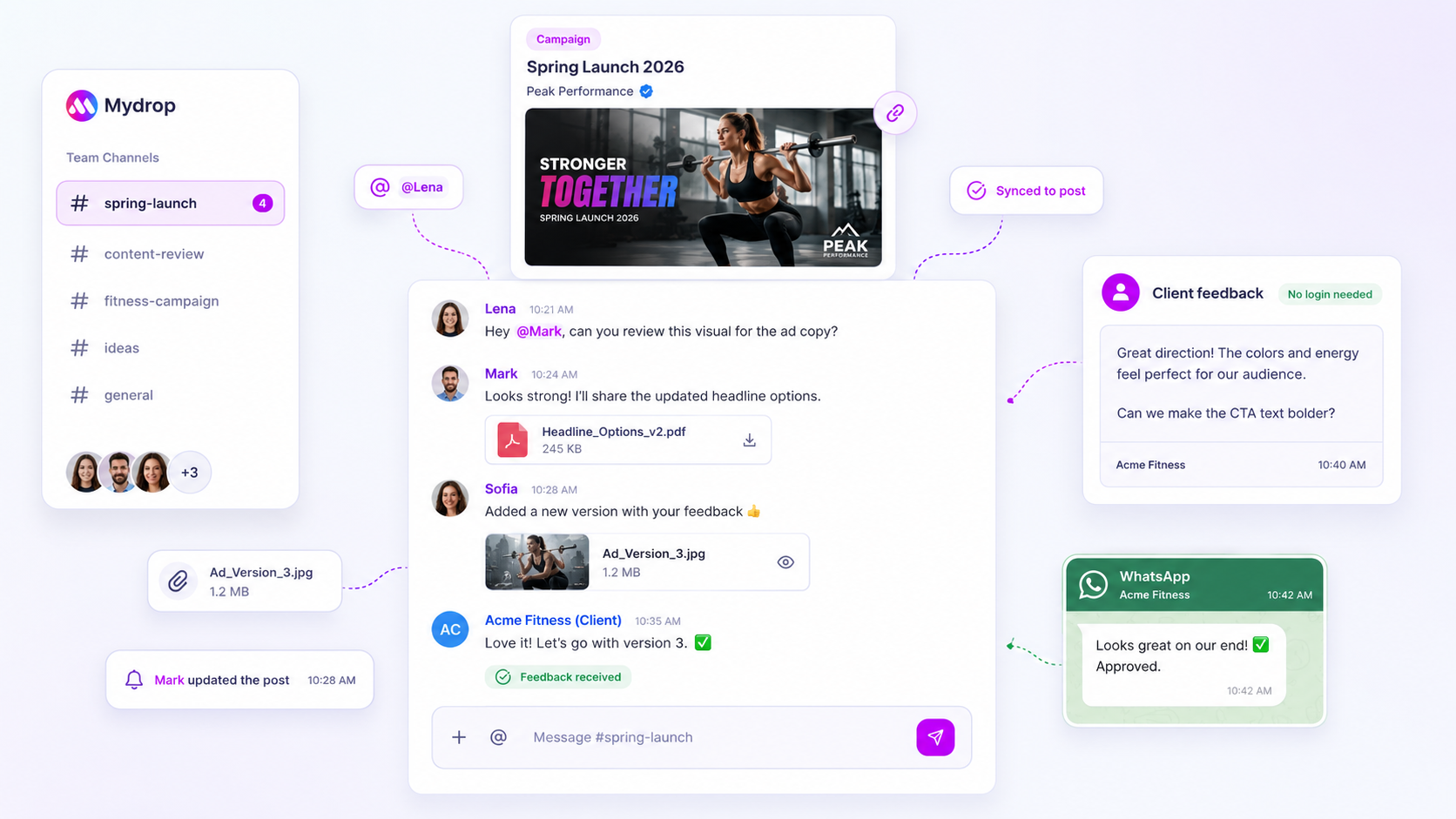
Fix it with two rules. First, comments live on the post itself. Second, an approver who doesn't respond by the deadline gets a reminder, not a silent wait. Approval workflows and the no-login client portal are built for this: the approver sees the post as it will look, and the record stays attached.
On timing, in Mydrop's data on client approvals, the median post took 6 hours from submission to sign-off, and 66% were approved within 24 hours. A Thursday approval slot is realistic when requests are clean.
Review: three numbers and one decision
The Friday review is short on purpose. Pull three numbers per brand: reach, engagement rate and one business action such as clicks or replies. Then make one decision for next week: repeat, change or stop one thing.
For context on what "normal" looks like, the Mydrop social media benchmarks show a median Instagram engagement rate of about 3.1%, with the middle half of posts between 1.1% and 6.7%. A 2% post is ordinary. Don't rewrite your strategy over it.
Signs the system is working
You'll notice three changes within a month. Fewer "where's the latest version?" messages. Fewer posts published on the day they were requested. And a Friday review that takes 20 minutes instead of an hour, because the numbers are all in one place.
If none of those change, the problem is usually intake. Check how many requests still bypass the list and close that door first.
Common ways the loop breaks
- The planner becomes a bottleneck. Give creators permission to fill open slots from the intake list without waiting.
- Approvers answer in chat. Remind them once, then stop replying to chat feedback. Ask for it on the post.
- Review turns into a status meeting. Keep it to three numbers and one decision.
Write the one-page version this week
You don't need a new tool to start. Open a doc and write five lines:
- Where requests go (the one door).
- Who owns the calendar.
- Who approves each brand, and the deadline.
- Which three numbers you review.
- Which day each ritual happens.
Run it for four weeks and fix the one ritual that slipped most. When the system holds, move the calendar, approvals and reports into one workspace. You can start free on Mydrop and set up your first brand in an afternoon.


 Google review
 Trustpilot review
 Product Hunt comment