

















The fastest way to break a social media operation is to treat every post like a formal press release. If your approval chain regularly needs more than three separate sign-offs, you are not guaranteeing quality. You are building a bottleneck into the structure that drains creative energy and kills your posting speed.
We have all been there. It is 6 p.m. on a Thursday, you are chasing a final signature on a post that was ready on Tuesday, and you are starting to wonder whether the brand will really collapse over a slightly different shade of blue. Every update feels like a hostage negotiation, and the actual work of being creative gets buried under endless Slack threads and "just one more look" requests.
This guide gives you a practical, scorecard-based method for spotting where your approval process is bloating. We will walk through how to trim the excess, so you can keep your brand standards high without turning your team into a group of professional file-passers.
The hidden cost of "thorough" approvals isn't just wasted time; it is context decay. Every time a post gets passed to a new person, the original intent and momentum behind the creative get diluted. The result is bland, by-committee content that rarely moves the needle.
The operating problem this solves

When your team is small, "everyone sees everything" is a workable strategy. You trust the person in the next chair, and you can shout across the desk to get a quick confirmation. As you scale to manage more brands, channels or global markets, that closeness disappears.
You end up with coordination debt. That is when the effort it takes to manage the process of publishing outweighs the effort it takes to create the content itself.
Most teams get stuck here because they confuse control with brand safety. They add more layers of review hoping to catch mistakes, but what they actually build is a system where no one is truly responsible. If five people need to sign off on a caption, everyone assumes "someone else caught the error."
Operator rule: If your review process relies on informal chat threads instead of centralised tools, you do not have an approval problem. You have a visibility problem.
Mydrop data, September 2026: across posts that went through a client approval on Mydrop, the median time from submission to approval was 6 hours, and 66% were approved within 24 hours. Method in the Mydrop social media benchmarks.
When approvals disappear into DMs or fragmented email chains, you lose sight of who is holding things up. We have seen this across hundreds of brand profiles: the bottleneck is rarely the person doing the work. It is the lack of a shared, transparent view of where the post is currently stuck.
To fix it, you have to move from a "who needs to see this" mentality to a "who is the final gatekeeper for brand safety" mindset. You need a hierarchy that protects the brand without strangling the feed.
The minimum system that works

The secret to a scalable approval flow is realising you do not need more people; you need better defined lanes. A high-functioning team runs on a rigid 3-step hierarchy: the Creator produces, the Editor polishes for voice, and the Approver checks for brand safety and legal clearance. That is it.
If you add a fourth step, you are probably just shifting your own anxiety onto someone else. We have seen teams across thousands of posts where adding a "Marketing VP" or a "Subject Matter Expert" as a mandatory sign-off caused a 48-hour delay on content that was already 95 per cent ready. The cost of that delay? The trend cycle moved on, and the post landed with all the excitement of a dry press release.
A healthy process assumes the Creator and Editor have already done the heavy lifting. The final Approver is not there to rewrite captions; they are there to act as the last gatekeeper for liability and brand alignment.
Sample Approval Matrix
Use this matrix to audit whether your current stakeholders are actually needed or just creating friction.
| Role | Responsibility | Authority | Failure Mode |
|---|---|---|---|
| Creator | Asset & Draft | Build to Spec | Subjective guesswork |
| Editor | Tone & Strategy | Refine/Reject | "Death by 1000 cuts" edits |
| Approver | Brand/Legal | Sign-off/Kill | Bottlenecking the pipeline |
Where teams overbuild the process
Most approval chaos stems from a lack of trust, not a lack of rigour. When a team feels insecure about a brand's voice, they default to "group editing", where every stakeholder takes a turn at the keyboard. That turns a social post into a bland consensus document that offends no one but moves no one, either.
The most common trap is the "all-eyes-on-everything" mandate. Teams managing dozens of brand profiles often assume, wrongly, that every tweet, story and video needs the same level of scrutiny. A high-stakes product launch needs a different level of oversight from a casual community engagement post or a daily status update.
Signs your process is overbuilt:
- The "Reply All" Trap: Feedback lives in disconnected email threads or Slack channels, losing all the original context of the draft.
- Format Blindness: Reviewers are approving text, but they cannot see the final image crop or video thumbnail until the post is live.
- The Ping-Pong Effect: Posts are sent back for minor edits, then wait another 24 hours to be seen by the same person.
Decision check: If a reviewer’s main feedback is "I don't like the colour" or "Can we try a different emoji," they are not a gatekeeper. They are a distraction. Move them to a passive role where they see the content for visibility, but do not need their signature to publish.
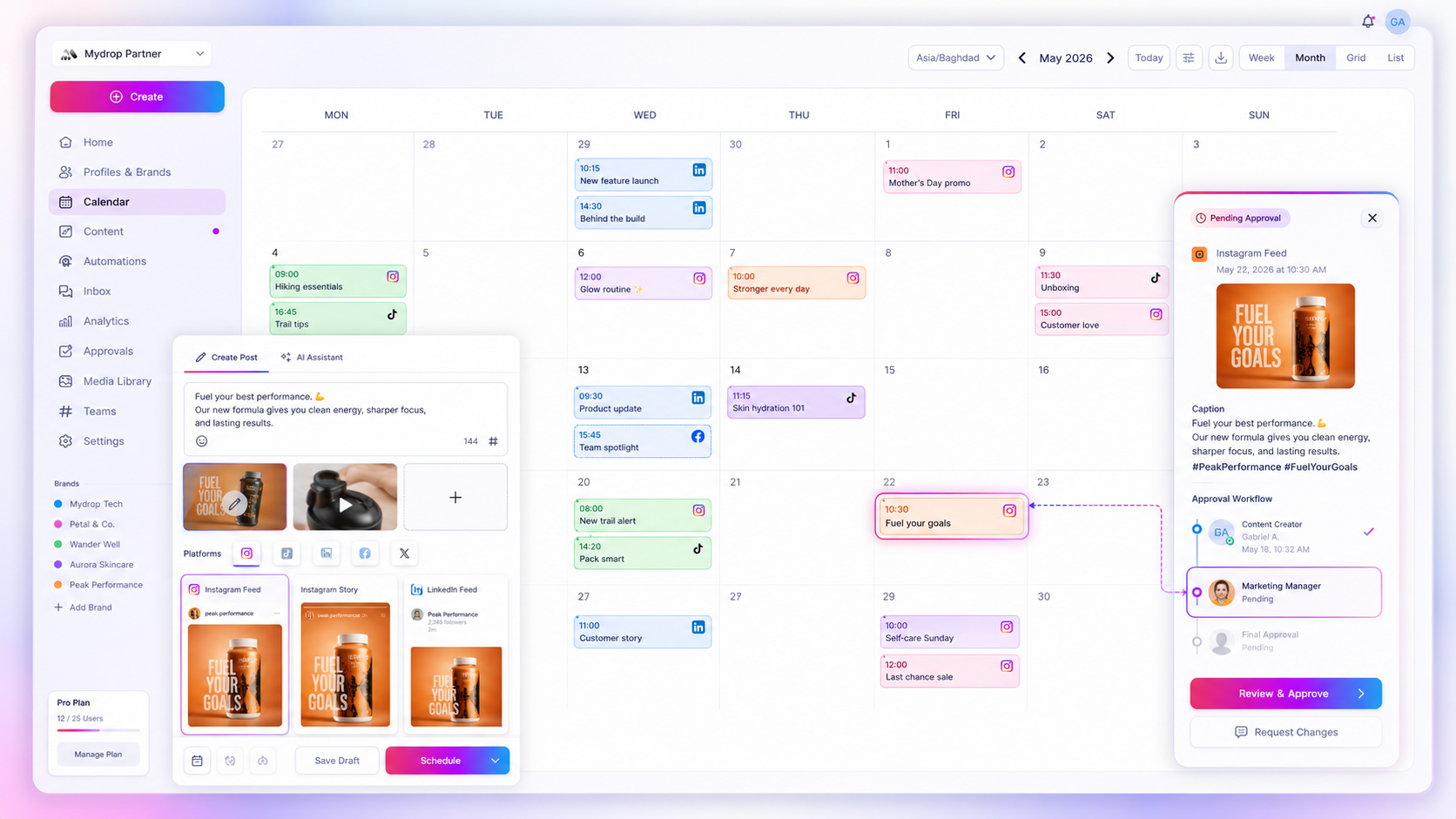
At Mydrop, we often see teams struggle because they are trying to manage these approval handoffs across three different tools. When you force your review process into a chat app, you lose the attachments, platform-specific specs and version history a reviewer needs to make a decision. If they have to ask, "Wait, which link goes in this?" or "Is this the latest version of the graphic?", you have already lost the speed you were trying to protect. Keeping that context pinned to the calendar, not the chat, is the only way to keep the train moving.
How to run the cadence
Getting your approval process lean is not a one-time project. It is a maintenance habit. If you do not audit the process, it will naturally drift back toward bloat, because stakeholders are inherently risk-averse. Schedule a 30-minute Process Sync every Friday to look at the week that just passed.
This is not a meeting to discuss individual posts. It is a data-driven look at your workflow health.
- Review the backlog: How many posts missed their original launch date because they were stuck in review?
- Identify the blockers: Which stakeholder held the most posts for more than 24 hours?
- Check the revisions: Did the feedback actually improve the content, or was it purely subjective "I just prefer this colour" commentary?
- Clean the list: Are there people on the approval chain who didn't actually offer input on 80% of your posts? Remove them.
If a specific brand or region is consistently slower, do not just push them to work faster. Ask why. Maybe the brand guidelines for that region are too vague, forcing the reviewer to guess instead of approve. Maybe the creative team isn't using the right brief templates.
At Mydrop, we see teams use the Calendar > Post approval feature specifically to create a paper trail for this audit. Since all comments and changes are linked directly to the post, you don't have to hunt through Slack to see why a post stalled. You can see exactly which stage the friction happened at, which turns your Friday audit into a five-minute task instead of an hour of detective work.
The proof that the habit is working
A healthy approval process is invisible. When it is broken, you feel the drag every single day. You know you have successfully shifted from "control" to "velocity" when your KPIs start to line up with a leaner, more predictable machine.
| Metric | Stalled State | Optimized State |
|---|---|---|
| Average Approval Turnaround | 24 to 48 hours | 2 to 4 hours |
| Missed Publishing Windows | 15% or higher | Under 2% |
| Revision Cycles | 3+ per post | 1, maybe 2 |
| Stakeholder Involvement | Everyone has "final" say | Only the accountable lead signs off |
If your metrics look like the Stalled State column, you are paying a "coordination tax" that limits your team's output. By tightening the hierarchy to the Rule of Three and removing optional reviewers, you aren't just saving time. You are protecting the creative integrity of the work.
Conclusion
The goal of restructuring your approval workflow is not to cut corners. It is to make sure your best creative work doesn't die in a queue. We often think more eyes mean higher quality, but in social media operations, more eyes usually just mean more versions of a post that nobody loves.
Stop treating every post like a board-level presentation. Start trusting your creators to work within clearly defined brand guardrails, and keep your reviewers focused on high-level risk rather than pixel-perfect preferences. If you can move from "who needs to see this" to "who is the last gatekeeper for brand safety," you will find your team suddenly has the capacity to do more.
Consistency is the only real shortcut to social media scale. Build a system that assumes success, not one designed to catch every possible mistake before it happens. Your team will be happier, your content will feel more authentic, and you might actually get your evenings back.

 Google review
 Trustpilot review
 Product Hunt comment