





























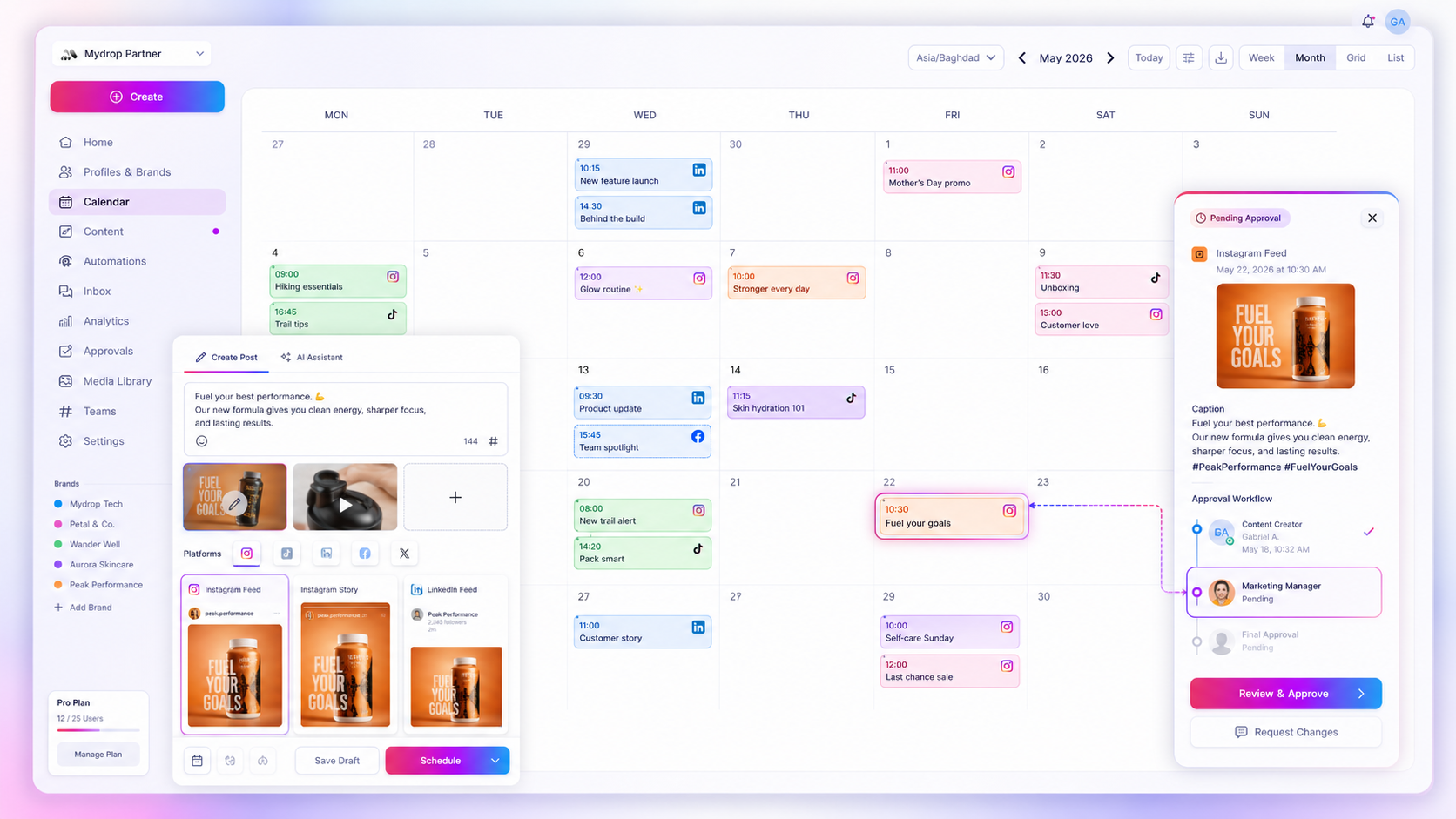
To streamline a multi-user content calendar with approval chains, put the approval status on the calendar itself, give every post one owner and named approvers, and set review deadlines counted back from the publish date. Then let reminders do the chasing, and make sure an unapproved post can never go live. Five steps, about an hour to set up.
TLDR: Keep the chain to two or three stages, show each stage as a status on the calendar, and give client sign-off a three-day buffer. In Mydrop's data, the median approval took 6 hours, but the slowest quarter waited almost three days.
Mydrop pricing check, September 2026: the entry paid plans of the eight tools most often compared with Mydrop run from $6 per channel (Buffer) and $25 a month (Later) to $99 per user (Hootsuite) and $199 per seat (Sprout Social), read on each vendor's pricing page. Mydrop is free to start, then $19 a month flat, not per seat. Full table on Mydrop's compare pages.
Why approval chains stall on a shared calendar
A multi-user calendar shows what is planned. It rarely shows where each post is stuck. The writer thinks the post is with the manager, the manager thinks it went to the client, and the client never received it.
Three patterns cause almost every stall:
- Status lives somewhere else. The calendar shows a block on Thursday, while the approval sits in an email thread.
- "The team" approves. When nobody is named, everybody waits for somebody else.
- No deadline before the deadline. The only date on the post is the publish date, so review starts the night before.
The five steps below fix each one.
Step 1: Cap the chain at three stages and name them
Every stage you add costs a day. Most teams only need these:
| Stage | Status on the calendar | Who moves it forward | Done by |
|---|---|---|---|
| Draft | Draft | Writer or designer | 5 days before publish |
| Internal review | Pending | Account lead or manager | 4 days before publish |
| Client sign-off | Pending, sent to client | Client | 3 days before publish |
| Ready | Approved and scheduled | Scheduler (often the lead) | Publish time |
If legal or compliance need to see some posts, add them only on those posts, not as a stage for everything. A chain built around your riskiest post slows down the other 90%.
Step 2: Give each post one owner and named approvers
Every post on the calendar gets one owner (the person who answers "where is it?") and named approvers (real people, not a role or a channel). Tagging "@marketing" for approval is the same as tagging nobody.
On a shared calendar, this also fixes visibility. Filter by owner and each person sees exactly which posts they need to push forward today.
Step 3: Count review deadlines back from the publish date
This is where most chains break. Give each stage a due date, counted backwards from the moment the post goes live.
How much buffer does the client stage need? In Mydrop's data on posts that went through client approval, the median time from submission to approval was 6 hours, and 66% were approved within 24 hours. The slowest quarter took more than 66 hours. A three-day buffer covers almost everyone. With a one-day buffer, a third of your posts are at risk.
Step 4: Make the status filter your morning view
Open the calendar every morning filtered by status, not by date. Two lists matter:
- Pending and due within 72 hours: these need a nudge today.
- Approved but not scheduled: these are finished work about to miss their slot.
In Mydrop's calendar you can filter by brand, profile, platform, campaign or status, so one view covers every client. For a deeper version, see how to filter a social media calendar by campaign.
Step 5: Automate the chasing and block unapproved posts
Manual follow-ups are the hidden cost of every approval chain. Two rules take them away:
- Reminders go out on their own. Overdue approvals trigger a nudge to the named approver, by email or in the app.
- Pending means paused. A post that isn't approved can't publish, even if it is scheduled. If someone puts it back on hold, scheduling stops.
Ask any tool you test what happens when an approver rejects a post an hour before it is due. The only good answer is "it doesn't go out".
How the Mydrop calendar shows the whole chain on one screen
This is how Mydrop's calendar works. Each post on the calendar carries its own chat, its approvers and its review link, so the conversation and the status sit on the same card.
- Assign approvers inside the composer: teammates, or outside email addresses.
- Clients approve from a no-login review link, the client portal, or with one tap in WhatsApp. Their edits land in the post's chat.
- Approval reminders fire automatically for overdue and scheduled posts.
- Each member chooses their own alerts, so approvers get pinged and analysts don't.
- A post on hold goes back to pending and pauses scheduling.
Roles keep the chain honest: creators draft, approvers approve, admins manage, and nobody can skip a stage they don't own.
Set up your calendar chain before next week's posts
Take next week's posts and run them through the five steps today. Name the stages, assign one owner and named approvers to each post, and set the client deadline three days before each publish date.
If your current calendar can't show the status on the post itself, start free with Mydrop, connect one brand and send its next five posts through the chain. By Friday you'll know exactly where every post is and who is holding it up.

 Google review
 Trustpilot review
 Product Hunt comment




