

















Coordination debt is the time you owe because finished work is waiting on a person. The post is written, the design is done, and nothing moves until a client replies. You pay it back with chasing, rescheduling and late-night fixes, and the bill grows with every client you add.
TLDR: Check five signs: approvals older than 48 hours, repeat feedback rounds, "which version?" questions, last-minute publishing, and one person who is the only link between you and the client. Two or more means you're carrying debt. Fix it by moving review into one place and setting a clock on every request.
Mydrop data, September 2026: across posts that went through a client approval on Mydrop, the median time from submission to approval was 6 hours, and 66% were approved within 24 hours. Method in the Mydrop social media benchmarks.
Five signs you're already carrying coordination debt
You don't need software to spot it. Look at last week and count.
| Sign | What it looks like | What it costs |
|---|---|---|
| Stale approvals | Posts waiting over 48 hours | Slots missed, gaps in the calendar |
| Second rounds | Same post reviewed 2+ times | Designer and writer redo work |
| Version confusion | "Is this the latest one?" | Wrong file goes live |
| Rush publishing | Posts approved the day they go out | No time to check captions or links |
| Single point of contact | Only you know what's pending | Nothing moves when you're out |
One sign is normal. Three or more means the process, not the people, is the problem.
Where the debt starts: feedback scattered across five places
Feedback arrives by email, WhatsApp, a call, a comment on a PDF and a reply in a shared doc. Each channel holds one piece. Someone has to collect them and decide which one wins.
That reconciliation is the real work, and nobody bills for it. It also hides: the post looks "in review" for days while the actual blocker is a clash between two people's comments.
Measure the debt in one afternoon
Take your last 20 client posts. For each, note when it was sent for review and when it was approved. Then work out three numbers:
- Median wait. The middle value, not the average, so one outlier doesn't hide the pattern.
- Share over 48 hours. This is your debt ratio.
- Posts with a second round. Each one is rework you paid for twice.
For a reference point, in Mydrop's data on client approvals, the median wait was 6 hours and 66% were approved within 24 hours. It shows what a short loop looks like when review sits next to the post.
If your median is measured in days, your clients aren't slow. Your process asks them to do too much.
Pay it down with three rules
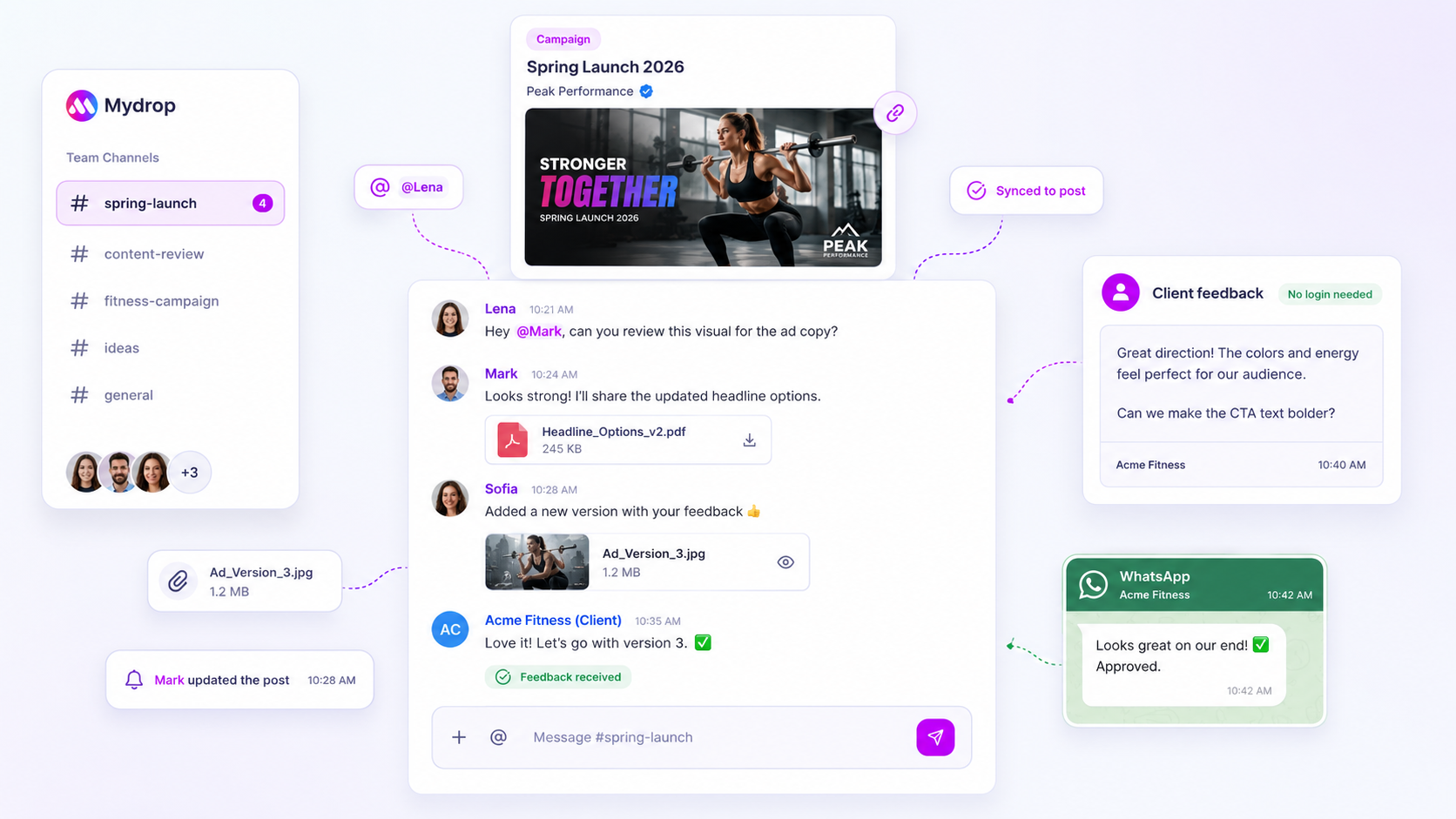
Bring the decision to the post. A client should open one link, see the post as it will appear, and press approve or comment. No login to remember, no attachment to open. This is how the client portal works in Mydrop: the client reviews without an account.
Put a clock on every request. Say "approve by Thursday noon, or it publishes as written" if the client agreed to that, or send an automatic nudge at 24 hours. Open-ended requests are how a 2-hour task becomes a 5-day wait. The approval workflow can hold the status so you stop tracking it in your head.
Batch the review, not the posts. Send one week of posts in a single review instead of seven separate asks. Clients answer one big request faster than seven small ones.
Make pending work visible to the whole team
Debt gets worse when only one person knows what's waiting. Keep a single view of every post by status: draft, in review, approved, scheduled. When anyone on the team can see that three posts are stuck for Client B, anyone can nudge. A shared content calendar with statuses does that without a standup.
Run the 20-post check again in 30 days
Do the same count after one month of the new rules. If the share over 48 hours drops by half, the fix works and you can keep tightening. If it doesn't, the delay is probably upstream, in briefs or assets, and the approval debt audit will show you where.
Start with one client. Move their next week of posts into a single review link, set the 24-hour reminder, and compare. You can set this up free at Mydrop.


 Google review
 Trustpilot review
 Product Hunt comment