
















You can tell whether collaboration is shortening your campaign cycle with four timestamps per post and a before-and-after comparison of 10 posts each. If the median time from brief to live goes down, and the number of review rounds goes down with it, collaboration is working. If it only feels faster, it probably isn't.
TLDR: Record four timestamps for every post (brief approved, draft ready, approved, live). Take the median of 10 posts as your baseline, change one thing about how you collaborate, then measure 10 more. Review wait time is where most cycles are won or lost.
Record these four timestamps for every post
Cycle time is a chain of waits. To see which wait changed, you need a date at each hand-off, not one start date and one end date.
| Timestamp | What it marks | Who usually owns it |
|---|---|---|
| T1: Brief approved | The post is cleared to be made | Strategist or account lead |
| T2: Draft ready | First version is in front of a reviewer | Creator or copywriter |
| T3: Approved | Last required reviewer says yes | Reviewer or client |
| T4: Live | The post is published | Scheduler or publisher |
From these you get three stage times: making (T2 minus T1), review (T3 minus T2) and launch lag (T4 minus T3). Add them up and you have your cycle time.
Two extra columns cost nothing: the number of review rounds and the number of people who touched the post. They explain the stage times.
Set a baseline before you change anything
Pick your last 10 posts of one type, for example Instagram carousels for one brand. Mixing a quick story with a launch video hides everything.
Write down the median for each stage, not the average. One post stuck with a slow client for two weeks will wreck an average and tell you nothing about normal days.
If you have no timestamps from the past, don't guess. Start logging today and use the next 10 posts as the baseline. For most teams that takes about two weeks.
Read the stages, not just the total
A shorter total can hide a worse process, so look at where the time moved:
- Making time fell, review time flat: your creators got faster. That's a win for your tools or your briefs, not for collaboration.
- Review time fell, review rounds fell too: the real collaboration gain. Reviewers are agreeing earlier and with fewer comments.
- Review time fell, review rounds rose: people are replying faster but disagreeing more. Check whether the brief is unclear.
- Launch lag is large: approved posts are waiting for someone to schedule them. That's a hand-off problem, and it's the cheapest one to fix.
For reference, in Mydrop's September 2026 data on posts that went through client approval, the median time from submission to approval was 6 hours, and 66% were approved within 24 hours. The sample is small, so treat it as a rough shape. If your own review median is several days, the wait is probably a queue problem, not a quality problem.
Change one thing, then measure 10 more posts
Resist the urge to bring in a new tool, a new meeting and a new template in the same week. You won't know which one worked.
Pick one change that targets your slowest stage:
- Review is slow: give reviewers a single place to comment and approve, and a deadline written on the post.
- Making is slow: put the brief, the assets and the brand rules in one place before drafting starts.
- Launch lag is slow: schedule a post the moment it's approved, not in a weekly batch.
Run it for 10 posts of the same type, then compare medians. A drop of 20% or more in the target stage is a result. A drop of 5% is noise.
Let your tool record the timestamps for you
Typing four dates into a spreadsheet works for two weeks and then stops. The better approach is a workflow where the dates are written automatically.
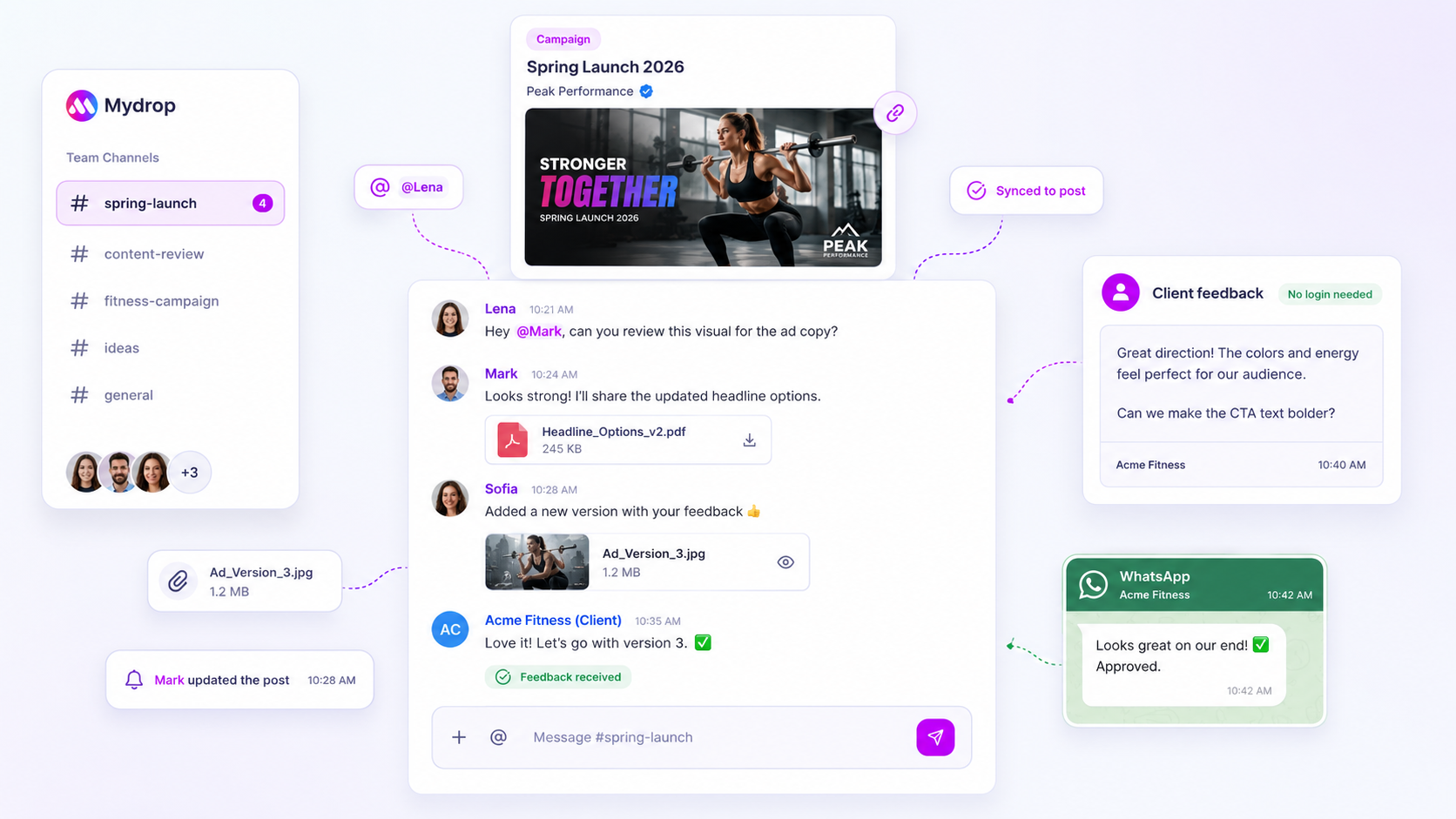
In Mydrop, a post moves through approval statuses and the submitted and approved times are stored with it. Clients can approve through the no-login client portal, so waiting for a client to create an account doesn't inflate your review time. The content calendar shows which approved posts haven't been scheduled yet, which gives you your launch lag in one view.
Pull your last 10 posts this afternoon
Open your most recent 10 posts of one type and fill in the four timestamps from your message history and your scheduler. Even a rough table will show you which stage is slowest. Then pick the single change from the list above that targets it, and start the next 10 posts as your test.
If your review stage is the slow one, our guide to building a collaboration workflow that gets approvals fast is the next read. You can also start free with Mydrop and let it log the approval times for you.



 Google review
 Trustpilot review
 Product Hunt comment





