Your analytics dashboard shows a "Direct" traffic spike for your biggest launch, but your social clicks are MIA. You are not missing data; you are missing a central source of truth for your campaign parameters. When three brand managers use three different versions of utm_medium (social, social-media, sm), your reporting becomes noise before it even reaches your stakeholders.
We get it. Managing a campaign across a dozen brand profiles is a balancing act of deadlines and content approvals. Somewhere between the last-minute copy edits and the pressure to go live, UTM tracking often becomes an afterthought, handled via a frantic, copy-pasted spreadsheet that is already out of date. The hidden cost of this manual entry isn't just bad reporting-it is the massive operational time sink spent cleaning CSV exports every Monday morning because your team lacked a shared source of truth.
The fix isn't another meeting about "naming conventions." It is shifting from manual, reactive tagging to a system where tracking parameters are automatically baked into your publishing flow.
What changed before the numbers moved

It is tempting to blame the social platforms when attribution drops off, but the reality is usually much closer to home. We often hear brand leaders say, "It worked fine last quarter," but that is usually the biggest lie in marketing attribution. What actually happened is that your team grew, your brand list expanded, and the complexity of your coordination finally outpaced your ability to keep a master spreadsheet synchronized.
When you were managing two channels for one brand, a shared document was enough. Once you move to managing campaigns across five markets or a dozen different product lines, that "simple" document becomes a liability. The error rate doesn't increase linearly with team size; it compounds.
Here is the reality of how "tracking by accident" silently ruins your data:
| Stage | Manual Workflow Risk | Resulting Data Noise |
|---|---|---|
| Creation | Copy-pasting from a static doc | Typo-driven fragmentation |
| Handoff | Slack messages with broken strings | Missing parameters in final link |
| Publishing | Last-minute manual appends | Mismatched utm_source values |
| Review | Weekly manual CSV scrubbing | High "Direct" traffic volume |
Coordination debt is what happens when your team’s output-the actual links going live-is no longer tethered to the original plan. If your brand teams don't have a way to pull active campaign parameters directly into their composer, you are essentially asking every person on your team to be a data scientist in their spare time. They won't be, and the data will suffer for it.
Operator rule: If your campaign tracking requires a human to copy and paste a string into a link shortener, your data is already broken. Your system should handle the concatenation automatically based on the active campaign window.
The failure patterns to check first

Most teams don't have a content problem; they have a coordination debt problem. You aren't missing data because the platforms are broken; you're missing it because your team’s manual processes can't keep pace with the volume of your campaigns.
If your tracking is failing, it usually boils down to these three "silent" killers. Spotting them is half the battle.
- The Spreadsheet Graveyard: You have a master sheet, but it is two versions behind. Every time a brand manager tweaks a post, the source of truth drifts further from reality.
- Parameter Drift: Your US team uses
socialforutm_medium, while your UK team preferssm. By Monday, your dashboard looks like a bowl of alphabet soup. - The 11th Hour Append: Links are being generated without UTMs and "fixed" later by someone in a panic, or worse, forgotten entirely until the campaign ends.
The real issue is that these tasks are decoupled from the act of publishing. When you treat UTM entry as a separate administrative chore-rather than a baked-in part of the composer flow-human error is mathematically guaranteed.
The proof that separates signal from noise
How do you know if your attribution is actually clean, or just "good enough" to get through a leadership meeting? We use a simple Attribution Confidence Scorecard. If you can't check these boxes for every campaign, your "Direct" traffic is going to keep eating your conversion data.
Attribution Confidence Scorecard
| Checkpoint | Risk Level | The "Signal" Standard |
|---|---|---|
| Naming Consistency | High | Every utm_campaign matches your internal naming convention exactly (no typos/case variance). |
| Parameter Completeness | High | Every link includes source, medium, and campaign fields without exception. |
| Automation Sync | Medium | Tracking is applied at the moment of creation, not appended after publishing. |
| Cross-Brand Parity | High | All brand profiles use an identical taxonomy for utm_source and utm_medium. |
| Temporal Accuracy | Low | UTMs are active only during the official campaign flight dates. |
If you are scoring lower than 4/5, your analytics team is spending more time "fixing" data than they are actually analyzing it.
The biggest mistake we see? Teams trying to solve this by adding more steps to their manual checklist. That only adds friction and guarantees more skipped fields. The only way to stop the noise is to make the correct action the only available action. At Mydrop, we designed our Campaigns feature specifically to move this tracking from a manual "hope-it-goes-right" task into an automated, system-level habit. When your tracking is tied to a central campaign period rather than a spreadsheet cell, the "Direct" spike problem tends to evaporate overnight.
What to fix this week
If you are currently relying on manual UTM entry, your first step is to stop treating link tracking as a creative task and start treating it as a configuration step. You need to remove the human variable before the content ever hits the scheduler.
Start your week by performing a "Tracking Debt" inventory. Look at your last three campaigns across your main brand profiles. If you cannot extract a consistent utm_source and utm_medium from every post link without opening a spreadsheet or guessing, you have already lost the data battle.
Here is your immediate operational checklist to stabilize your tracking:
- Define the source standard: Lock in exactly one naming convention for your platforms (e.g.,
facebook,linkedin,instagram-stories). - Centralize the parameters: Move your campaign parameters out of project management tickets and into your core social management platform.
- Audit the hand-off: Identify where the link is currently being shortened or UTM-tagged. If it happens in a separate tool or manually by the social manager, move that step directly into your publishing workflow.
- Enforce, don't ask: Replace "please add UTMs" requests with a system that appends them automatically.
Decision check: If your team has to remember to type a UTM parameter, they will eventually forget to type it, type it wrong, or skip it entirely when they are rushing to hit a deadline.
When to stop diagnosing and change the workflow
There comes a point where no amount of team training or "polite reminders" will fix your attribution gaps. You have hit this threshold when your weekly reporting requires more than 30 minutes of manual cleaning to fix inconsistent campaign naming.
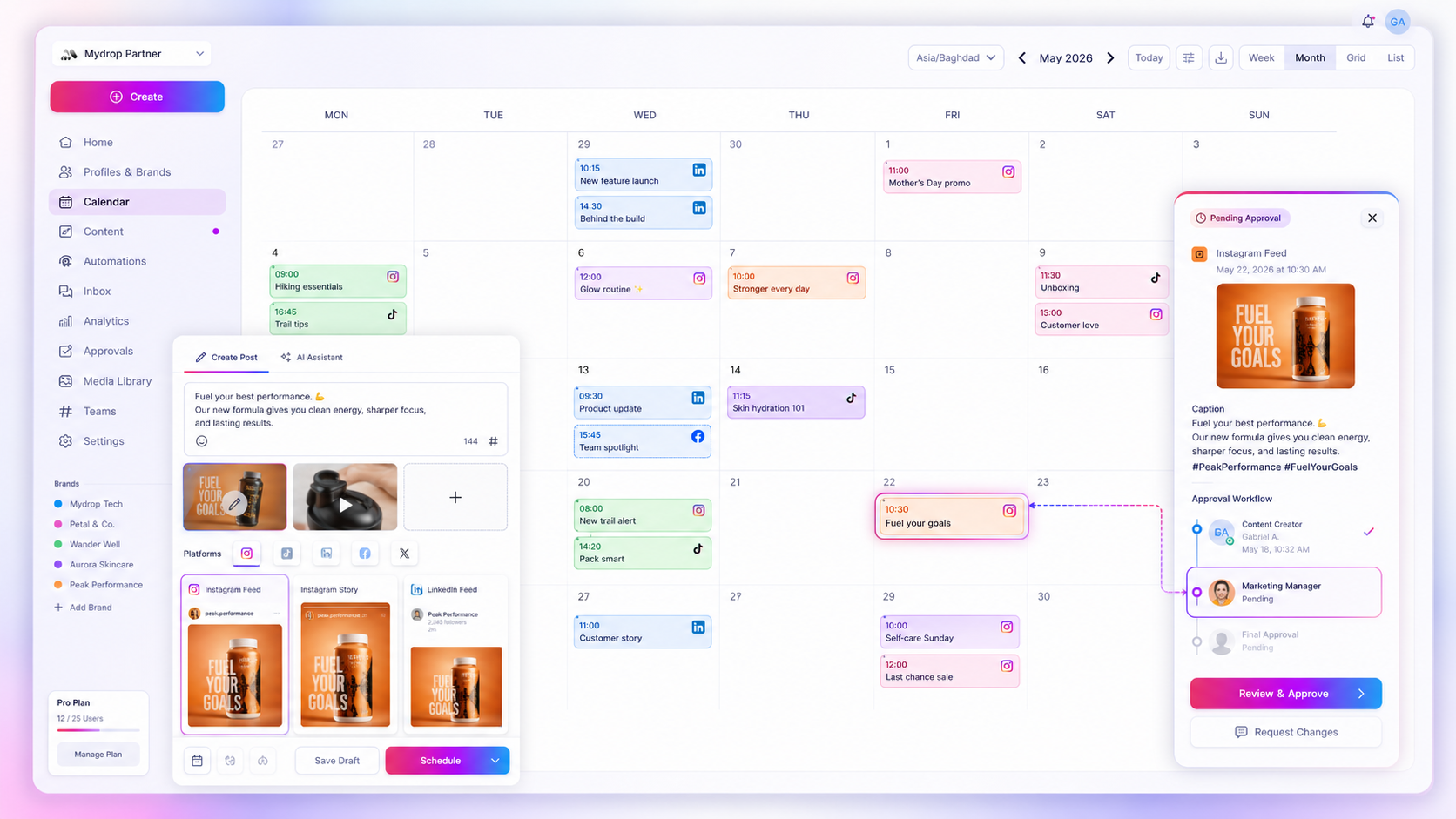
At Mydrop, we often see teams try to patch this with increasingly complex Slack bots or shared documents. These are just stopgap measures. The real solution is moving to Active-period UTM automation. When you set up a campaign in Mydrop, the tracking metadata stays locked to the campaign, not the individual post. As long as the campaign is active, every link you drop into the composer inherits the correct parameters automatically.
| Feature | Manual Spreadsheet Workflow | Automated Campaign Workflow |
|---|---|---|
| Data Integrity | Dependent on human memory | System-defined by campaign rule |
| Time Investment | 10+ minutes per campaign | 0 minutes after initial setup |
| Error Rate | High (typos, outdated strings) | Zero (system-enforced) |
| Visibility | Siloed in local files | Shared across all brand team members |
Moving to an automated system doesn't just save you the headache of cleaning up data on Monday mornings. It changes the conversation with your stakeholders. You stop explaining why "Campaign_Name_Final_v2" shows up as three different line items in your analytics, and you start showing them how specific content themes are actually driving conversion.
Conclusion
The messy state of your attribution isn't a sign that your social strategy is failing. It is a sign that your operation has scaled past the tools you started with. When you stop chasing UTM typos and start anchoring your publishing process to centralized campaigns, you reclaim the one thing every marketing lead is short on: predictable clarity.
Decentralized brand teams need a common operating language. By forcing that language into the background of your publishing flow-rather than asking humans to remember it-you don't just get better data. You get the breathing room to focus on the actual content, knowing the numbers will be there to back it up when you check the dashboard.