
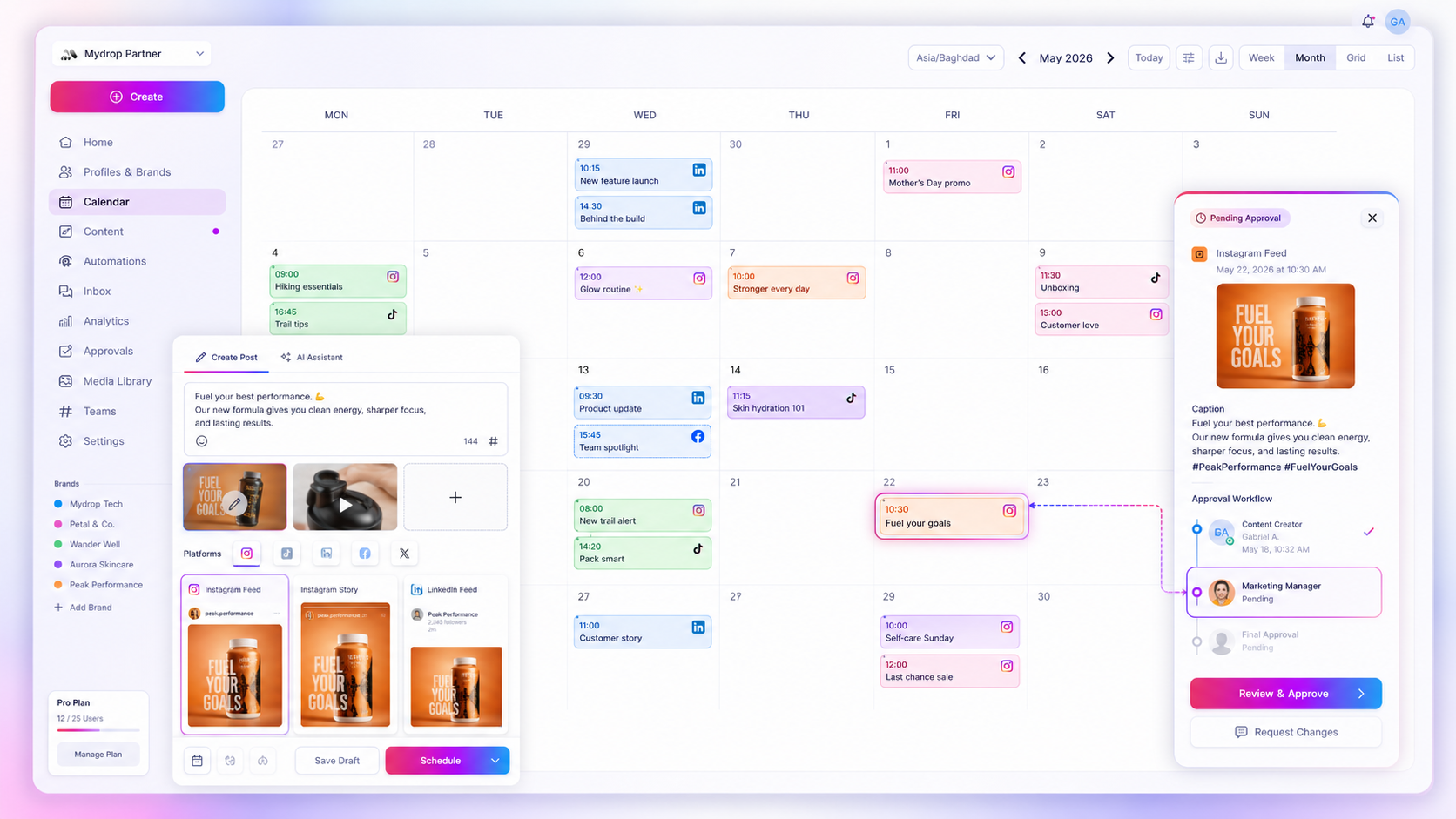
If your analytics dashboard shows direct traffic spikes while your social campaigns are live, stop looking at your pixels and start looking at your spreadsheet. You aren't missing clicks; you are missing the link between your post-creation workflow and your tracking logic. Attribution gaps aren't a technical glitch-they are a coordination failure. When UTM parameters are managed manually, they are statistically guaranteed to drift, expire, or conflict. Centralizing campaign identity at the point of creation is the only way to ensure your data matches your effort.
We get it. You spent weeks perfecting the creative and the copy, only to have a single, forgotten typo in the UTM string turn your entire campaign report into a dark traffic void. It is frustrating, messy, and entirely preventable.
What changed before the numbers moved

The moment a human manually copies a UTM string from a cell into a social media composer is the moment your attribution fails. In our experience, across thousands of posts and dozens of teams, the decay starts with the "near-enough" syndrome. A social manager creates a link, realizes they forgot the utm_term, adds a placeholder, and moves on. By the time that link hits the feed, it is already orphaned from the central campaign strategy.
This is where the spreadsheet-to-composer gap wreaks havoc. As teams grow, they add more stakeholders and more platforms, but they often stick to the same manual, file-based tracking. The result is a system where the "source of truth" lives in a disconnected document that nobody updates in real time.
Here is how the data starts to leak:
- Manual Drift: Teams rely on tribal knowledge or copy-paste habits for UTM strings instead of system-enforced schemas.
- Context Loss: When an author builds a post in isolation, they have no visibility into the active campaign window.
- Governance Debt: Because there is no central association, each team member defines their own version of "active," leading to conflicting campaign tags on identical content.
When you look at your attribution, you are seeing the result of these micro-failures. You aren't dealing with a lack of data; you are dealing with a lack of system-level association.
Operator rule: If your team has to manually copy and paste UTM parameters from a document into a composer, you have already lost the battle for accurate attribution.
To help you diagnose where your workflow is currently leaking data, we have put together a quick audit of the most common failure patterns. If you find yourself hitting "Yes" on any of these, it is time to move your attribution out of the spreadsheet and into your platform workflow.
| Failure Pattern | Symptom | Hidden Cost |
|---|---|---|
| Manual Override | Links lack utm_term or utm_content |
Orphaned traffic; inability to segment by post type. |
| Expired Windows | UTMs persist after campaign end | Inflated numbers for legacy/wrong campaigns. |
| Naming Drift | utm_source varies (e.g., "social" vs "SocialMedia") |
Fragmented reports requiring manual cleanup. |
| Disconnected Tooling | Tracking defined post-publishing | Zero correlation between asset and outcome. |
This is the part most teams underestimate: accurate attribution is a habit, not a feature. Once you stop treating tracking as a final step in the publishing process and start treating it as a foundational part of your campaign setup, the data quality shifts almost instantly.
The failure patterns to check first

When your attribution numbers start looking like a ghost town, it is rarely a technical breakdown of the internet. It is almost always a coordination failure. In our experience, teams managing dozens of profiles across multiple markets hit the same three walls. If you see these signs, you aren't dealing with a glitch; you are dealing with coordination debt.
First, the campaign window drift. You schedule a launch for July, but the team keeps using that same tracking link through September. By then, the original campaign identity is dead, and all that late-stage traffic is getting funneled into a "completed" bucket where it effectively vanishes from your active performance reports.
Second, manual override fatigue. When a creator has to copy a long, complex UTM string from a spreadsheet into a composer, they are going to make a mistake eventually. Maybe it is an extra space, maybe it is a swapped parameter, or maybe they just copy the link from last year because "it looks the same." A single character change turns your data into noise.
Third, the "too many cooks" conflict. When multiple people are managing the same brand, everyone has their own "shorthand" for tracking. One person uses utm_source=social_ig, another uses utm_source=Instagram_Organic. Your analytics tool sees two different channels, and your boss sees two different stories.
The proof that separates signal from noise
Stop guessing where the data is leaking. Use this scorecard to audit your last five posts. If you cannot answer "yes" to these points, you are likely losing 20-40 percent of your measurable traffic to attribution gaps.
| Checkpoint | Risk Level | Why It Matters |
|---|---|---|
| Link Auto-Appended? | High | Manual copy-pasting is a 100% failure rate predictor over time. |
| Campaign Active? | High | If the date has passed, the link is effectively a black hole. |
| Naming Convention? | Medium | Inconsistent keys (e.g., utm_medium=social vs organic) kill reporting. |
| Asset Bound to Campaign? | Medium | Disconnected posts are orphans; they have no parent performance context. |
Decision check: If your team is still manually typing or pasting UTM parameters into a composer, your data is a crime scene.
At Mydrop, we see teams stabilize this by forcing a "Campaign-First" habit. Instead of pasting a link, you select an active Campaign from the selector. The system handles the appending based on the central config you already defined. It is the difference between hoping your team is accurate and knowing the system is consistent.
The threshold is simple: once you have more than two people pushing content to the same brand, manual link management is no longer a "convenience" or a "simple step." It is a liability that guarantees your quarterly report will be wrong. You aren't just saving time; you are protecting the integrity of your entire marketing feedback loop.
What to fix this week
If you are currently patching broken links with manual redirects or worse, ignoring the drop-off in your analytics, take a breath. You don't need a total department overhaul to start cleaning up this data mess. Start by auditing your current state against a repeatable standard.
Use this checklist to identify where your coordination debt is highest:
- The Link Audit: Pull your top 10 most recent posts with external links. Open them in an incognito window. Do they actually carry the expected
utm_sourceandutm_campaignparameters? - The Expiry Check: Check if any of these links belong to campaigns that technically "ended" last week but are still live on your social profiles.
- The Workflow Test: Ask two different team members to create a tracking link for the same upcoming promotion. If the resulting URLs differ by even one character (e.g.,
utm_source=socialvsutm_source=Social), your process is the source of the rot.
Once you have identified the gaps, stop allowing manual string entry for any campaign spanning more than one channel. At Mydrop, we see teams stabilize their attribution overnight by simply moving the UTM logic out of the hands of the individual creator.
Workflow check: If a campaign has more than two stakeholders or crosses more than one platform, the tracking configuration must be defined at the Campaign level, not at the Post level.
By shifting the burden of consistency to a centralized record, you stop treating UTMs as a "final touch" and start treating them as an intrinsic part of the campaign identity.
When to stop diagnosing and change the workflow
There is a point where manual management crosses from "a minor operational hurdle" to "a structural liability." If your team spends more than two hours per week manually auditing, fixing, or apologizing for bad link data, you have hit that threshold.
At this stage, "better training" or "stricter guidelines" will not solve the problem. Your team is suffering from coordination debt, and the only way to pay it down is to automate the hand-off between planning and publishing.
If you find yourself in any of these scenarios, your current manual approach is failing your business:
- You have more than five active brands and your team can no longer recite the tracking naming conventions by heart.
- The creative team routinely starts publishing before the campaign configuration is fully approved, leading to "orphan" posts that lack proper tracking.
- Your reporting cycle is delayed by a full day because someone has to manually aggregate and sanitize UTM data from five different spreadsheets.
When you reach this point, you need a system that enforces the data structure automatically. Using the Mydrop Campaign Modal is a great way to force this hand. By requiring a brandId and an active window before a campaign is even created, you essentially bake the governance into the start of your workflow. Once the campaign is saved, the UTMs are no longer a "copy-paste" job; they are an automated output that follows the post wherever it goes-be it an automated feed, a bulk upload, or a last-minute schedule change.
Conclusion
The difference between a clean, actionable analytics dashboard and a "dark traffic" headache isn't a better tracking pixel-it’s how you handle the administrative hand-off from your content plan to your social output. Attribution fails the moment a human is asked to remember a naming convention under pressure.
Fixing this isn't about working harder; it’s about moving the tracking logic upstream, where it can be set once, verified once, and applied to every post automatically. Stop relying on your team to "get it right" every time they hit the composer button. Instead, build a pipeline where the tracking is as much a part of the campaign record as the logo or the color palette. Your reports will be cleaner, your team will be less stressed, and for the first time in a while, your data will actually tell you what your content is worth.