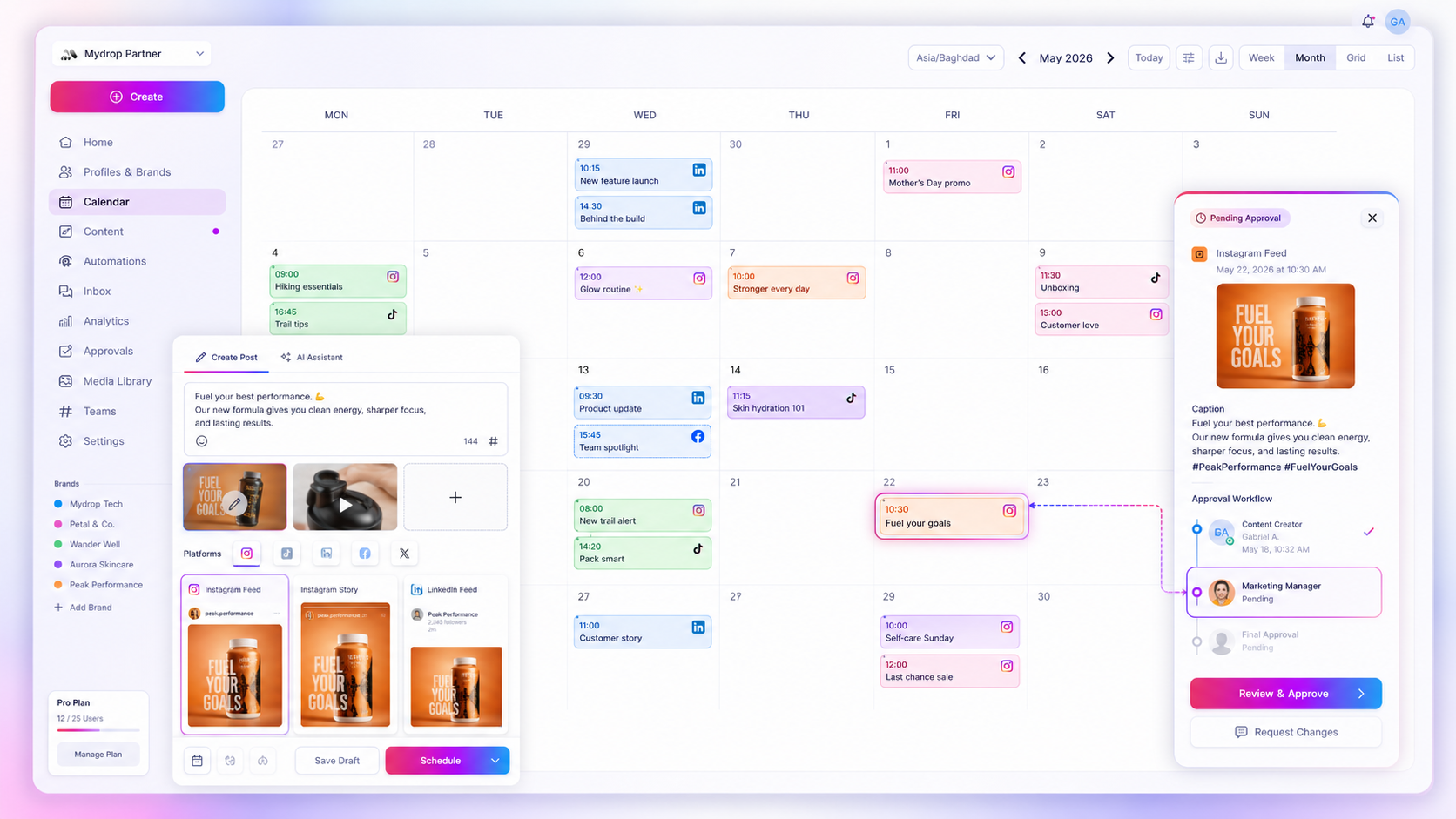
When your campaign traffic isn't tracking, stop looking at your analytics dashboard and start checking your campaign's active-period boundaries. We’ve seen this happen across thousands of posts: you spend weeks aligning stakeholders and creative assets, hit publish, and then find a flatline in your reports. The awkward truth is that most tracking gaps aren't "glitches." They are coordination debt.
Ninety percent of attribution gaps occur because you’re publishing just outside the defined campaign window or because the link wasn't properly synced to the campaign metadata before it left your outbox. When your tracking requires manual, last-minute intervention in the composer, it’s already broken. A sustainable system treats UTMs as immutable metadata attached to the campaign at the start, not as an afterthought added during the final approval loop.
It feels personal when the data breaks-you’ve put in the work-but this is a solvable operational issue. You aren't failing at marketing; you're just experiencing a classic handoff misalignment between your content calendar and your measurement model.
What changed before the numbers moved

Before you pull the fire alarm, look at the timeline. In our experience, when traffic tracking stops, the culprit is usually a mismatch between the calendar date and the campaign configuration. Large teams move fast, and it is incredibly common for a campaign start date to shift by 48 hours to accommodate a late creative delivery or a delayed product launch.
If your publishing automation or composer logic is locked to a specific active window, any post scheduled outside that window will strip your UTM parameters to avoid "polluting" your data with out-of-period traffic.
Here is the diagnostic sequence we use to surface these sync breaks:
| Potential Failure Point | Check This First |
|---|---|
| Window Mismatch | Did the launch date shift? Verify if the post date falls strictly within the start and end period. |
| Assignment Gap | Was the post actually linked to the Campaign ID? Check the composer assignment, not just the caption text. |
| Source Mode | Does the campaign's sourceMode setting match the channel you just pushed to? |
| Link Integrity | Did the platform's native link-shortener interfere with the query string appended to your URL? |
Operator rule: If your team manages hundreds of brand profiles, never rely on manual UTM entry per post. Use a centralized campaign object that auto-appends parameters only when the campaign is active. If the data is missing, the campaign was likely "closed" or "upcoming" at the precise microsecond of publication.
Stop treating every post as an isolated event. If you find yourself manually checking UTMs on every scheduled item, you have a coordination bottleneck that will inevitably bleed data as your volume scales. The fix isn't more vigilance; it's a tighter definition of your active periods before the first post even hits the wire.
The failure patterns to check first

If you are staring at a blank analytics dashboard, start by checking your link hygiene. Most attribution gaps are not malicious platform changes; they are simple, human-sized errors that happen when content moves from a spreadsheet to a live post.
Teams often default to the "guess and check" method, which is a fast track to burnout. Instead, look for these three high-frequency failure points:
- The Phantom Assignment: You drafted the post perfectly, but the link between the post and the campaign never clicked. If the campaign ID is missing, the UTMs do not travel. It is the digital equivalent of mailing a letter without an address.
- The Shrinking Link: Sometimes a native platform shortener or a manual link intervention strips the UTM parameters before the post even goes live. If the tracking isn't there when the post hits the feed, it’s gone forever.
- The Date-Stamp Mismatch: Many systems, including Mydrop, only apply automated tracking during the active campaign window. If your campaign end date was yesterday, the system essentially says, "I am off the clock," and drops the UTMs.
It is easy to blame the platform, but this is usually just coordination debt-a byproduct of moving fast across dozens of profiles.
The proof that separates signal from noise
The only way to stop the bleed is to verify the UTMs at the source rather than waiting for the end-of-month report to show zero results. If you aren't checking the live post, you are effectively flying blind.
We suggest a simple Traffic Attribution Audit to sanity-check your work before it scales. Use this table to map where your internal process might be losing data.
| Checkpoint | Expected Behavior | Troubleshooting Signal |
|---|---|---|
| Campaign Status | Status: Ongoing or No Period |
If Coming or Finished, UTMs are inactive. |
| Link Integrity | URL contains utm_source & utm_campaign |
If link is clean, tracking was stripped or not applied. |
| Assignment | CampaignId matches post metadata |
If null, the link was never connected in the composer. |
| Source Mode | sourceMode matches platform target |
If mismatch, the platform logic may ignore the append. |
| Reporting Filter | Analytics view is scoped to CampaignId |
If scoped to wrong filter, data is hidden, not lost. |
Decision check: Never assume a post is tracking correctly until you verify the published URL. If your process relies on "trusting the system" without a validation step, you are one manual change away from an attribution gap.
This is the part most teams underestimate: you need an immutable record. At Mydrop, we treat campaign configuration as core metadata that travels with every post. If you have to manually type or add UTMs in the composer, you have already created a failure point. A sustainable system treats tracking as a rule, not an afterthought.
If you find that your tracking is missing for the last three days of posts, stop guessing. Check your campaign dates first. You would be surprised how often a simple "Campaign Ended" setting is the only thing standing between you and the data you need.
What to fix this week
If you are currently chasing missing data, stop trying to patch the reports retroactively. Instead, use these five days to formalize the handoff between your content calendar and your tracking setup.
- Run a 72-hour lookback: Identify every post from the last three days that returned zero campaign traffic. Check if the post was scheduled before the campaign's start date or after its end date.
- Audit the Campaign Library: Go through your active campaigns and ensure every single one has the
utmSource,utmMedium, andutmCampaignfields fully populated. We often see teams leaveutmTermorutmContentblank-which is fine-but if the core source/medium parameters are missing, the automation engine simply has nothing to append. - Standardize the "Campaign-First" habit: Stop letting the composer be a blank slate. Whether your team uses Mydrop or a custom workflow, require that every post creation starts by selecting a campaign from the dropdown. If the post isn't assigned to a campaign at the drafting stage, it shouldn't get an approval slot.
- Verify the link source: Ensure the links in your captions are standard, full-length URLs. If someone is manually shortening a URL or using a third-party redirect before the post hits our system, the auto-append logic often fails to find the anchor point it needs to attach the UTM string.
- Sync the calendar: If you frequently shift launch dates, make a rule that the campaign period in your tool must be updated before the post is rescheduled.
Workflow check: A campaign is not "ready" until the tracking configuration is set. If the tracking isn't part of the initial campaign creation, the data will always be a secondary thought that gets skipped during the rush to publish.
When to stop diagnosing and change the workflow
There is a point where manual "link-fixing" becomes a structural liability rather than a one-off error. If you find your team spending more than two hours a week auditing UTMs or manually appending parameters in the composer, your current setup has reached its limit.
When the system requires a human to "remember" to add tracking, you are operating on a broken pipeline. Humans are great at creative strategy and managing complex stakeholder relationships; they are objectively terrible at ensuring a consistent string of characters is appended to a URL every single time.
The moment of truth for any enterprise team is when you realize that your "process" is actually just a collection of tribal knowledge and post-it notes. If you're here, stop treating this as a technical issue. You don't need a more robust analytics tool; you need a more constrained publishing environment.
At Mydrop, we see the most successful teams moving away from "manual tracking" entirely. They use campaigns to enforce boundaries. By treating the campaign as an immutable container for metadata, they ensure that every post published during an active period inherits the correct tracking automatically. If you have to ask yourself "Did we add the UTMs?" before clicking publish, you've already lost the battle.
Conclusion
Campaign traffic shouldn't be a mystery you solve on Friday afternoons. It is the output of a repeatable, low-friction operation. When you stop treating tracking as an optional tagging exercise and start treating it as a required field for your content lifecycle, you remove the biggest point of friction in your marketing engine.
Take the audit steps above to clear the current backlog, but remember: the goal isn't to be better at finding errors-the goal is to build a workflow where these errors are technically impossible. Your team has enough to worry about with content strategy and brand narrative. Let the machine handle the strings.