
The fastest way to kill your agency’s profit margins is to treat client updates as a manual task rather than automated infrastructure. When your account managers spend every Friday afternoon copy-pasting data into slide decks, you aren't providing high-touch service; you are performing expensive administrative penance.
We get it. That manual ritual feels like "client care." There is a deep, psychological comfort in opening the data yourself, reviewing the charts, and hitting "send" on a personalized email. But that comfort is a shroud for the operational chaos and bottlenecks that actually prevent you from scaling. Your clients do not pay for your time spent formatting PDFs-they pay for the strategic insights derived from the numbers. If you think they can tell the difference between a hand-crafted manual report and a high-fidelity, branded report delivered at 8:00 AM sharp, you are mistaken. You are choosing manual labor, and that choice is quietly capping your firm's growth.
Where the handoff is actually breaking

The "Friday afternoon bottleneck" is the most common silent killer of agency capacity. It happens when your best talent stops being a strategist and starts being a human file-transfer protocol.
When reporting is manual, delivery becomes fragile. If an account manager is sick, traveling, or just overwhelmed by a different campaign, the report is late or forgotten. This isn't a failure of people; it is a failure of your operating model. You are relying on individual heroics to bridge a gap that a system should handle.
Common mistake: Treating reporting as a "check-in" task instead of a scheduled deliverable. When delivery is tied to a person's schedule rather than a system clock, you create a permanent dependency that halts your ability to onboard new brands.
Here is the true cost of that dependency, broken down by what we call your Coordination Debt:
| Metric | Manual Reporting Cost | Automated Reporting Value |
|---|---|---|
| Setup Time | 30-60 mins per client/week | 10 mins (one-time setup) |
| Delivery | Variable (often late) | Consistent (8:00 AM sharp) |
| Error Risk | High (copy-paste, manual math) | Zero (system snapshot) |
| Scale Limit | Bound by headcount | Bound by infrastructure |
| Client Trust | Low (fragile delivery) | High (reliable cadence) |
When you dig into these numbers, the "coordination debt" becomes obvious. Every hour spent manually generating a report is an hour you cannot spend on strategy, creative refinement, or high-value client communication.
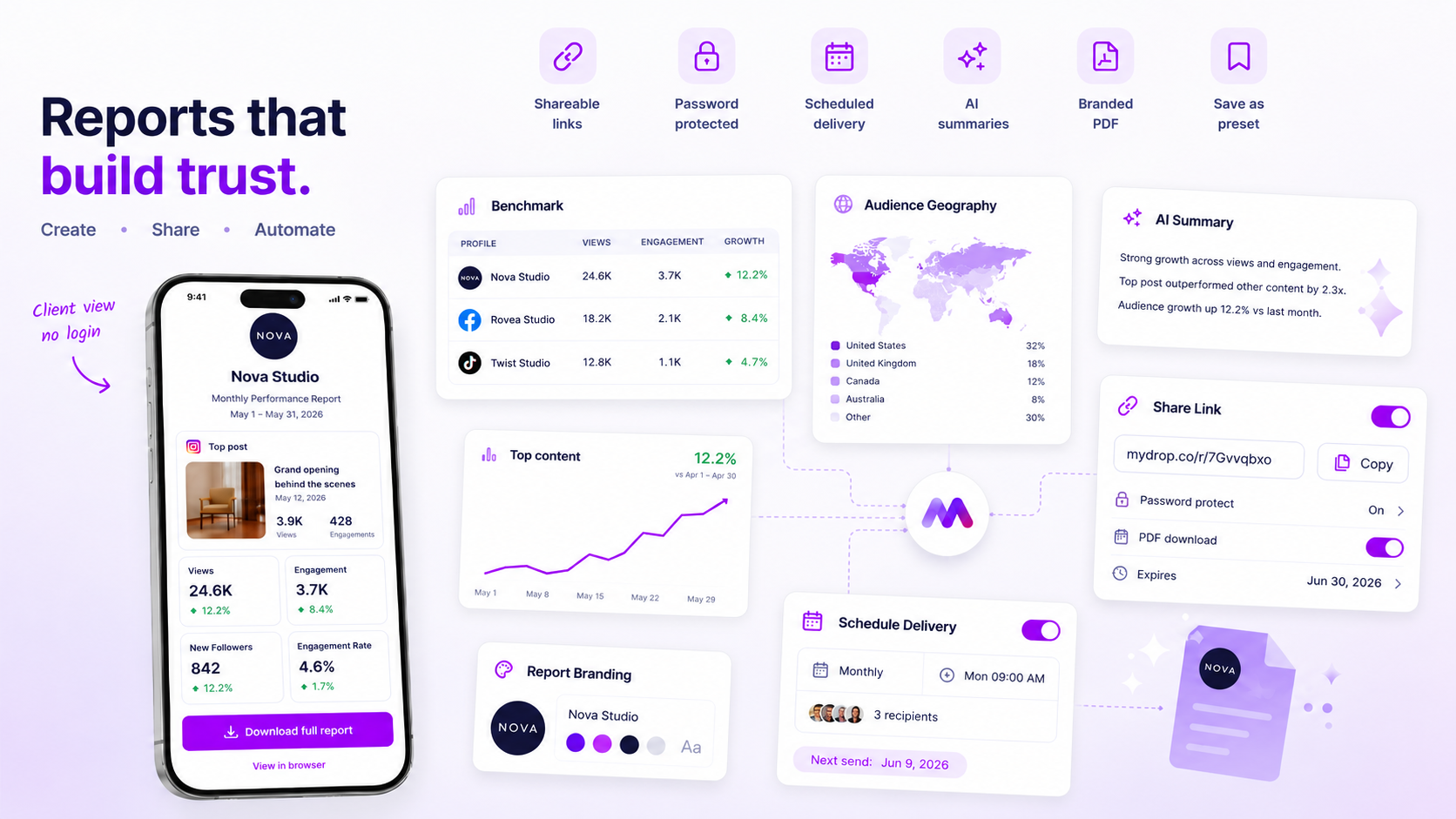
The most successful teams we see-those managing hundreds of brand profiles-have made a singular, radical shift: they moved from Human-as-Messenger to System-as-Standard. They use tools like Mydrop’s Analytics Report Scheduling to set the cadence once, define the configuration, and then step back. They treat the report delivery as a utility, like electricity or internet, rather than a recurring project. By decoupling client visibility from manual intervention, they ensure that the data is waiting for the client before they even finish their morning coffee, regardless of what the agency team is doing that day.
The coordination debt checklist

Most teams don't realize they are drowning in administrative overhead until a major deadline slips. Your reporting workflow is likely accruing interest-the kind that compounds until you're burning weekends just to keep stakeholders informed. If you see these signs, you aren't just reporting; you are paying a heavy coordination tax.
| Symptom | The Hidden Cost | Operational Impact |
|---|---|---|
| Friday Crunch | 2-4 hours of manual data pulls per client | Lost weekends and high burnout risk |
| Format Drift | Inconsistent charts across different brands | Professional perception suffers |
| Failure Silence | No way to know if a report link expired or failed | Clients see an error before you do |
| Context Switching | 15 minutes of "setup" per report session | Deep work is impossible on report days |
| Delivery Latency | Reports arrive Monday or Tuesday | You are reacting to last week's news |
Operator rule: If your reporting process requires more than two mouse clicks to generate and deliver for a single client, you are not scaling. You are just sustaining a manual loop.
How to move decisions closer to the work
The transition to automated infrastructure isn't just about speed; it's about shifting the focus from generation to interpretation. When you stop being the "human router" for spreadsheets, you actually gain the time to act on what the data is telling you.
At Mydrop, we see teams move from chaotic, human-dependent delivery to a systemized cadence by adopting a three-step Report-as-Infrastructure model. This removes the "delivery burden" entirely.
- Define the Template: Standardize your metrics so the same view serves all stakeholders in that category. Don't build one-off reports for every request; build one robust template that scales.
- Set the Schedule: Use the Analytics Report Scheduling engine to define the exact cadence your client needs-whether that is a daily pulse for a high-velocity campaign or a monthly deep-dive for executive reviews.
- Automate Delivery: Once configured, the platform handles the execution. It generates the PDF or public link, attaches the summary, and sends it out without anyone needing to hit a "send" button.
When you trust the system to run the job, you get more than just time back. You get failure visibility. If a report fails to generate, the system logs the event, allowing you to address it proactively. Compare that to the standard manual model, where the only way you know a report didn't arrive is when a client emails you to ask where it is.
The goal isn't to remove the human touch. The goal is to ensure the human touch is reserved for strategy, insights, and high-level client advice-not for waiting on a file export to finish at 5:00 PM on a Friday. Your best work happens when you aren't performing administrative chores.
The roles and rules that reduce rework
The reason manual reporting bloats into a full-time job is that every report is treated like a unique snowflake. You need to stop crafting art and start building a factory. Define your metrics once, build the template once, and then let the machine handle the rest.
At Mydrop, we see teams fail when they try to customize every delivery for every stakeholder. Instead, establish a "Gold Standard" report schema. Decide which KPIs matter for your agency and which ones satisfy the client's reporting needs. Once you lock in that configuration, don't deviate. If a client asks for a custom metric every week, you are back to the manual grind. Charge for custom data or direct them to a self-service dashboard, but keep the core delivery automated.
Decision check: If you are manually filtering columns in a spreadsheet before emailing a client, you have already lost the margin on that account. Standardize the data view first, then schedule the delivery.
The weekly habit that keeps the system honest
Automation is not "set it and forget it" if you never check on the results. You need a 10-minute cadence to verify your delivery pipeline. We call this the "Delivery Sanity Check."
Every Monday morning, your lead manager should scan the status of your recurring report jobs. Did the scheduled runs fire? Did any failure emails hit the inbox? Did the PDF attachments render correctly? If a schedule snapshot becomes stale because a brand profile was renamed or removed, you catch it in minutes rather than hearing about a missed report from an annoyed client on Tuesday afternoon.
The Weekly Reporting Audit Checklist
| Stage | Action | Why it matters |
|---|---|---|
| Review | Check status of all active Analytics Report Schedules | Ensures the engine is still authorized and running. |
| Audit | Scan for failure notifications from the Schedule Runner | Catches data gaps or credential issues immediately. |
| Verify | Open a sample PDF from a recent run | Validates that your layout hasn't broken. |
| Update | Pause or delete schedules for closed accounts | Prevents "zombie reports" from cluttering the inbox. |
Conclusion
The transition from manual labor to automated infrastructure is the single biggest unlock for agency growth. You aren't just saving hours on a Friday; you are removing the friction that prevents you from onboarding the next ten clients.
Stop asking your team to be the conduit for data. Build a system that delivers that data reliably, consistently, and without human intervention. When you decouple client trust from the act of hitting "send," you finally get to focus on what actually moves the needle: the strategy itself, not the administrative task of proving it works.