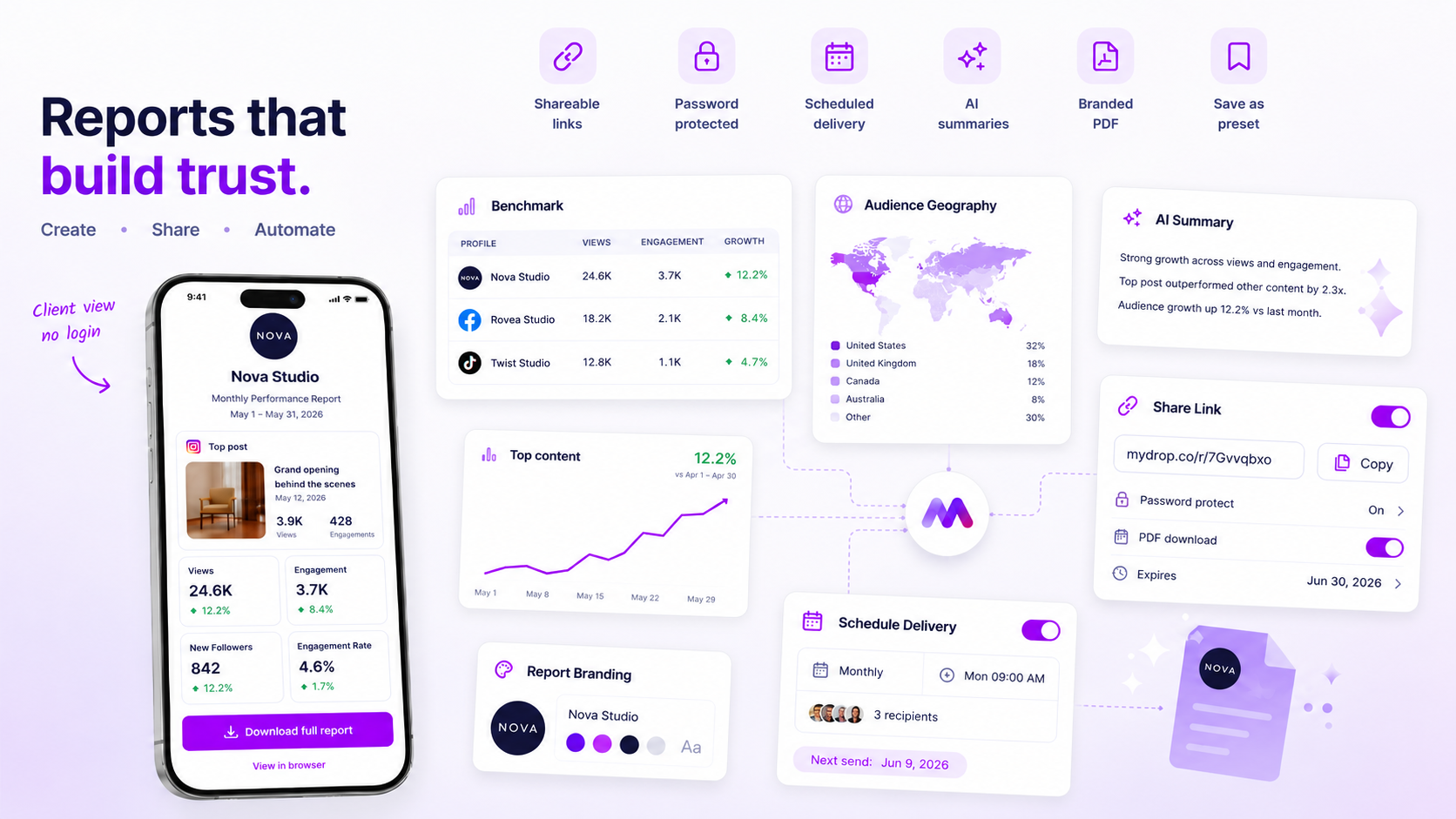
You should automate recurring analytics reports the moment your team spends more time preparing data than interpreting it. When an analyst’s week begins with manual exports and formatting instead of strategic narrative building, you are not performing "high-touch" reporting; you are trapped in a low-value administrative cycle.
We get it. The ritual of opening spreadsheets, tweaking charts, and drafting cover emails feels like a safety net. It gives you a final look at the numbers and a chance to spin the narrative before a client sees it. But this "manual quality control" is a classic trap. It creates a massive coordination debt that slows you down every single time a new brand or channel is added to your roster.
The decision teams usually frame too broadly

Teams often debate whether a report should be "manual or automated" as if they are choosing between two opposing philosophies. They are not. This is a simple matter of information architecture. You do not need to choose between automation and quality; you need to decouple the raw data delivery from your expert analysis.
The reality is that your clients do not need you to manually refresh a chart showing last week’s follower growth or basic engagement counts. They need that data to be in their inbox at 9:00 AM on Monday, consistent and reliable. When you automate these pulses, you save your best minds for the deep-dive quarterly strategy sessions where your actual consulting fee is earned.
Operator rule: If a report requires no manual commentary or strategic re-contextualization to be useful, it must be automated.
Here is how to classify your current reporting load to stop the manual churn.
| Report Type | Purpose | Responsibility |
|---|---|---|
| Pulse Check | Baseline health, status, and reach. | Automated Scheduled Delivery |
| Performance Review | Trend analysis, campaign pivot, KPI audit. | Hybrid (Automated data, manual commentary) |
| Strategic Advisory | High-level roadmap, competitor bench, market shift. | Fully Manual Custom Report |
If you are currently treating a "Pulse Check" as a manual project, you are creating a bottleneck. Every hour spent on a recurring delivery is an hour stolen from the work that actually prevents client churn.
At Mydrop, we see teams struggle because they view the report builder as the finish line. They build a perfect dashboard, but then they treat the act of sending it as a separate, manual hurdle. By moving these to our Analytics > Schedules workflow, you effectively turn your reporting engine into a permanent, background process. You configure the cadence, recipients, and format once-choosing between PDF attachments or secure links-and then let the system handle the delivery.
The shift is small, but the impact on your operational velocity is immediate. Once you stop manually chasing recurring emails, you start seeing the "messy middle" of your reporting process for what it really is: an expensive habit you no longer need.
What should stay manual and what can move faster

The golden rule here is simple: Automate the pulse, protect the narrative. If a report is purely about keeping stakeholders informed on standard KPIs-the "did our reach go up or down?" check-in-then manually pulling those numbers is just expensive busywork. You are essentially paying an expert analyst to be a human spreadsheet calculator.
However, you should keep the human touch for reports that require consultative interpretation. If a client is in the middle of a crisis, a pivot, or a high-stakes campaign launch, an automated email will feel robotic and detached. Those moments require a human to explain the "why" behind the numbers, translate data into business impact, and steer the next steps.
We have seen teams try to automate everything, only to realize that clients started ignoring the reports because they lacked context. Conversely, we have seen teams manually building every single report until their best people burned out. The sweet spot is automating the high-frequency operational reporting to free up the headspace needed for the deep-dive strategy.
Decision check: If you find yourself typing the same two sentences of context into every weekly email, that isn't personal service-it is a template you haven't built yet.
The tradeoff matrix
Deciding what stays manual often comes down to balancing the audience’s need for speed against your team’s need for focus. Use this matrix to audit your current reporting workload and identify which processes are ripe for an upgrade.
| Report Type | Audience Expectation | Complexity | Recommended Path |
|---|---|---|---|
| Weekly Pulse | "Quick check, no surprises." | Low (standard metrics) | Automate |
| Monthly Executive | "High-level summary of wins." | Medium (consistent KPIs) | Automate |
| Campaign Post-Mortem | "What happened and why?" | High (cross-data narrative) | Manual |
| Quarterly Strategy | "What is our plan now?" | High (future-looking insights) | Manual |
When moving to an automated workflow, your goal should be to maintain the "look" of a bespoke report while cutting out the mechanical labor. Using tools like the Analytics Report Scheduling feature in Mydrop allows you to set up these recurring pulses once. You get to define exactly what the client sees-whether that is a quick PDF summary or a link to an interactive dashboard-and then let the system handle the delivery.
The real win happens when you treat the automated report as a baseline, not the destination. By automating the data delivery, your team moves from being "report generators" to "strategic partners." You aren't losing the personal touch; you are finally earning the time to actually use it where it counts.
If you are currently spending your Monday mornings stuck in the "copy-paste-email" cycle, you are suffering from hidden coordination debt. It is time to let the machines handle the data counting so your team can get back to the work that actually justifies your retainer.
How to pilot the workflow safely
You do not flip a switch and pray for the best. The secret to a stress-free migration is a three-step validation loop that keeps your team in control while letting the machine handle the delivery.
- The Internal Dry Run: Create your schedule, but set the recipient list to only you and your lead analyst. This forces a real-world test of the report’s design, summary clarity, and link permissions before a client ever sees it.
- The "Spot Check" Interval: For the first two weeks of an automated cycle, keep your manual copy-paste habit but perform it after the automated report arrives. If the numbers match and the formatting holds, you have earned your Tuesday morning back.
- The Stakeholder Feedback Loop: Once the automation is stable, add a simple note to the automated email template: "This report is delivered automatically for speed. Let us know if you need us to pivot to a deep-dive session this month."
At Mydrop, we see teams that treat automation like a "set it and forget it" tax. That is a mistake. The best operators use the time saved by the Analytics Report Scheduling feature to actually look at the data before it goes out, rather than spending that time fighting with PDF export settings.
The operating rule to keep
Even when your reporting is running on autopilot, your role as a trusted partner hasn't vanished-it has just evolved from "data clerk" to "data curator." You are still responsible for the narrative.
Workflow check: Never send a scheduled report without a
Five-Minute Narrative Review. Set a calendar recurring task to open your scheduled report 15 minutes before the automated delivery hits your client's inbox. If the data looks strange or if a specific campaign is underperforming, use therun-nowcontrol to pause the automated send and reach out with a personal note instead.
Automation should handle the delivery, not the relationship. If you see a performance dip, you have a strategic opportunity to lead the conversation rather than just dropping a PDF and hoping for the best.
Conclusion
The messy middle of scaling an agency or a large marketing team is defined by the tension between providing "high-touch" service and achieving operational efficiency. You don't solve this by adding more hours to the work week. You solve it by ruthlessly decoupling your value from the repetitive tasks that don't require your brain.
By moving your standard pulse checks to Analytics Report Scheduling and reserving your custom analysis for high-stakes quarterly reviews, you stop being a bottleneck. You stop being the person who is "still working on the report" at 6 p.m. on a Friday.
You become an analyst who delivers clear, timely insights. That is not just better for your sanity-it is exactly what your clients are paying for. Start small, automate the pulse, and protect your time for the insights that actually matter.