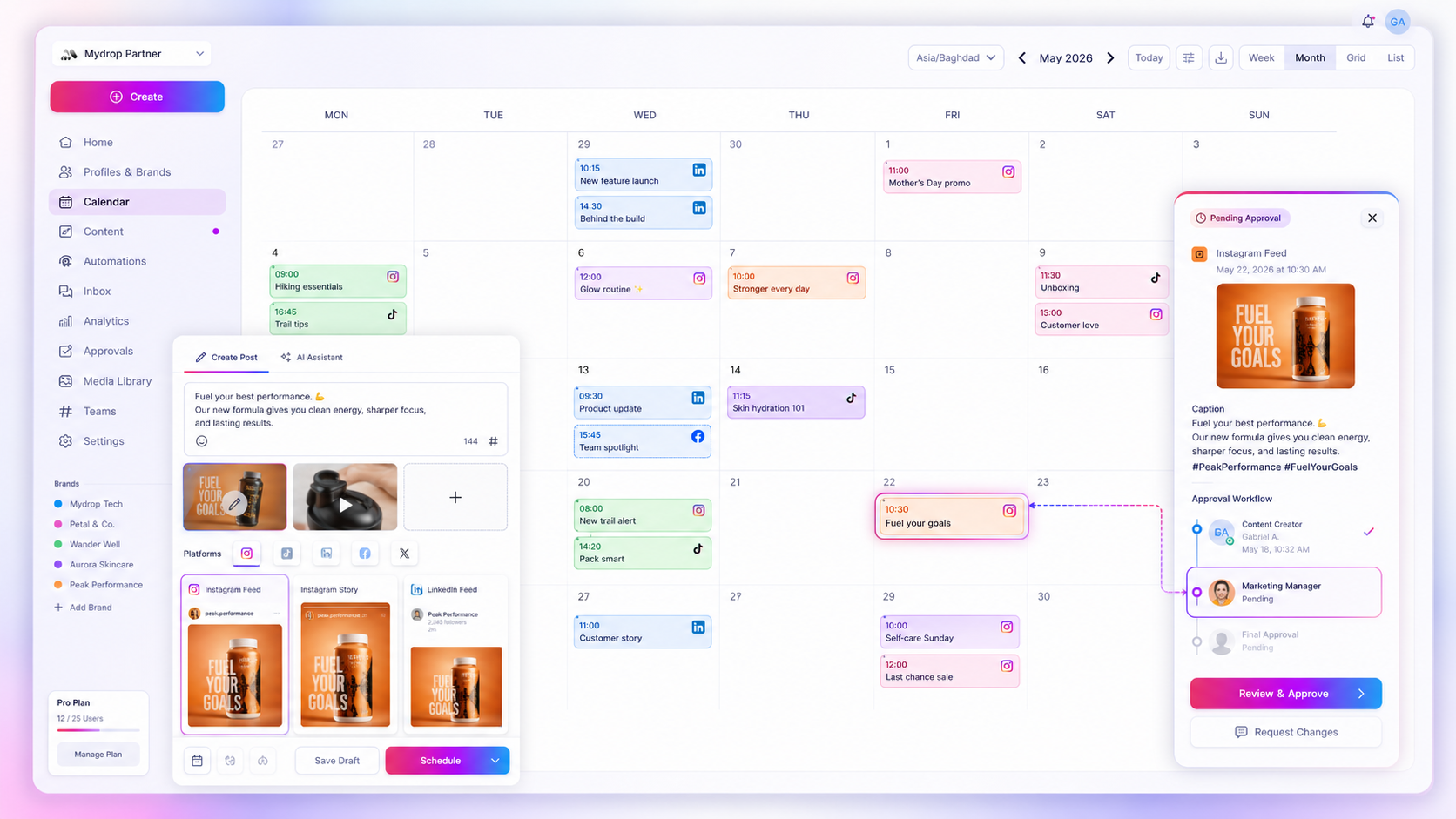
The secret to never missing a recurring marketing task is not a tighter calendar; it is attaching your planning requirements directly to the assets, posts, and profiles they serve. When you rely on a standalone notification, you are asking your brain to bridge the gap between "do this" and "find where this belongs" at the exact moment you are busiest.
We get it. You have a planning calendar, a production spreadsheet, and a go-live dashboard. By the time you get the generic notification to "prepare monthly assets," the context is gone, the file links are missing, and you are starting from zero. This work is messy, and the reminder itself is usually the least helpful part of the process.
The operating problem this solves

The real issue is what we call contextual decay. If your planning task lives as a floating event on a digital calendar, it has zero gravity. It doesn't know which brand it’s for, which social profiles it affects, or where the creative brief is saved. When the alert pops, you aren't ready to execute; you are ready to start a scavenger hunt.
This disconnect is why even the most disciplined social teams end up with "ghost tasks"-those recurring items that everyone eventually learns to ignore because they arrive empty-handed.
| Feature | Disconnected Calendar | Mydrop Linked Reminder |
|---|---|---|
| Data Source | Manual entry | Automated workflow object |
| Context | Often missing or stale | Always attached (posts/media/profiles) |
| Completion | Ignored or deleted | Syncs done state to stakeholders |
| Maintenance | High fatigue, prone to error | Self-sustaining via recurrence rules |
When you treat planning as an object-linked operation rather than a calendar entry, you shift the burden away from your memory. You stop "remembering" to plan and start "executing" on pre-connected requirements.
Operator rule: If a recurring task requires you to open more than two browser tabs to gather context, you have already lost the battle against coordination debt.
The goal is to move from Notification Only to Operationally Linked. By embedding the task into the content lifecycle-attaching that monthly asset brief to the specific recurring reminder-you ensure that when the time comes to work, the work arrives with its own instruction manual. This isn't just about efficiency; it's about reducing the cognitive load that makes planning feel like a chore instead of a strategic advantage.
The minimum system that works

You do not need a new enterprise suite to stop the bleeding. You need a single source of truth that binds your planning to your output. If your calendar reminder exists in a vacuum, it will be ignored the second someone gets pinged with an urgent request.
To break this, your recurring task must be an operational packet.
At a minimum, every recurring planning task needs three things attached to it:
- The Object: A link to the specific post, media file, or brand profile in your library.
- The Owner: A clear assignment that moves with the recurrence.
- The State: A
Doneflag that actually syncs with your team's wider calendar visibility.
When you use a system like Mydrop, you are not just setting a recurring alarm; you are creating a persistent container. If the task is "Review monthly beauty vlogger tutorial," you attach the media directly to the reminder. When the alert hits your phone or calendar, you are one click away from the creative file. You are not hunting for a file name in an email thread or a legacy drive. You are opening the work.
Comparison: The Cost of Disconnected Planning
| Feature | Disconnected Calendar | Object-Linked Planning |
|---|---|---|
| Context Access | Manual search required | One-click via attachment |
| State Tracking | "I think I finished that?" | Global Done status sync |
| Recurrence Handling | Reset manually every month | Automatic sync & overrides |
| Coordination Debt | High (constant status check-ins) | Low (transparent status) |
The goal here is zero-search execution. If you have to ask "Where are the assets for this?" you have already failed the recurring planning test.
Where teams overbuild the process
Here is the awkward truth about marketing operations: The more complex your "master" planning sheet, the less anyone actually trusts it.
Teams often try to solve coordination debt by building massive, multi-tabbed spreadsheets that track everything from concept to archival. It looks impressive in the quarterly review, but in the trenches, it is a graveyard of stale data. People stop updating it because it takes six minutes to log a single status change.
Decision check: If an operational tool takes more than 10 seconds to update, your team will eventually stop using it.
When you overbuild, you create a "Shadow Process"-the real work happens in Slack or email, while the official tracker becomes a ghost town. You end up with two sources of truth, which is just a fancy way of saying you have zero sources of truth.
Instead of building a sprawling architecture, start by linking your tasks to the work.
If you have a recurring content audit, don't build a separate document to track it. Use a reminder tied to your specific library. When you mark it done, the team sees it. The audit happens in the same layer where the content lives.
Stop trying to force your team to feed a spreadsheet. Start making your planning tasks feel like they are part of the actual work. If a task isn't connected to a profile or a post, ask yourself why it even exists on your calendar. If it doesn't serve the output, it is just noise.
How to run the cadence
Running an effective recurring planning cadence is not about adding more meetings to your team calendar. It is about converting that recurring notification into a genuine handover point. If your team receives a reminder but still has to open Slack to ask, "Wait, where is the draft for this?", you haven't automated anything-you have just automated the request for more manual labor.
When you treat a reminder as a self-contained operational packet, the habit becomes self-sustaining. We recommend shifting your team’s weekly rhythm to focus on the Done state as a form of communication:
- Clear the deck: At the start of the week, the lead content manager reviews all upcoming recurring reminders. If a specific week’s campaign is canceled or shifted, edit that specific occurrence exception so the team isn't chasing ghosts.
- Assign the context: Ensure every recurring reminder has the necessary links attached. If the reminder is for "Monthly Analytics Review," make sure the relevant dashboard or folder is linked directly in the task description.
- The "Done" signal: When a team member marks a recurring occurrence as "Done" in Mydrop, treat that as the official status update. Because Mydrop syncs this state, your connected calendars update automatically, removing the need for "Is this done yet?" check-ins.
- Audit the exceptions: Once a month, review why certain occurrences were marked "skipped" or "overridden." This is usually where you find your biggest process bottlenecks-like a recurring reminder that keeps getting delayed because the approval lead is always stuck in another meeting.
Workflow check: If a recurring reminder is consistently marked "done" but the actual work is always two days late, your process is not broken; your schedule is just lying to you. Shift the reminder date, do not blame the team.
The proof that the habit is working
You know you have moved past the "Ghost Task" phase when the conversation in your planning meetings changes from "What are we doing?" to "Why are we doing it this way?".
Use this simple scorecard to track whether your team is actually building a coordination infrastructure or just shuffling digital paper.
Coordination Health Scorecard
| Metric | Signal of Weak Coordination | Signal of Operational Maturity |
|---|---|---|
| Context Access | Team members ask for links or files in chat. | All assets are linked directly in the reminder. |
| Status Clarity | "Is this done?" is a frequent Slack query. | The calendar view shows the real-time "Done" state. |
| Schedule Integrity | Frequent "Oh, I forgot that was today." | Recurring tasks align with actual team capacity. |
| Exception Handling | Reminders are ignored and pile up. | Reminders are marked done, skipped, or rescheduled. |
If your team is currently hitting the "Weak" signals, do not try to fix everything at once. Pick one recurring, high-friction planning task-like your monthly content calendar audit-and move it into an object-linked workflow this week.
Conclusion
The difference between a frantic marketing team and a predictable one is rarely the volume of content they produce. It is the invisible, recurring work that keeps that content moving.
When you stop treating planning reminders as mere calendar pings and start treating them as linked operational assets, you buy back hours of mental bandwidth every single week. You stop hunting for context and start executing on strategy.
The work is always going to be complex. Your process for managing it does not have to be. Start linking your tasks, trust your calendar to hold the history, and get back to the actual creative work your team was hired to do.