If you find yourself manually rebuilding the same planning tasks every month across a dozen brand profiles, stop using one-off calendar events. They are the primary source of your coordination debt. Instead, use a recurring, linked reminder that acts as a permanent operational layer. By attaching these reminders to the actual campaign assets, you transform a fragile, disconnected "to-do" into a structured, visible habit that persists across your entire team.
We get it. Your calendar is currently a graveyard of one-off "Check status" events that you inevitably snooze, ignore, or lose in the shuffle of a high-pressure launch week. Keeping multi-brand projects synchronized is a messy business, and it is exhausting to manually rebuild the same planning workflows every single week. When you treat recurring campaign tasks as generic, floating calendar blocks, you are intentionally choosing to lose the connection to your assets, your team’s done-state history, and the agility to pivot without breaking your entire chain of operations.
The operating problem this solves

The awkward truth is that most marketing teams suffer from "Calendar Bloat." You are likely juggling dozens of brand channels and hundreds of stakeholders, yet your planning system relies on memory or manual, fragmented calendar entries. This creates a hidden tax on your team’s focus-every time you have to recreate a monthly performance audit or a quarterly asset review cycle, you introduce the risk of missing a step, forgetting an approval, or simply dropping the ball because the task wasn't anchored to the project it supports.
In our experience, the failure isn't in your team's intent; it's in the friction created by a disconnected planning surface. When tasks live in a calendar but the actual work happens inside your social management tool, you inevitably deal with a state-sync nightmare. You mark something done in your head, but it stays "active" on your team’s shared calendar, creating confusion about who is responsible for what.
Here is how you can diagnose if your current coordination strategy is failing:
| Symptom | The "Calendar Bloat" Reality | Operational Impact |
|---|---|---|
| Asset Detachment | Reminder title is "Check creative" with no link. | Wasted minutes searching for the actual post draft. |
| State Sync Friction | Task is marked done in calendar but not in CMS. | Inconsistent visibility for leadership and approvers. |
| Manual Rebuild | Recurring task is recreated as a "new" event. | High administrative overhead; high chance of error. |
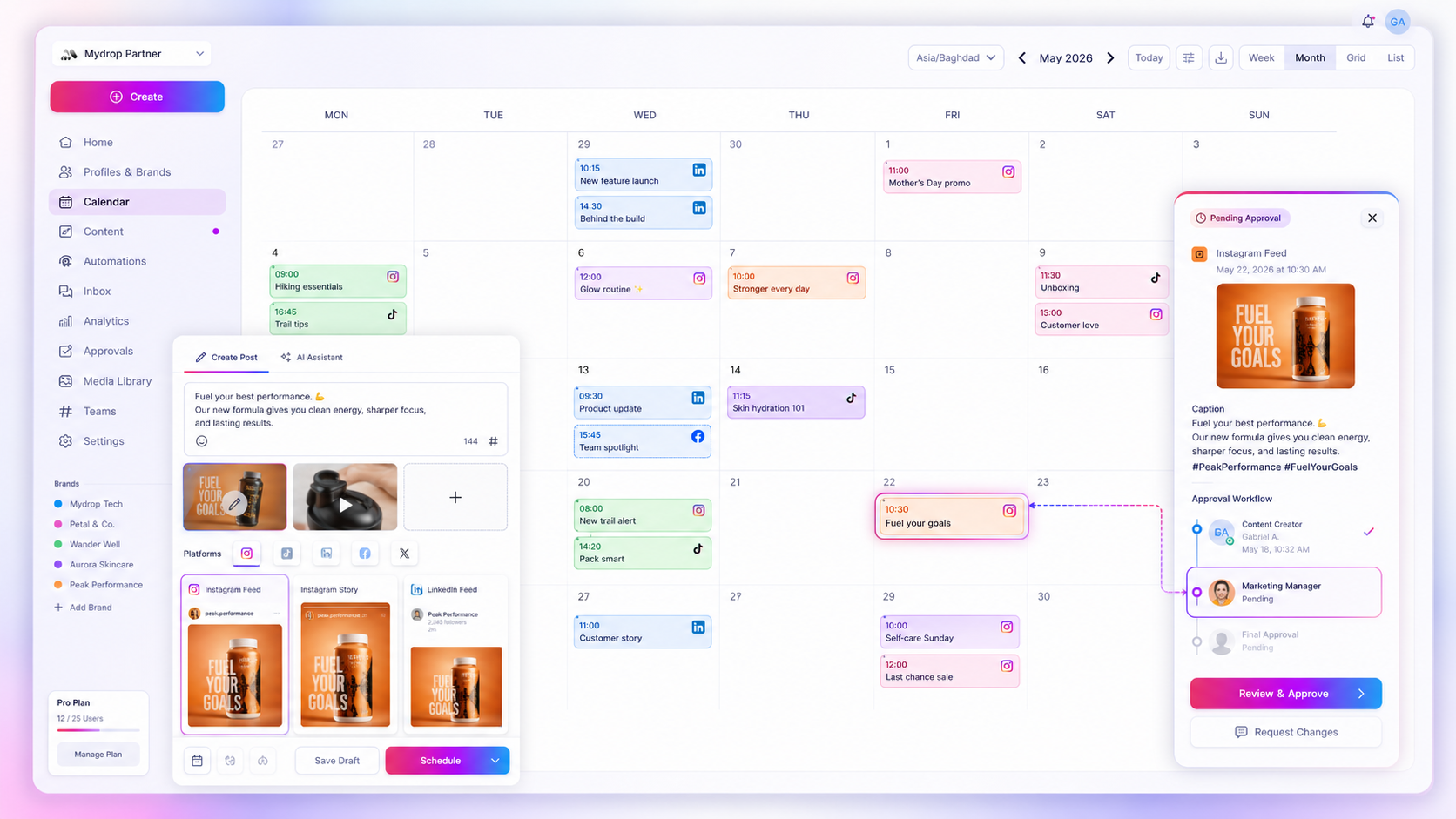
When you adopt a "Link, Don't Recreate" philosophy, you stop managing events and start managing an operational machine. Using Mydrop reminders, for example, allows you to anchor a task directly to the specific posts, profiles, or media files that require follow-up. When the reminder repeats, it carries that connection forward, ensuring your team has everything they need at their fingertips without a scavenger hunt.
This moves the burden from your calendar management to your campaign execution. A recurring reminder that syncs with Google Calendar gives everyone visibility, but the underlying data-who did what, which assets were attached, and when it was finalized-stays right where the work lives.
Operator rule: If a task exists to support a recurring campaign asset, it must be attached to the asset, not just a floating block of time on your calendar.
The minimum system that works

The secret to stopping calendar fatigue isn't willpower; it is separating your static schedule from your active work. If you are using a standard calendar for both, you are likely suffering from what we call "event drift"-where critical tasks get pushed, snoozed, and eventually ignored because they feel like optional appointments rather than operational requirements.
To fix this, you need a minimum system that distinguishes between things that happen and things that must be done.
- Map your cadence: Identify which tasks repeat by nature (like end-of-month reporting) versus those that are unique project milestones.
- Define the link: If a task relates to a specific content asset-like a recurring review of your core brand pillars or a monthly check of social media ad creative-the task must live on that asset.
- Use persistent state: When a task is recurring, you need a system that tracks "done" status per occurrence without wiping out the root instruction.
At Mydrop, we see teams stabilize their operations by moving these repetitive tasks into a dedicated reminder layer. This keeps your actual calendar clear for high-level meetings while ensuring the "grunt work" of social media management stays attached to the profiles and posts it actually concerns.
| Feature | Standard Calendar Event | Mydrop Recurring Reminder |
|---|---|---|
| Asset Link | None (Text only) | Linked to post, profile, or media |
| Recurrence Logic | Limited, rigid | Flexible (Hourly to Monthly) |
| Done State | Deleting/Marking "Busy" | Native isDone toggle per occurrence |
| Sync | Basic | Bidirectional sync with Google Calendar |
| Operational Value | High maintenance | Low maintenance (Self-sustaining) |
Where teams overbuild the process
The most common trap we see in enterprise marketing is the "Over-Engineering Tax." Teams often start by building an incredibly detailed, nested hierarchy of reminders for every single sub-task imaginable, hoping this will force consistency. Instead, they just create a new type of coordination debt.
If you find yourself spending more time updating your task-management system than actually managing the campaign, you have overbuilt.
Common mistake: Creating a unique, one-off calendar entry for every individual stage of a multi-brand approval cycle. If you have ten brands and five reviewers, you are creating fifty opportunities for someone to miss a notification, lose the link to the asset, or simply get overwhelmed by the noise.
Instead, consolidate. If a task requires a recurring check-in-like "Review monthly channel performance"-use one recurring reminder set to the team responsible for that specific brand profile. By pinning the reminder to the profile itself, you eliminate the need for someone to hunt through a spreadsheet or a cluttered email inbox to find the right data source.
A simple rule helps: If a task doesn't require a collaborative, high-stakes meeting, it shouldn't be a calendar appointment. It should be a persistent, linked operational task that your team can check off once the work is verified. When you stop treating every reminder like an event, you stop the death-by-a-thousand-notifications that kills high-output social media teams.
How to run the cadence
Once you have identified which tasks are cluttering your calendar, the shift to a structured system is simpler than it sounds. The goal is to stop creating calendar ghosts-events that exist only to nudge you-and start using live anchors that actually hold your operational data.
When you set up a recurring Mydrop reminder, you are not just adding a block of time. You are creating a workspace anchor that links your task directly to the assets involved.
- Pick the root task: For a monthly performance audit, create the reminder for the first of the month.
- Attach the context: Link the relevant profile groups, the shared media folder for the report, or the specific campaign post template.
- Set the recurrence: Use the
foreveroruntil-completemode to lock the cadence into your team view. - Mark as done: When the task is finished, click
Done. The system handles the state sync to your integrated Google Calendar, so you and your stakeholders see the progress without needing to ping each other in Slack.
Decision check: If a recurring task does not have a clear owner or a linked asset, it is not a campaign task; it is a meeting request. Do not put it in your Mydrop planning layer.
Here is a quick diagnostic check to see if your current recurring tasks are healthy or just noise.
| Diagnostic Signal | Keep as Calendar Event | Convert to Mydrop Reminder |
|---|---|---|
| Asset Dependency | None (e.g., generic meeting) | High (e.g., specific post/media) |
| Work Output | Discussion | Completion of a tangible item |
| Approval Chain | Single owner | Multiple stakeholders |
| Visibility Need | Private | Team-wide / Agency access |
The proof that the habit is working
You know the habit has taken hold when your calendar is no longer a to-do list, but a map of your actual campaign rhythm.
In our experience with teams managing hundreds of brand profiles, the shift is measurable not in hours saved, but in reduced noise. When your recurring reminders are linked, you stop asking "Wait, which asset did we review last week?" because the done-state history is physically attached to the reminder itself.
You will see the proof in two specific ways:
- The "Zero-Inbox" Effect: Your calendar is no longer cluttered with one-off "Check status" blocks that you constantly move.
- Context Persistence: When a new team member joins a multi-brand project, they can click a past occurrence of a reminder and see every asset and profile linked to that specific cycle. They inherit the institutional memory that used to live in your head or a hidden spreadsheet.
Conclusion
The messy truth about multi-brand campaigns is that you cannot manage them by brute force. If your process relies on you remembering to manually recreate tasks every week, you are not scaling; you are just delaying your own burnout.
The fix is surprisingly quiet: move the work out of your personal calendar and into a shared, recurring operational layer. By linking your reminders to your actual content objects, you transform a chore into a system.
Stop managing your calendar. Start managing your cadence. Your team-and your stress levels-will thank you by the end of the next launch cycle.