
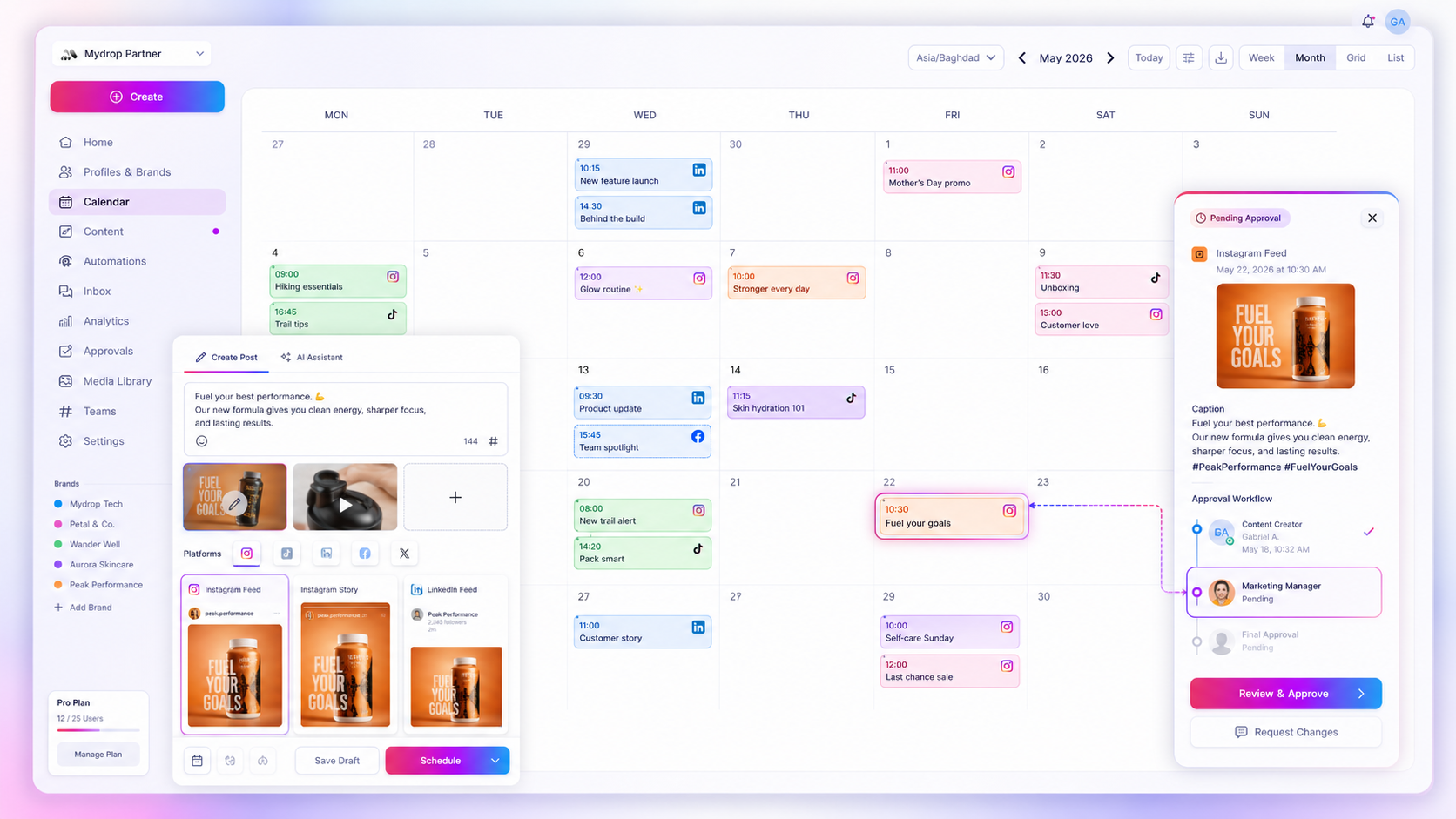
If you are still relying on static spreadsheets or personal sticky notes to track recurring content tasks, your biggest bottleneck isn't the volume of your content-it's the friction of your coordination. The solution is to stop treating planning and execution as separate silos and instead move your recurring tasks into a synced, automated reminder layer that bridges the gap between your campaign objects and your calendar.
We get it. You are juggling dozens of profiles, multiple markets, and a rotating cast of stakeholders. The "messy middle" of manual task management leads to missed deadlines and disjointed collaboration, making it feel like you are repeating the same setup work for every single cycle. When your planning isn't tied to the actual posts, profiles, or assets they govern, you are essentially paying "coordination debt"-where the time spent managing the work starts to exceed the time spent actually creating it.
The operating problem this solves

The awkward truth is that most marketing teams use tools that are technically disconnected. You might have a robust project management board, but when that board doesn't talk to your team's live calendars, you end up with two versions of the truth. This creates a hidden operational cost where information is trapped in documents that no one looks at until it is already too late.
When a recurring task, such as a monthly platform performance review or a recurring holiday campaign setup, isn't linked to the specific post or media involved, your team is forced to play a scavenger hunt every time the task comes due. Worse, if your current tracker doesn't support a shared "done state," marking a task finished in your local view does nothing to alert the rest of the team or update the shared calendar. You end up with five different people checking the same task because no one knows who already handled it.
Here is where teams usually get stuck:
- Fragmented visibility: The team lead sees a calendar, but the content creator sees a list. They never actually see the same status.
- Manual sync fatigue: You spend an hour every Monday morning manually updating calendars to match your planning doc. That is not work; that is administrative maintenance.
- Ghost tasks: Recurring reminders that don't allow for exceptions-like rescheduling a specific occurrence during a holiday-eventually get ignored because they become "noise" rather than actual tasks.
At Mydrop, we have seen this across brands and agencies of all sizes. The teams that scale aren't the ones working harder to keep track of their spreadsheets; they are the ones who have automated the "plumbing" of their operations. By using a reminder layer that sits directly on top of your campaign objects, you turn planning notes into structured operational tasks that live exactly where your team already spends their time.
Operator rule: If a task isn't linked to the underlying asset, profile, or campaign it governs, it is just noise. Your system should connect the what (the content) to the when (the deadline).
The minimum system that works

The secret to stopping coordination debt isn't adding more tools; it's enforcing a single source of truth. When a task exists in a spreadsheet but its deadline lives in a calendar, you have already lost. The absolute minimum system requires three components: a shared calendar, a link to the creative asset, and a clear "done" state that reflects across both.
When you use a tool like Mydrop, this happens automatically by attaching operational tasks directly to your posts and profiles. You stop hunting for the "latest version" of a brief because the reminder lives inside the campaign architecture, not in a buried email chain.
Before-After: The coordination shift
| Feature | Manual Spreadsheet Tracker | Mydrop Automated Layer |
|---|---|---|
| Visibility | Requires manual team update | Real-time sync to shared calendars |
| Asset Linkage | Copy-paste links to drive/cloud | Native link to post or media object |
| Status Update | Email "done" to manager | One-click sync to Google Calendar |
| Recurrence | Manual re-entry per cycle | Set-and-forget RRULE logic |
The goal is to stop treating your calendar as a simple scheduling device and start using it as an operational engine. By linking your recurring planning tasks directly to your content objects, you ensure that everyone from the strategist to the community manager sees the same progress, at the same time, without a single status update meeting.
Decision check: If a task isn't linked to the post, profile, or asset it governs, it does not exist. It is just noise waiting to derail your morning.
Where teams overbuild the process
We have seen this across dozens of agencies: the "perfectionist trap." Teams spend weeks designing an incredibly complex, 15-step manual workflow in a task manager, complete with sub-tasks, dependencies, and elaborate tagging systems. Then, they wonder why no one actually uses it.
Most teams do not have a content problem. They have a decision bottleneck. Adding more layers to a broken process just creates more friction.
Why complex manual systems fail
- High maintenance cost: If your team spends more time managing the tracker than creating the content, the system is actively hurting your output.
- State drift: The moment a team member forgets to manually update a checkbox, the entire "source of truth" becomes unreliable.
- Low adoption: If the system requires five clicks to log a simple task, your best team members will find a "faster" way-usually via personal DMs or sticky notes.
The most effective content operations teams we work with prioritize automation over administration. Instead of building a complex, custom-coded task machine, they identify the three or four recurring beats that actually drive their month-like monthly influencer check-ins or quarterly compliance audits-and automate the reminders for those specific hooks.
Start small. Automate the tasks that repeat every week. If you find your team is still "checking in" on each other to see if a post is ready, you have identified a gap that an automated, linked reminder should fill.
How to run the cadence
To make these reminders actually stick, you need to treat your calendar as a high-integrity operational layer rather than just a place to store meeting times. This is where most teams falter: they set up a recurring task, but they don't define what "done" looks like for that specific cycle.
Start by mapping your recurring workload to a fixed weekly or monthly rhythm. If you are a team managing dozens of brand profiles, do not create one generic "Content Planning" reminder. Break it down into discrete, object-linked tasks:
- Intake and Strategy: A monthly reminder to review performance data and set focus themes for the upcoming 30 days.
- Asset Procurement: A bi-weekly reminder to verify that the media team has uploaded the necessary creative to the correct asset library.
- Approval Loop: A recurring reminder that triggers 48 hours before the main publish window, ensuring legal and brand stakeholders have signed off.
Workflow check: If a recurring reminder doesn't have an attached post, profile, or media folder, it will eventually be ignored. Always link your operational tasks to the actual content objects you are governing.
When you use a tool like Mydrop, you can take this further by utilizing recurrence exceptions. If your team has a holiday or a mid-month re-org, you don't need to delete your entire series. You simply mark that single occurrence as an exception or delete it for the week, leaving the rest of your quarterly cadence intact. This keeps your calendar clean and your team focused on what is actually due today, not what was supposed to happen last Tuesday.
The proof that the habit is working
You know your new cadence is working when the "scavenger hunt" for campaign status disappears. Your success won't be measured by how many reminders you set, but by the reduction in "Where are we on X?" messages in your team chat.
Here is a simple scorecard to audit your progress after the first full month of automated sync.
| Metric | Manual Baseline (Spreadsheet) | Automated Target (Synced Calendar) |
|---|---|---|
| Status updates per week | 10 to 15 manual status checks | Zero (Status is visible on calendar) |
| Missed asset deadlines | 15% to 20% occurrence rate | Near 0% due to linked media tasks |
| Approval bottleneck time | 24 to 48 hours of delay | Under 4 hours (automated triggers) |
| Coordination overhead | 5 to 8 hours per week | 1 hour (set once, auto-recurs) |
Example calculation: If your team spends 7 hours/week on status pings, and you reduce this to 0, you've recovered roughly 300 hours per year of high-leverage time.
If your team is still spending hours each week manually confirming if "Post A" is ready for "Market B," you don't have a content problem. You have a coordination debt problem. The moment you move these tasks into a synced, state-aware calendar, the "messy middle" of your operations starts to clear up.
Conclusion
The goal of automating your recurring tasks isn't just to save a few minutes of scheduling time-it is to eliminate the cognitive load of remembering who needs to do what and when. When your planning tasks live in the same ecosystem as your actual posts, you stop managing spreadsheets and start managing outcomes.
Pick one recurring workflow-perhaps your weekly community sentiment report or your bi-weekly asset review-and transition it into a synced reminder today. Once your team experiences the relief of having these tasks appear automatically, linked to the correct profiles and media, the move toward a fully automated operational layer becomes inevitable. Stop the scavenger hunt. Start the sync.