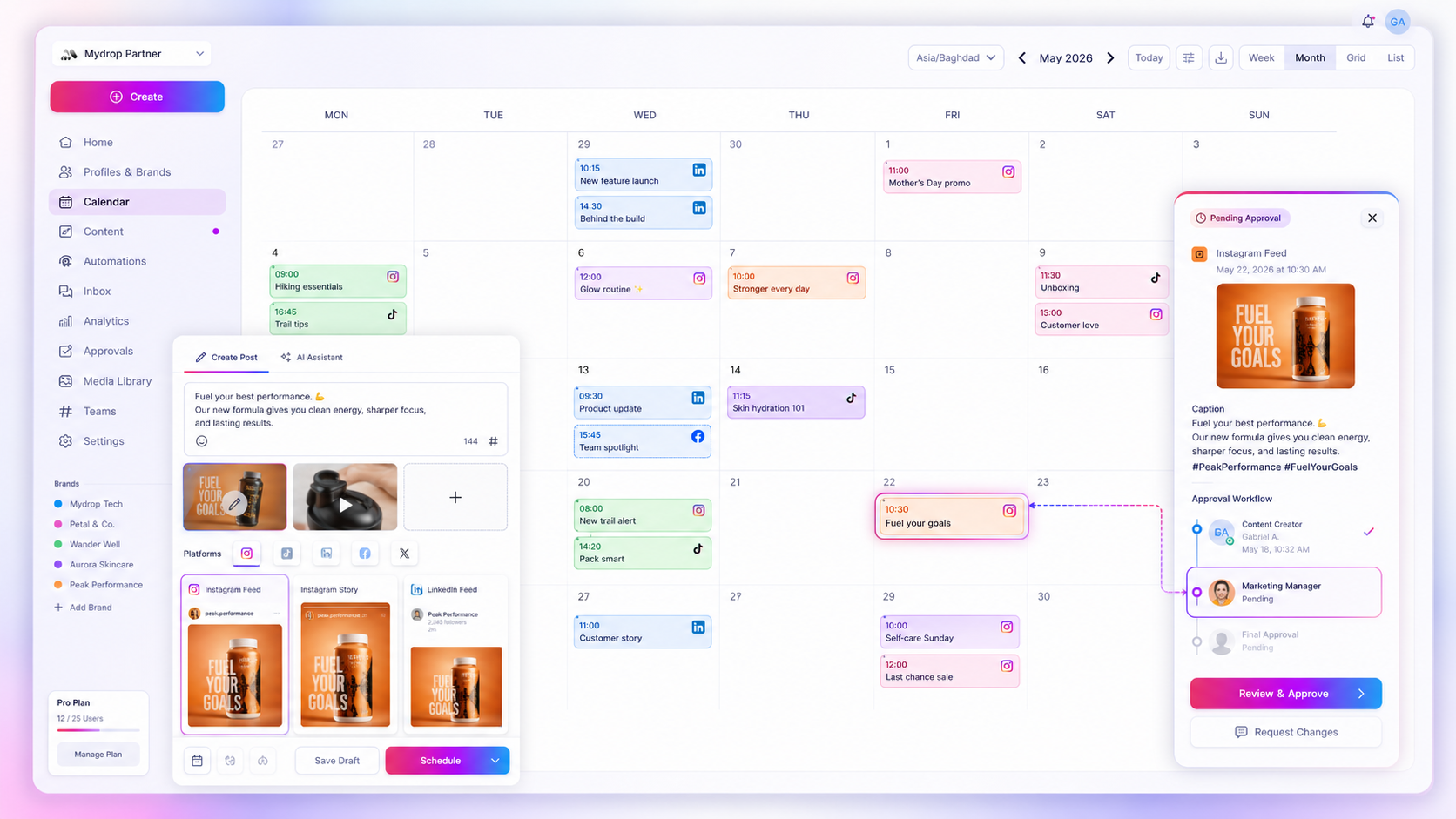
Stop treating your team's content calendar like a digital post-it note. The secret to managing multiple brands without losing your mind is simple: move from static, text-based calendar events to an active, linked operational layer where every reminder anchors directly to the post, profile, or media asset it concerns.
We get it: the content churn is relentless, and the coordination debt of juggling four different brands across three overlapping calendars is quietly killing your team's focus. You are likely spending more time manually copying task details from a project board into Google Calendar than actually shipping the work. It is an exhausting way to operate, and the awkward truth is that your current reminder system is less of a workflow and more of a notification graveyard-a place where planning tasks go to be ignored, duplicated, or forgotten the moment they hit your lock screen.
The good news is that this friction is largely optional. When you stop treating reminders as separate entities and start treating them as components of your campaign assets, you eliminate the context-switching tax that drains your daily output.
The decision teams usually frame too broadly

When teams realize their coordination is falling apart, the default reaction is to look for a new tool-usually a dedicated task manager or a more robust scheduling suite. They frame the requirement as, "We need a better way to track reminders," but this is the wrong goal. Adding another siloed tool doesn't fix coordination debt; it just moves the debt to a different interface.
Instead of hunting for "more reminders," you need to build a content-operations task layer. The decision shouldn't be about whether to send a notification, but about how to ensure that notification carries enough context to be actionable.
Most teams struggle because they force a choice between two bad extremes:
| Approach | Typical Workflow | The Fatal Flaw |
|---|---|---|
| Manual Calendar | Creating disconnected events in Google Calendar. | Context Blindness: The alert fires, but the team can't see the attached guidelines or assets without hunting through emails. |
| Project Board | Tracking tasks in a tool like Jira or Asana. | Maintenance Drag: The calendar surface is empty; nothing is synced, and you end up manually updating both the board and the calendar daily. |
At Mydrop, we see teams managing hundreds of brand profiles fall into this trap constantly. They start with the best intentions, building complex recurrence rules in a calendar that doesn't actually talk to their campaign assets. They end up with hundreds of "Content Audit" reminders that provide zero insight into which audit is for which brand, or which media docs need review.
If your reminder doesn't let you jump straight into the relevant post or media folder, it is just noise. An operational task is only useful if it is anchored to the work itself. When you link a recurring reminder to a specific asset, you stop being a coordinator who manages calendar entries and start being a lead who manages campaign execution.
What should stay manual and what can move faster

The golden rule here is simple: anything requiring human judgment or nuance stays manual; anything requiring repetitive administrative labor moves to automation.
If you are brainstorming a new campaign theme, debating the tone of a brand response, or evaluating the visual polish of a high-stakes asset, stay in your creative tools. These tasks thrive on friction, debate, and the messy, nonlinear process of collaboration. You want those conversations to be deep and intentional.
However, the administrative "glue" holding your operation together-the things you currently do just because "someone has to remember"-should be the first things you hand off to a recurring task system.
- Move to Automation: Weekly brand audit checks, monthly sentiment report reminders, quarterly platform guideline updates, recurring stakeholder approval pings, and standing asset management syncs.
- Keep Manual: Strategy alignment sessions, creative feedback cycles, crisis response coordination, and cross-departmental campaign planning.
The moment you find yourself setting a calendar reminder for a task that will happen exactly the same way next month, you have stopped doing creative work and started doing clerical work.
Operator rule: If a task takes more than five minutes to set up, requires coordination across two or more team members, and recurs at least once a month, it is an operational candidate for automation.
The tradeoff matrix
Deciding what to automate is often less about time saved and more about the cost of forgetting. This matrix helps you visualize the risk of keeping a task manual versus moving it into a structured, linked reminder system.
| Task Characteristic | Manual Calendar Entry | Mydrop Linked Reminder |
|---|---|---|
| Visibility | Siloed in personal view | Unified team view |
| Asset Context | None (Text only) | Linked to post/media/profile |
| Done-State Tracking | Manual check-off | Automated/Synced state |
| Risk of Forgetting | High (Notification graveyard) | Low (Auto-persisting) |
| Best For | Ad-hoc brainstorming | Recurring ops requirements |
Most teams view a "reminder" as a static event on a calendar. At Mydrop, we see it differently: a reminder is a container. When you link a recurring administrative task to an actual brand profile or media asset, the reminder stops being a passive alert and starts functioning as a checkpoint.
When you use the Mydrop Reminders system to set these up, you aren't just creating a digital sticky note. You are building a permanent operational asset that lives alongside your campaign data. If a team member marks a recurring monthly content audit as done within the system, that status propagates across your team's view. You stop chasing people for status updates because the "done state" is built directly into the workflow.
Most teams do not have a content problem; they have a decision bottleneck caused by administrative overhead. By moving these recurring chores out of your head and into a linked task layer, you finally clear the mental space to actually manage the brands you are responsible for.
How to pilot the workflow safely
Do not try to overhaul your entire multi-brand calendar in one afternoon. The easiest way to break your team's rhythm is to force a system migration without letting them see the immediate benefit. Start with a single "low-stakes" brand or one recurring process that currently causes the most friction.
Pick a process that is high-volume but low-creativity-like your weekly platform audit or a monthly community sentiment report. These are prime candidates because they are already scheduled, they have predictable outputs, and missing them creates "coordination debt" rather than a creative crisis.
Follow this three-step pilot to test the change:
- Audit the friction: Identify the one recurring meeting or task where someone asks, "Wait, where is the draft for this?" or "Has this been approved for all brands yet?"
- Anchor the task: Create a
Mydropreminder for that specific task. Attach the relevant post or media document that serves as the final deliverable. - Sync and Done: Set the recurrence, link it to your Google Calendar, and have the team member responsible mark it "done" within the tool rather than emailing you an update.
If the team starts seeing the relevant assets directly in their calendar notifications, the internal resistance will vanish. The goal is to make the "right" way to do things the path of least resistance.
The operating rule to keep
When you are managing dozens of profiles across different time zones, your biggest enemy is the "disconnected notification."
Decision check: A reminder without a linked asset is just noise; a reminder linked to a specific post, profile, or media doc becomes an actionable component of your campaign.
Every time a team member gets an alert, they should be able to click through to the exact work that needs doing. If they have to open a separate project management tool, dig through a shared drive for the file, and then go back to the calendar to report status, you have failed the workflow test. Keep the context as close to the action as possible.
Conclusion
The transition from a scattered, manual calendar to a unified content-operations layer is rarely about finding a "better" tool; it is about stopping the bleed of time spent on administrative busywork. When you link your planning tasks directly to your campaign assets, you stop managing the calendar and start managing the work itself.
The next time you find yourself manually copying a task into three different brand calendars, stop. That is not just a missed automation opportunity-it is a clear sign your operation has outgrown its current structure. Take that recurring task, anchor it to the actual post or media it supports, and get your team back to the actual creative output.