
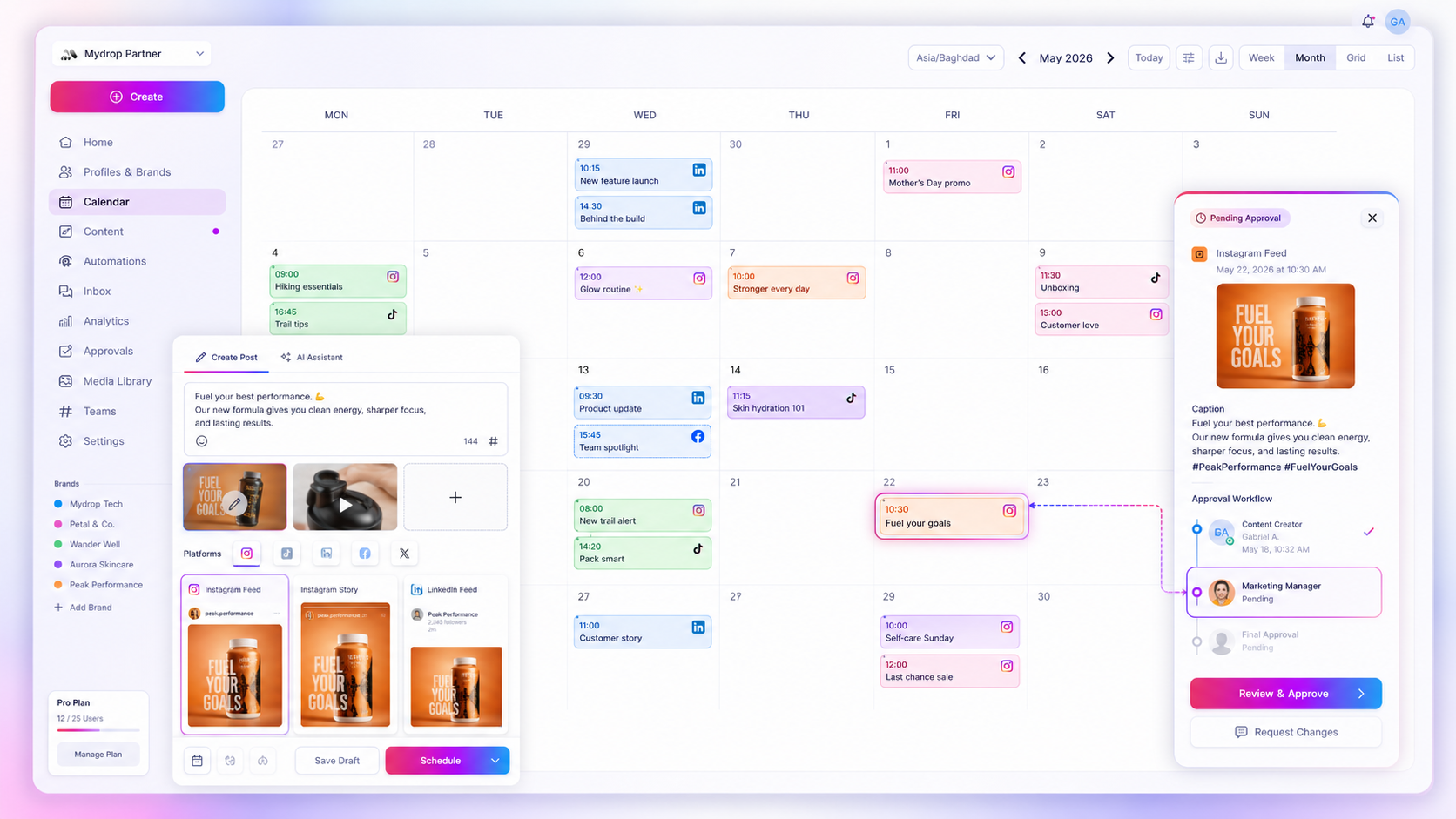
The "single source of truth" calendar is a lie for enterprise teams. When you aggregate fifty profiles, ten brands, and three time zones into one view, you aren't seeing a schedule-you are just staring at white noise. To regain control, you must stop looking at the "all" view and start enforcing filtered, campaign-specific workflows.
We get it. Your calendar is a wall of color-coded chaos. It is nearly impossible to distinguish a critical brand launch from a recurring post you scheduled six months ago. That feeling of dread when you open your planning tab? That is not poor management; it is standard-issue cognitive overload. You are not failing to plan; you are failing to filter. By shifting from a "view everything" mindset to a "filter for execution" habit, you cut through the static and focus on what actually needs to be done today.
The Master Calendar is usually your biggest bottleneck. By attempting to track every single asset for every brand at once, you have introduced hidden friction where team members waste hours sifting through unrelated content just to find their own tasks.
Where the handoff is actually breaking

The breakdown happens the moment your team grows past a single brand or a handful of profiles. When you treat the calendar as a giant shared bucket, you lose the ability to see the relevant signal.
In our experience across teams managing hundreds of brand profiles, the friction stems from two primary failure modes:
- Visual Overlap: High-stakes launches get buried under low-impact reminders and repetitive automated posts.
- Access Overload: Stakeholders and agency partners are forced to wade through content that has nothing to do with their specific brief or region, leading to missed approvals and stalled pipelines.
Teams often try to solve this by creating more spreadsheets or separate documentation, which ironically just creates another place for information to go stale. The reality is that the calendar already contains the data you need; you are just looking at the entire database instead of your specific lane.
Common mistake: Expecting a single team member to maintain awareness of every brand’s calendar. If an approver or a planner is looking at content outside their scope, they are not being "thorough"-they are being distracted.
If you are using Mydrop, the fix is to treat the Calendar surface not as a passive display, but as a query tool. You should be applying filters for the specific brand or campaign you are working on, then saving that view. If it does not serve the specific campaign you are currently executing, it shouldn't be in your line of sight. Most teams do not have a content problem; they have a decision bottleneck caused by trying to look at everything at once.
The coordination debt checklist

If you feel like you are perpetually digging yourself out of a content avalanche, you are likely suffering from a silent buildup of administrative drag. It is not that your team lacks talent; it is that your current process forces everyone to pay a "viewing tax" just to get a single task done.
Audit your team against these five signals. If you hit three or more, it is time to dismantle your master calendar view immediately.
- The "Who is doing what?" pause: Does your team spend more than 30 seconds searching for their own assigned posts when opening the dashboard?
- Notification fatigue: Are people ignoring alerts because half of them relate to brands or campaigns they do not work on?
- Approval gridlock: Does the senior approver have to navigate through routine, low-stakes posts just to find the urgent brand-launch content?
- Information fragmentation: Do you find yourself cross-referencing a spreadsheet or a chat thread just to remember which posts belong to the current quarter's campaign?
- The "All-Day" blur: Are your high-impact campaign launches visually indistinguishable from automated posts or mundane internal reminders?
If these sound familiar, your planning surface is no longer helping you-it is actively obscuring the work.
How to move decisions closer to the work
The secret to a manageable calendar is simple: stop looking at the everything. You need to shift your team to a "Filter-First" habit where the default state of your planning surface is restricted to the specific context of their current assignment.
When we look at how high-performing teams manage this in Mydrop, they rarely use a single global view. Instead, they treat the calendar as a customizable lens. Whether you are a campaign manager, a regional lead, or a final approver, your view should show exactly what requires your input, and nothing more.
Filter strategy by role
Use this matrix to assign specific calendar views to your team members. This limits noise and ensures that the only decisions hitting their inbox are the ones they are authorized to make.
| Role | Primary Calendar Filter | Why this works |
|---|---|---|
| Campaign Manager | Filter by [Campaign Name] | Isolates a specific project sprint, removing all "background noise" from other brands. |
| Regional Lead | Filter by [Profile Group/Market] | Ensures the view contains only relevant local content, avoiding cross-market timezone confusion. |
| Final Approver | Filter by [Post Status: Pending] | Forces a "triage-only" experience, turning the calendar into a focused queue of urgent approvals. |
| Social Operator | Filter by [Profile/Brand] | Keeps the interface clean, showing only the specific channels they are responsible for executing. |
By enforcing these constraints, you stop treating your planning tool like a museum gallery where everything is on display at once. Instead, you turn it into a surgical dashboard.
The goal is to reach a state where, when you open the calendar, you are not searching for work-you are executing it. If you have to scroll past thirty irrelevant posts to find one that matters, you have already lost the battle against decision fatigue.
Reset your team’s default view to a filtered state by the end of this week. If it doesn't fit the immediate campaign focus, it should stay hidden.
The roles and rules that reduce rework
Structure breaks down when everyone has keys to the entire house but only needs to paint one room. In large teams, we see managers drowning in notifications for post approvals that belong to regional marketing associates, while regional leads lose visibility into global campaign dates. The fix isn't just better communication; it is stricter permission-based visibility.
If your team is managing hundreds of profiles, stop relying on general email notifications or shared spreadsheets. Use Mydrop to scope the calendar view by role and project.
Operator rule: A planner should only see the campaigns they are actively building. An approver should only see the posts currently waiting in their specific brand-queue.
By applying filter-first workflows, you essentially hide the noise. When a regional social lead logs in, they should arrive at a filtered dashboard that shows their market's upcoming posts and relevant reminders-nothing else. This reduces the cognitive load of scanning fifty profiles to find the three that matter.
Role-Based Filter Protocol
| Role | Primary Filter Focus | Why it matters |
|---|---|---|
| Regional Planner | Profile / Brand | Keeps focus on local audience requirements. |
| Campaign Lead | Campaign / Tag | Prevents missing cross-channel launch windows. |
| Global Approver | Post Status: Pending | Stops "stalled chain" issues before they escalate. |
| System Admin | Automation / Reminders | Ensures structural work isn't buried under content. |
The weekly habit that keeps the system honest
Systems rot the moment you stop checking them. If you don't perform a "Friday Filter Reset," you are inviting the mess back into your workflow by Monday morning. This is the simple ritual that prevents that feeling of waking up to an avalanche of unmanaged content.
Every Friday, before the team signs off, spend 15 minutes as a unit clearing the view for the upcoming sprint:
- Clear Completed Statuses: Archive or move finalized posts to keep the board clean.
- Review the Filtered Sprint: Toggle the campaign filter to ensure nothing is overlapping or double-booked.
- Audit Reminders: Delete or update any all-day reminders that are no longer relevant for the next week.
- Spot-Check Stalled Approvals: If a post is stuck, move it or kill it. Do not let it sit in the calendar as "visual clutter" that creates false urgency.
Treat your calendar like a inbox, not a storage locker. If it isn't scheduled for action, remove it from the primary view.
Conclusion
Most teams do not actually have a content problem. They have a decision bottleneck caused by trying to look at everything at once. When you treat your calendar as a surgical tool for specific campaigns rather than a giant, unfilterable map of every brand activity, you stop fighting the tool and start executing on the strategy.
The shift is simple: stop trying to manage the "master view" and start mastering the filtered view. When your team can open their workspace and see exactly what they need to act on-without the distraction of fifty other projects-they stop wasting time on noise and start moving faster.
Take back your Friday afternoons, kill the unnecessary notifications, and enforce the filter. Your brand consistency will improve, your team will breathe easier, and you might actually enjoy planning the next campaign.