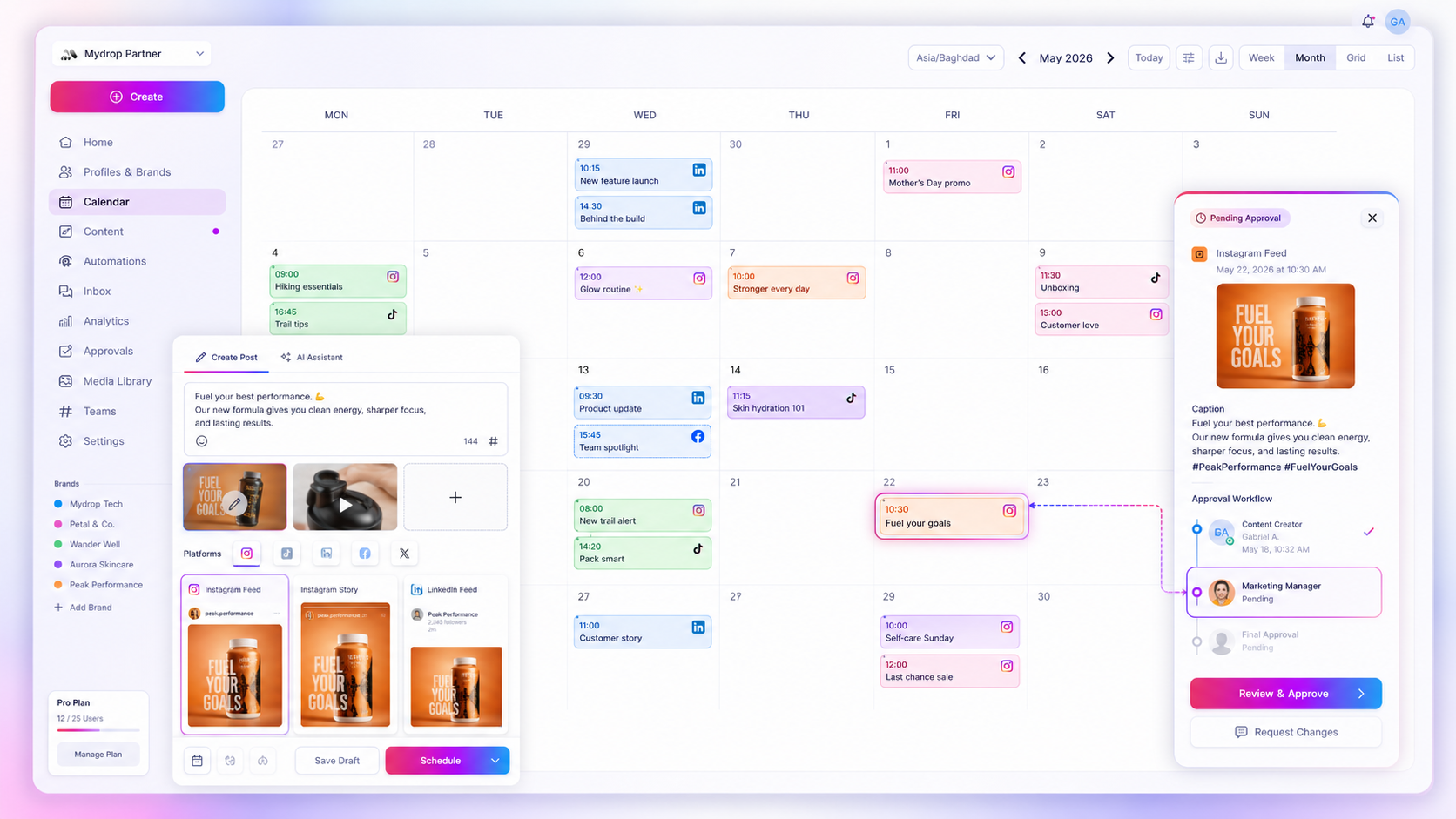
The secret to managing multiple brands without losing your mind is moving away from disparate, isolated spreadsheets and toward a single, filterable calendar surface that forces visibility across all your campaigns, profiles, and post statuses in one view. If you are still hunting through browser tabs for a "final-final" version of a post, or if your team spends their Monday mornings manually cross-referencing three different documents just to confirm who is posting what, you have a coordination problem.
We have all been there. It is exhausting to feel like you are perpetually chasing your own tail, trying to keep track of a dozen different brand voices and twice as many approval workflows. You are not alone, and frankly, this is harder than it looks; managing high-volume social operations is less about being a creative genius and more about mastering the boring, repetitive logistics of getting content out the door without a compliance headache.
The operating problem this solves

Most teams think their content problem is a lack of creativity, but it is actually coordination debt. This is the hidden operational cost of jumping between platforms and tools to manually track what is live, what is pending approval, and what is about to miss its window. When you work across multiple brands, this debt compounds. You end up with a spreadsheet that has become a crime scene of color-coded tabs, broken links, and outdated notes.
Here is where teams usually get stuck: they create too many granular, disconnected calendars. While this seems like a way to maintain focus, it actually creates massive visibility gaps. If your luxury brand calendar is invisible to your lifestyle brand lead, you cannot prevent cross-brand cannibalization or ensure your messaging remains consistent.
Operator rule: If a piece of content is not on the master calendar, it does not exist for the organization.
The goal is to stop treating your calendar as a static record of what happened and start using it as an active operational dashboard. When you collapse these silos into one view, you aren't just saving time on status updates; you are building a resilient, repeatable cadence that allows your team to move from reactive firefighting to proactive strategy.
At Mydrop, we see this across agencies and enterprise brands managing hundreds of profiles. The teams that scale successfully are the ones that stop viewing their calendar as a simple "to-do" list and start using it to filter, audit, and move content through a unified pipeline. The moment you force every brand and every campaign into a shared, filterable surface, the "shadow work" of manual coordination vanishes.
The minimum system that works
The secret isn't a more complex tool; it is a flatter, more disciplined surface. You need to shift your focus from where the content lives to when and why it publishes. In our experience, teams that stop juggling isolated documents and start using a unified, filterable calendar surface instantly cut their coordination debt in half.
The goal is to turn your calendar into a functional dashboard. If you can't filter your view by brand, campaign, and status in under three clicks, you are not managing a schedule-you are managing a memory game.
| Feature | The Old Spreadsheet Way | The Unified Calendar Way |
|---|---|---|
| Visibility | Siloed by sheet or tab | Holistic view of all brands |
| Status Tracking | Manual updates (stale data) | Real-time status tags (live) |
| Searchability | Ctrl+F through a mess | Instant filter by Campaign/Profile |
| Blocker ID | Hunting for comments | Direct view of "Pending Approval" |
At Mydrop, we often see teams successfully stabilize their operations by implementing a "Three-Filter Rule." During your weekly planning, require that your calendar view be constrained by exactly three criteria: Brand Profile, Active Campaign, and Approval Status. This forces you to see the gaps-the missing posts, the unapproved copy, and the accidental overlaps-before they become public.
Where teams overbuild the process
Here is the trap almost every high-growth team falls into: the urge to create "perfect" granular sub-calendars for every single niche, platform, and content type. It feels like you are getting organized, but you are actually just building more walls that prevent visibility.
When you fragment your calendar into too many isolated views, you lose the ability to see the "Big Picture" rhythm of your social footprint. We have seen teams manage hundreds of profiles where the marketing manager had to toggle between twelve different calendar views just to check the weekend schedule. That is not organization; that is a navigation nightmare.
Decision check: If you need more than two distinct calendar views to understand your upcoming week, your tagging schema is too complex.
Teams overbuild when they treat their calendar like a project management tool. A calendar is for timing and sequence, not for task management. You do not need a sub-calendar for every minor content iteration; you need a single surface that shows you what is scheduled, what is blocked, and what is ready to launch.
The moment you start over-tagging or creating custom calendar views for every internal stakeholder, you lose the speed that the calendar is supposed to provide. Instead of adding more views, focus on improving your filter logic. If a piece of content is tagged correctly, a single, master calendar view is all you need to maintain control across five markets, three brands, and dozens of contributors.
The best calendar is the one that stays boring, consistent, and visible. When you start adding "helper" views for every person in the building, you stop seeing the schedule-you just start seeing more work.
How to run the cadence
The biggest mistake teams make is treating the calendar as a static schedule. A calendar is a living organism; if you don't feed it, it dies. At Mydrop, we see high-performing teams treat the Calendar surface as a daily dashboard rather than a "set and forget" planner.
To keep your sanity, you need to transition from "planning mode" to "clearing mode." Your goal isn't just to look at the pretty rows and columns; it’s to systematically remove friction. Every Tuesday morning, your team lead should open the calendar in List Mode, filtered by "Pending Approval" and sorted by "Publish Date."
Workflow check: If a post is within 48 hours of its publish date and hasn't cleared the final approval queue, it gets pulled from the schedule automatically. No exceptions. This prevents the "last-minute fire drill" that kills team morale.
This cadence forces stakeholders to treat deadlines as real commitments, not suggestions. When you use the calendar filters to isolate by brand and campaign, you stop seeing a sea of tasks and start seeing the actual output of your marketing machine.
Use this simple, three-step weekly audit to keep the pipeline moving:
- The Blockage Check: Filter by "Status: Pending Approval." Anything older than 24 hours without a comment or action requires a direct ping to the stakeholder.
- The Overlap Audit: Toggle your campaign filters. Are three of your sub-brands posting about the same "Summer Sale" incentive within two hours of each other? If so, shift the calendar slots to prevent internal competition.
- The Coverage Review: Switch to the monthly view. Look for "dead zones" where no content is scheduled. If you see a week of silence, drop a note into the calendar to assign a placeholder topic for the creative team to fill.
The proof that the habit is working
How do you know if you are actually winning, or just busy? The data is in the friction-or lack thereof. When you run a disciplined calendar, the signals are usually quieter, which is exactly what you want.
You should look for these three markers of operational maturity:
| Metric | Pre-Audit Symptom | Post-Audit Signal |
|---|---|---|
| Approval Cycle Time | 48+ hours of back-and-forth | Under 12 hours |
| Emergency Edits | Frequent "can we pull this?" alerts | Near zero |
| Calendar Accuracy | "Is this scheduled?" questions | "The calendar says yes." |
The most important proof is the disappearance of the 6 p.m. frantic email chain. When your team trusts the single source of truth, they stop needing to ask you if something is ready. They just look at the calendar, see the status, and move on.
Conclusion
Most teams don't have a content problem; they have a decision bottleneck. You can pour money into more creators or smarter tools, but if you're still hunting for the latest version of a post inside a spreadsheet, your efficiency will remain capped.
Real scale comes from the boring stuff: standardized status labels, filterable planning surfaces, and the discipline to clear your blockers before they become crises. Start by centralizing your view, apply the filters that make sense for your specific brand structure, and protect your team’s time by making the calendar the only place where decisions are finalized.
Once your team knows that the calendar isn't just a schedule, but the final word on what gets published, you’ll find that you actually have time to think about your strategy again, instead of just chasing the clock.