
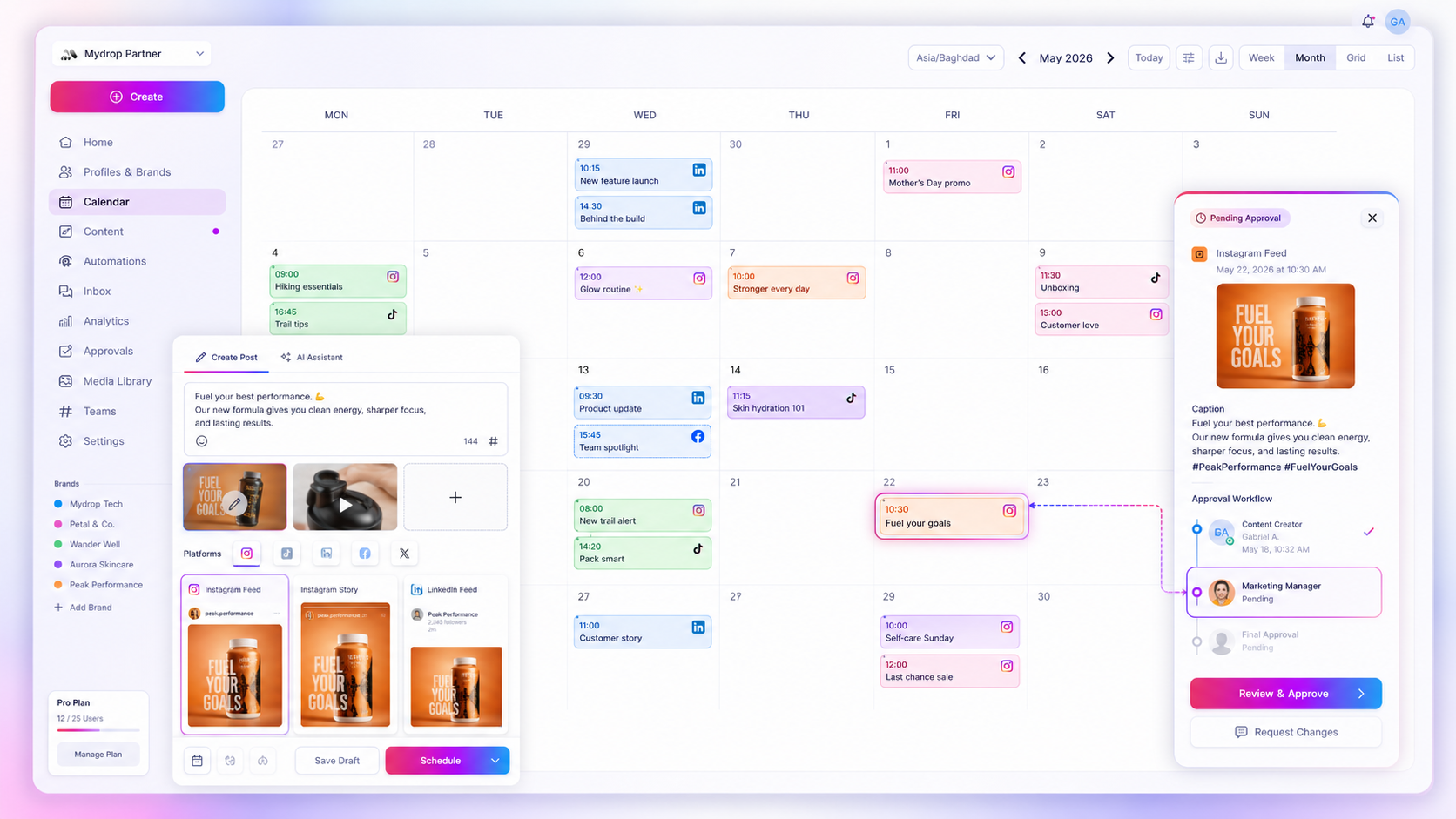
The secret to never missing a social media deadline is not working harder or adding another layer of manual reminders; it is narrowing your view to a granular, filtered list. When you manage content across multiple brands, relying on traditional "all-in-one" wall calendars is your biggest liability. These cluttered interfaces hide individual post statuses, forcing your team to play a constant game of hide-and-seek to find out what is actually ready to go and what is still stalled in approval limbo.
We know that sinking feeling when a post meant for Brand A goes out on Brand B, or worse, doesn't go out at all. The constant context-switching between native platform dashboards, spreadsheets, and Slack threads is exhausting. It is exactly where the best teams lose their grip. In our experience, teams managing hundreds of profiles do not have a content production problem; they have a coordination debt problem. You are likely spending more time manually checking status updates than actually reviewing the creative work itself.
If you cannot filter your master schedule to show only "Needs Approval" items in two clicks, you do not have a production schedule-you have a growing list of future problems. To stop the cycle, you need to shift from passive calendar viewing to active status filtering.
The decision teams usually frame too broadly

When teams realize they are missing deadlines, the immediate reaction is almost always: "We need a better calendar." They start shopping for tools that promise a more beautiful UI or a more colorful drag-and-drop interface. But this is the wrong problem statement. A prettier calendar doesn't fix a broken review process; it just makes the chaos look more organized.
The real issue is that most teams treat the calendar as a storage bin rather than an operational filter.
Operator rule: If your calendar view displays everything at once, it is effectively displaying nothing.
When you try to monitor thirty brand profiles on a single screen, your brain naturally stops scanning for exceptions and starts focusing on the visual noise. You lose the ability to see which posts are trapped in the draft stage, which ones are missing legal sign-off, and which are scheduled for the wrong timezone.
Here is why teams usually get stuck in this trap:
| The "All-in-One" Trap | The Filtered List Approach |
|---|---|
| View: Monthly wall calendar | View: Filtered list by status |
| Effort: Manual check of every slot | Effort: Instant surface of exceptions |
| Outcome: Missed deadlines (surprise) | Outcome: Proactive bottleneck clearing |
| Cognitive Load: High (constant scanning) | Cognitive Load: Low (management by exception) |
In Mydrop, we see teams move away from the traditional wall view as soon as they reach a certain scale-usually around five or more active brands. They switch to Calendar List Mode. Instead of looking for empty holes in a calendar grid, they filter by status to see only what needs attention now.
This shift turns your workflow from a passive "wait and hope it goes out" exercise into an active "find and fix" operation. When you stop looking at the calendar as a calendar and start looking at it as a filtered status report, the deadlines stop disappearing.
What should stay manual and what can move faster

Most teams get into trouble because they try to automate the wrong things. They treat the creative spark like a factory line and the actual logistics like a creative choice. If you are manually tracking every post across five brands in a spreadsheet, you are treating publishing-a purely mechanical task-as a high-stakes, manual labor event.
Creative planning should stay messy. You need the freedom to move sticky notes, debate copy, and iterate on visual assets without worrying about system locks or validation rules. If you try to force the early ideation phase into a rigid scheduling tool, you will just kill your team's momentum.
Operational scheduling, however, must be automated. The moment a post is "ready for review," it should move into a controlled pipeline. At Mydrop, we see teams fail when they keep their final approval stages in the same "brainstorming" space where they keep their raw ideas. You need a clear, binary exit point from the creative chaos into the execution machine.
Decision check: If a task requires a binary yes/no decision or a time-based trigger, move it to a status-filtered list view. If it requires human debate, keep it in your brainstorming tool.
The tradeoff matrix
Every decision in social operations is a tug-of-war between speed and control. You can move fast by cutting out review steps, but you will eventually hit a compliance wall. You can tighten control to perfection, but your team will eventually drown in administrative overhead.
The goal isn't to pick one; it’s to move the slider toward high-volume throughput without losing the safety net.
| Strategy | Speed | Control | Risk Profile |
|---|---|---|---|
| Manual Spreadsheets | Low | Low | High (Human error is inevitable) |
| Platform-Native Tools | Medium | Medium | Medium (Siloed visibility) |
| Status-First Lists | High | High | Low (Validated gatekeeping) |
Why status-first lists win
When you use a calendar list mode, you are essentially creating a filterable "ground truth" for your operations. Unlike a visual grid that hides detail behind a thumbnail, a list view lets you sort by Needs Approval, Rejected, or Scheduled.
This visibility transforms your operations from reactive fire-fighting to proactive management. Instead of checking every single brand profile to see what is coming up, you log in, open the Calendar list view, and filter for Status: Needs Approval.
If you can't see the bottlenecks, they don't stop existing-they just become invisible until they explode. Most teams think they have a "content volume" problem, when they actually have a "coordination debt" problem. By using granular filters in a centralized view, you stop playing hide-and-seek with your own schedule and finally start seeing the clear path to your next publication date.
How to pilot the workflow safely
You do not need to overhaul your entire operation to see immediate relief. Start small by treating next Monday as a controlled experiment. Pick one of your most high-volume brands-the one where "missing a post" happens most often-and move its management into a dedicated Calendar List Mode view.
For one week, skip the monthly wall view entirely. Open your calendar in Mydrop, toggle to the list format, and apply a filter for your specific profile group and the Needs Approval state. If you see more than five posts sitting there with a publication date inside 48 hours, you have found your bottleneck.
Use this simple 3-step Monday morning audit to reset your pace:
- The Gap Check: Filter your list by
TodayandTomorrowacross all active profiles. If a slot is empty, it is a priority. - The Bottleneck Hunt: Apply a
Needs Approvalfilter. Anyone with more than three pending posts is currently creating a risk for your team. - The Buffer Sweep: Check for any posts with an
All-Day Reminderattached. If the reminder date is past and the post is still in draft, kill the post or move the date immediately.
This gives you a clear, binary status check. You are either on track, or you have identified the specific post, person, or profile that needs your attention.
The operating rule to keep
We have seen this across hundreds of brands: the most reliable teams do not rely on memory or "calendar intuition." They rely on a rigid habit of filter-first interaction.
Workflow check: Filter before you create.
Before you ever open the post composer or drag a file into your calendar, your first action must be applying your brand-specific filter set. This prevents the "everything everywhere" noise that causes teams to accidentally drop content into the wrong campaign or miss an approval deadline entirely.
If you make it a requirement for your team to check the filtered List Mode before adding new content, you effectively force a "look before you leap" culture. It turns an otherwise invisible process into a visible, manageable queue. The goal is not just to see more; it is to see only what matters at this exact moment.
Conclusion
Stopping missed deadlines is rarely about better tools alone-it is about fixing the coordination debt that hides your true status. When you switch from a wide-angle calendar view to a precise, status-aware list, you stop guessing and start operating.
The next time you feel the pressure of a deadline creeping up, do not just stare at the wall calendar. Filter the noise, surface the pending approvals, and deal with the specific items that are actually at risk. You will find that when the view is clear, the work becomes significantly quieter.