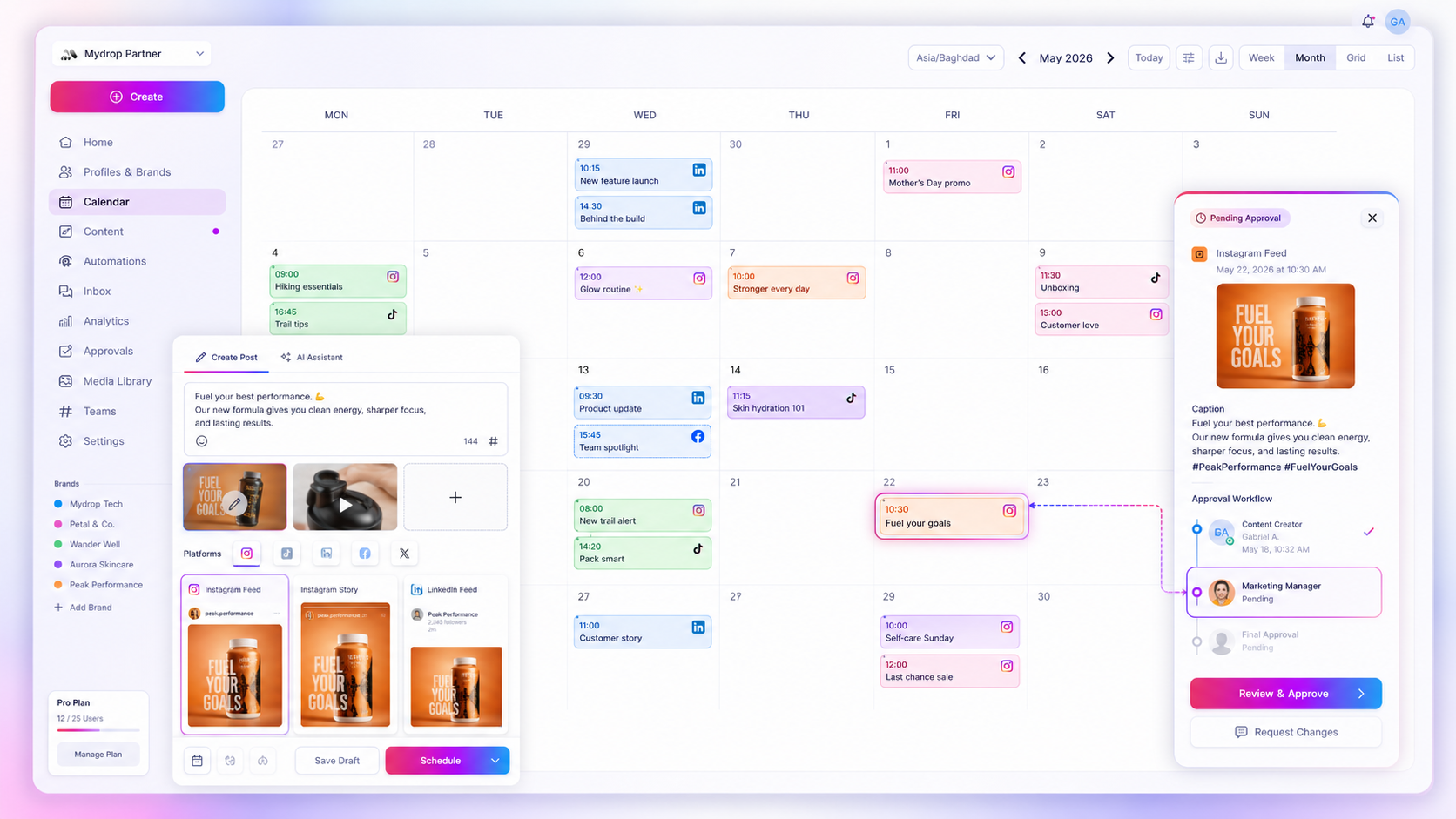
The "scheduling problem" is a myth you have been sold to keep your team chasing status updates instead of executing strategy. You do not need more calendar slots; you need to collapse the distance between your high-level campaign reminders and your granular post execution on a single, filterable surface. When your planning tool is just a storage bin for posts, your strategy lives in a separate, disconnected ecosystem of spreadsheets and PM apps. To scale, you must stop treating your calendar as a passive record and start using it as the active operating system for your team's collective output.
We have all been there: you are juggling a dozen platforms, a spreadsheet that has become a crime scene, and a Slack channel where campaign themes go to die. You know the strategy, but the "visibility" you are promised requires three extra meetings just to confirm that the Tuesday post actually aligns with the monthly objective. It is draining, and frankly, it is avoidable.
The operating problem this solves

Most enterprise teams suffer from coordination debt. You have brilliant planners designing campaigns and hardworking creators building assets, but they operate in different time zones of the tool stack.
When your planning surface is disconnected from your execution data, you hit a wall of context fragmentation. Your reminders are buried in an email thread, your notes are in a project management tool, and your posts are in a scheduler. By the time someone tries to stitch these together, the original strategy is already diluted.
Operator rule: If an input-whether it is a creative note, a strategic reminder, or a scheduled post-is not on the same surface as your execution data, it does not exist for the team.
This fragmentation creates a vicious cycle. Because you cannot see the full picture in one place, you schedule status-check meetings to force the alignment that your tool should be providing natively. At Mydrop, we often see teams that spend up to 20 percent of their week just manually cross-referencing calendars to prevent brand misalignment.
Here is why your current calendar setup likely feels like a losing battle:
| Symptom | The Hidden Cost |
|---|---|
| Global View Clutter | Everything is visible, so nothing is findable. |
| Static State | You see the post, but not its lifecycle status (e.g., Draft, Approval, Failed). |
| Reminder Silos | Strategy notes live in a separate tool, divorced from the post they inform. |
The goal of a high-performance calendar is not to show you "everything." It is to give you the exact view required to make a decision. When you move to a unified surface, you stop managing the calendar and start managing the cadence. You replace the spreadsheet with live filters, ensuring that the person responsible for the campaign, the brand, or the region sees exactly-and only-what matters to their current workload.
The minimum system that works
The secret to a high-performance calendar isn't adding more bells and whistles; it is enforcing a strict Unified Surface Rule. If your campaign strategy (the "why"), your internal reminders (the "how"), and your actual posts (the "what") don't live in the same view, you are just waiting for a mistake to happen.
In our experience, the teams that stop burning out are the ones who stop treating their calendar like a digital storage locker. Instead, they treat it as an interactive command center.
To build this, start by centralizing these three distinct inputs:
- Timed Reminders: Not just post dates. Add reminders for asset delivery, legal sign-offs, and competitor tracking windows.
- Notes: Dedicated space for campaign briefs or "aha!" moments that would otherwise get lost in Slack or email threads.
- Posts: The final execution items, clearly tied to a status workflow.
When you use a platform like Mydrop, this looks like flipping between your list mode for a quick status scan-seeing what is "Pending Approval" versus "Ready to Post"-and the full calendar view to visualize your actual distribution density. If you cannot see your strategy reminders alongside your scheduled posts, your "visibility" is a mirage.
Where teams overbuild the process
Here is where it gets messy: the trap of "calendar clutter." We have seen teams attempt to solve a lack of clarity by adding more data to the screen. They pipe in every minor event, every auto-response, and every minor update until the calendar becomes a graveyard of information where nothing important stands out.
If you are struggling to find your high-priority items, your filters are probably doing more harm than good. You have to be ruthless about the Filter Hierarchy.
The Calendar Health Scorecard
Use this simple audit to determine if your current setup is actually working or if it is just adding noise.
| Metric | Healthy Threshold | Warning Sign |
|---|---|---|
| View Complexity | Max 3 active filters | Global "All Content" view used daily |
| Reminder Density | 1-2 strategy milestones per day | 5+ tactical reminders per day |
| Status Visibility | Single click to filter by status | Multiple manual steps to check approval |
| Cross-Tool Load | 1 external source (e.g., G-Cal) | 3+ external tools synced to calendar |
Decision check: If a filter doesn't help you make a decision in under five seconds, delete it.
Teams often overbuild by trying to force every piece of documentation into the calendar view. A note about a brand voice tweak is helpful; a full 20-page creative brief is just clutter. Keep the calendar focused on actionable events.
When you manage across multiple brands, the temptation to "see everything at once" is powerful, but it usually leads to paralysis. At Mydrop, we recommend setting up persistent, filtered views for specific teams (e.g., "North America Product Launch" or "APAC Brand Awareness"). This lets your team focus on the work that actually matters to their specific mandate, rather than scrolling past hundreds of unrelated posts.
Remember, the goal of a high-performance calendar is cognitive ease. If looking at your schedule makes you feel exhausted before you have even started the day, you have overbuilt the system. Simplify the inputs, lean into your filters, and let the calendar do the heavy lifting of keeping your strategy and execution aligned.
How to run the cadence
The biggest mistake we see teams make is treating the calendar as a storage facility rather than an active control center. To kill coordination debt for good, you need a recurring weekly loop that shifts your team from passive "scheduling" to active "governance."
At Mydrop, we suggest a simple 15-minute Calendar Sync every Monday morning. It is not about drafting content; it is about filtering the noise so you can see the signal.
- Set the Filter: Start by applying your primary "Profile Group" filter. If you manage five brands, don't look at all of them at once. Focus on one.
- Clear the Red: Use the
post statusfilter to isolatePending Approvalitems. If a post is sitting there for more than 48 hours, it is not just a bottleneck-it is a compliance risk. - Cross-Reference Strategy: Toggle on your
Campaignfilter to ensure your scheduled posts actually align with this week’s high-level goals. If you see a gap, drag and drop anall-day reminderor anotedirectly into the calendar slot to signal the team. - Check the "Automated" Health: Review any automated workflows or recurring posts. Are they still relevant to the current brand narrative, or are you accidentally blasting outdated content?
Workflow check: If you find yourself opening a spreadsheet during this meeting, you have already failed. Use the calendar as your only source of truth. If it is not on the surface, it does not exist.
The proof that the habit is working
How do you know you have actually scaled? Look for the silence. When your team stops pinging you on Slack or jumping into emergency Zoom calls to ask, "Is that post approved?", you have successfully built a high-performance system.
Here is a simple scorecard to help you diagnose if your calendar habit is actually delivering value or just adding more work.
| Metric | Signs of Coordination Debt | Signs of High Performance |
|---|---|---|
| Approval Loop | > 3 emails or Slack threads per post | Single-click status update in Mydrop |
| Strategy Visibility | Campaign goals live in a separate doc | Goals pinned as calendar reminders |
| Meeting Volume | Weekly status meetings to track progress | Zero status meetings; check the dashboard |
| Filter Usage | Global view ("everything everywhere") | Dedicated saved views for specific markets |
| Post Lifecycle | Last-minute "firefighting" | Stable pipeline with 72-hour lead time |
If your team is still spending more than 20% of their time just tracking content, you aren't managing social media-you're managing a spreadsheet. The goal is to spend that time creating and optimizing. When the calendar becomes the primary operating system, the "status update" meeting becomes obsolete.
Conclusion
The difference between a frantic team and a high-performance one isn't the number of platforms they manage, but the discipline they bring to their workspace. You don't need a more complex scheduling tool; you need a more disciplined surface.
By consolidating your strategy, execution, and internal notes into one filterable view, you stop the death-by-a-thousand-cuts that kills most enterprise social programs. Stop chasing individual posts and start managing the system. Clear the clutter, enforce the Unified Surface Rule, and watch your team's output stabilize. After all, the best marketing is the kind that doesn't feel like a constant, chaotic emergency.