
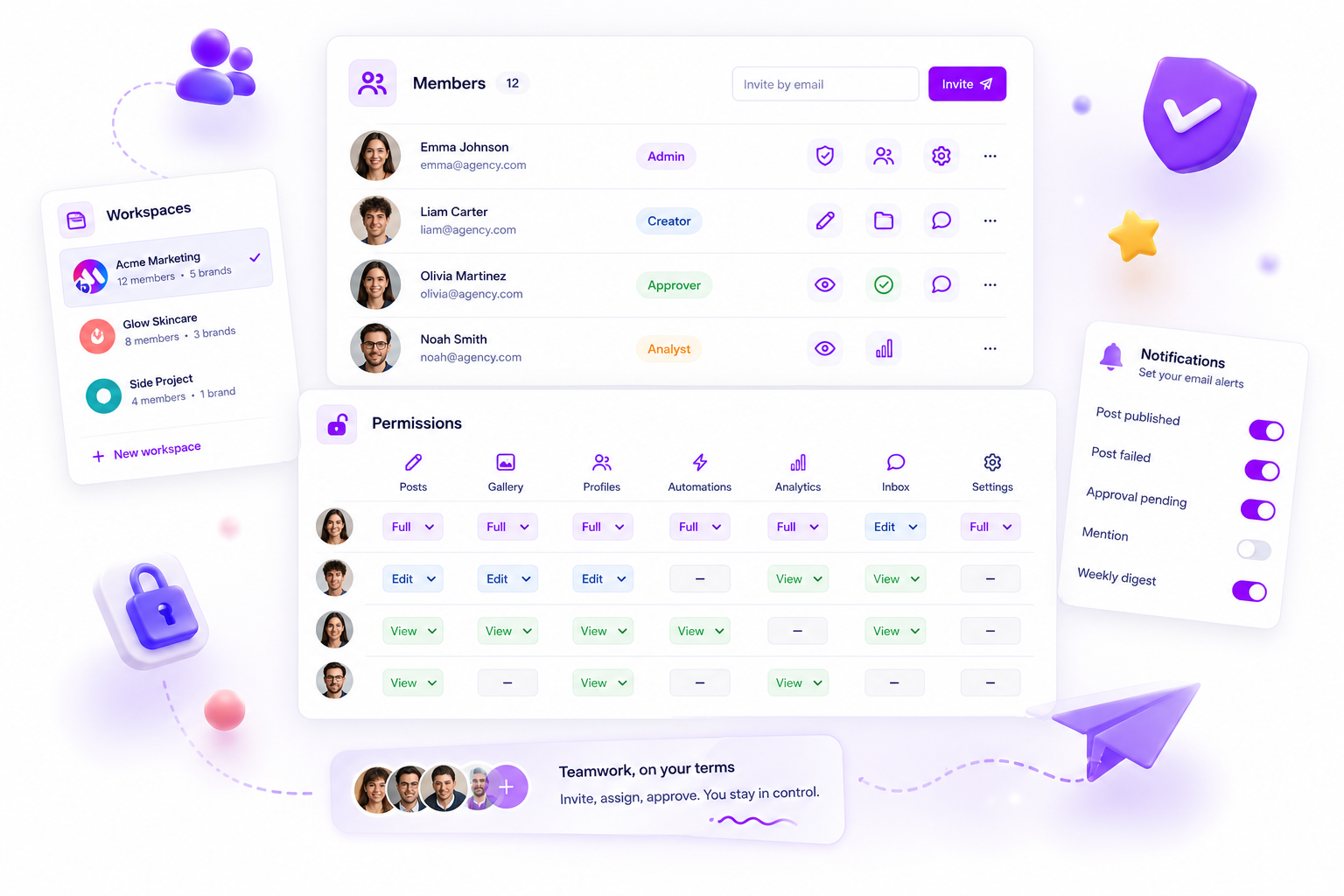
The fastest way to fix your social media operations is to treat team access like a recurring inventory check rather than a one-time onboarding task. If you haven't audited who can create, approve, or delete content in your workspace in the last 90 days, you are likely carrying a heavy burden of "permission creep"-a state where legacy roles and redundant access slow down your agility and quietly increase your compliance risk.
We have all been there: a freelancer joins for a holiday campaign, a coordinator gets promoted, or a client needs a quick look at a draft, and permissions are added in the heat of the moment. Months later, the workspace is cluttered with unused roles and broad access that invites accidental edits or simply adds noise to everyone's daily view. This is less about security and more about protecting your team's mental focus. Every extra permission a user doesn't actually need is a potential source of anxiety during their workflow. By cleaning this up, you aren't just locking doors; you are removing the friction that makes your team move slower than they should.
The decision each metric should trigger

An audit is only useful if it leads to action. Use the scorecard below to diagnose the health of your workspace and determine exactly where you need to trim the excess.
| Metric | High Integrity Signal | Actionable Decision Rule |
|---|---|---|
| Role Alignment | Titles match current duties. | Move any user with "stale" or "misaligned" roles to a default restricted state until reviewed. |
| Action Granularity | Approvals restricted to leads. | Revoke "approve" permissions from any user who is not explicitly in a lead or manager position. |
| Ghost Cleanup | Zero inactive accounts. | Immediately remove any user who has not logged in for 30 days or is no longer on the active roster. |
| Notification Hygiene | Alerts only match tasks. | Reset all user notification settings to disable high-volume, non-essential operational alerts. |
| Onboarding Accuracy | Default is "minimum access". | If a new invite starts with broad permissions, update your internal template to a "restricted" default. |
Operator rule: If a team member cannot articulate exactly why they need a specific permission-such as the ability to delete a profile or push a live post-they should not have it.
Most teams struggle because they assume that removing access will break the workflow, when in reality, having too much access usually breaks the communication. When everyone has the power to change everything, no one takes ownership of the final check. At Mydrop, we see the most resilient teams treat their permission maps as living documentation. They update these settings during the same quarterly window they use for strategy planning. It keeps the workspace lean, ensures that your leads remain the final gatekeepers for brand quality, and lets your creators focus purely on output without the low-level anxiety of accidentally touching global settings.
The scorecard that keeps reporting useful

Your team's access map is effectively an audit of your communication structure. If your reporting dashboard is showing messy data or your inbox is flooded with notifications that have nothing to do with your daily responsibilities, your permission architecture is likely the culprit. When you have too many people with "read" access to every single analytics stream or inbox thread, the noise quickly drowns out the signal.
Use this scorecard to diagnose if your current setup is helping your team or just keeping them busy with irrelevant data.
| Audit Metric | Indicator of Healthy Access | Warning Sign (Operational Debt) |
|---|---|---|
| Data Visibility | Roles see only the metrics they can act upon. | Every team member sees every global dashboard. |
| Notification Volume | Alerts are limited to active work streams. | Inbox is cluttered with irrelevant activity updates. |
| Action Mapping | "Approve" is reserved for final sign-off roles. | Junior staff can inadvertently push live content. |
| Onboarding State | New invites default to a "restricted" profile. | New team members inherit "admin-lite" by default. |
| Role Precision | Permissions update immediately upon job changes. | Roles are "set and forget" for years. |
When we see teams struggling with reporting, it is rarely because their data is wrong. It is almost always because the wrong people are seeing the wrong things, leading to unnecessary questions, delayed feedback, or just plain old digital clutter. If a team member cannot change an outcome, they probably don't need to be alerted to the granular data behind it.
What to stop measuring by default
The most common trap is assuming that "more visibility is better." It is not. In our experience, giving every team member access to every resource-from raw gallery assets to full-workspace analytics-is the fastest way to kill focus.
Decision check: If a team member is not responsible for the outcome of a resource, remove their access to it.
Start by pruning these three areas. First, bulk inbox notifications that aren't tied to active projects. If you have ten people monitoring a shared inbox, you have a coordination bottleneck, not a team. Second, global analytics access for users who are only creating content. They need performance feedback on their own work, not a firehose of data for every brand, region, and channel you manage. Third, administrative actions like workspace-level deletions or profile modifications. These should be strictly limited to the absolute minimum number of people required to maintain the business.
Permission minimalism isn't just about security compliance. It is about clearing the mental bandwidth your team needs to do their best work. When you configure your Mydrop team settings, think of it less as "giving access" and more as "defining the operational boundaries." By trimming the permissions map to only what is strictly necessary, you turn a chaotic, noisy workspace into a focused, high-velocity machine where everyone knows exactly what they are responsible for-and what they can ignore.
How to connect metrics to next actions
The data you gather from your audit-the gaps between who should be doing what and who actually can-is only useful if it sparks an immediate change in your workspace. If you discover a junior coordinator has "Approve" permissions because they needed them for a one-off campaign six months ago, that isn't just an observation; it is a clear signal to revoke access.
We often see teams treat permission maps as static records, but they should function like an active ledger. When your scorecard shows "Role Alignment" at 60%, you are essentially signaling that your team’s actual work has drifted from their documented responsibilities.
Action trigger matrix
| Finding | Immediate Action | Why this works |
|---|---|---|
| Broad Admin roles | Downgrade to "Editor" or "Contributor" | Removes the risk of accidental workspace-wide deletions. |
| Legacy contractors | Remove access entirely | Prevents "silent" account activity from external parties. |
| High notification volume | Toggle specific email/alert categories | Reclaims focus by silencing non-essential operational chatter. |
| Missing approval roles | Update role templates | Ensures leads are the only ones signing off on content. |
Workflow check: If a team member asks, "Why can't I do X anymore?" and the answer is "Because it's not part of your current job," you have successfully tightened your operational security.
The review cadence that makes the model stick
Attempting to audit your entire organization at once is a recipe for burnout, which is why we recommend moving to a rolling, quarterly review cycle. Instead of treating access management as an annual chore, bake it into your existing rhythm of business.
If you are already running monthly planning or quarterly business reviews (QBRs), add a 15-minute "Governance Sync" at the end of that meeting.
- Week 1: Review "Active" vs. "Inactive" members. Disable anyone who hasn't logged in for 30 days.
- Week 4: Evaluate "Role Alignment." Check if any "Editors" need "Manager" level access based on recent promotions.
- Week 8: Audit "Notification Hygiene." Identify where alerts are being ignored or where teams are missing critical inbox threads.
- Week 12: Full-scale cleanup. Update all permission maps to match the next quarter's operational plan.
At Mydrop, we see the most resilient teams treat these reviews as a basic hygiene habit, no different than clearing out old email drafts. They don't wait for a crisis to realize that half their team has access to settings they don't even know exist.
Conclusion
Your access map is the hidden engine of your social media operations. When it is cluttered, your team feels the drag in every approval, every thread, and every post. By stripping back access to the minimum functional requirement, you do more than secure your assets; you provide the psychological safety your team needs to act decisively.
The goal isn't just a clean spreadsheet; it is a workspace where everyone knows exactly what they are empowered to do-and can get it done without the noise. Start with your leads this week, then work your way down the ladder. Once the clutter is gone, you will find that "moving fast" becomes the default, not the exception.