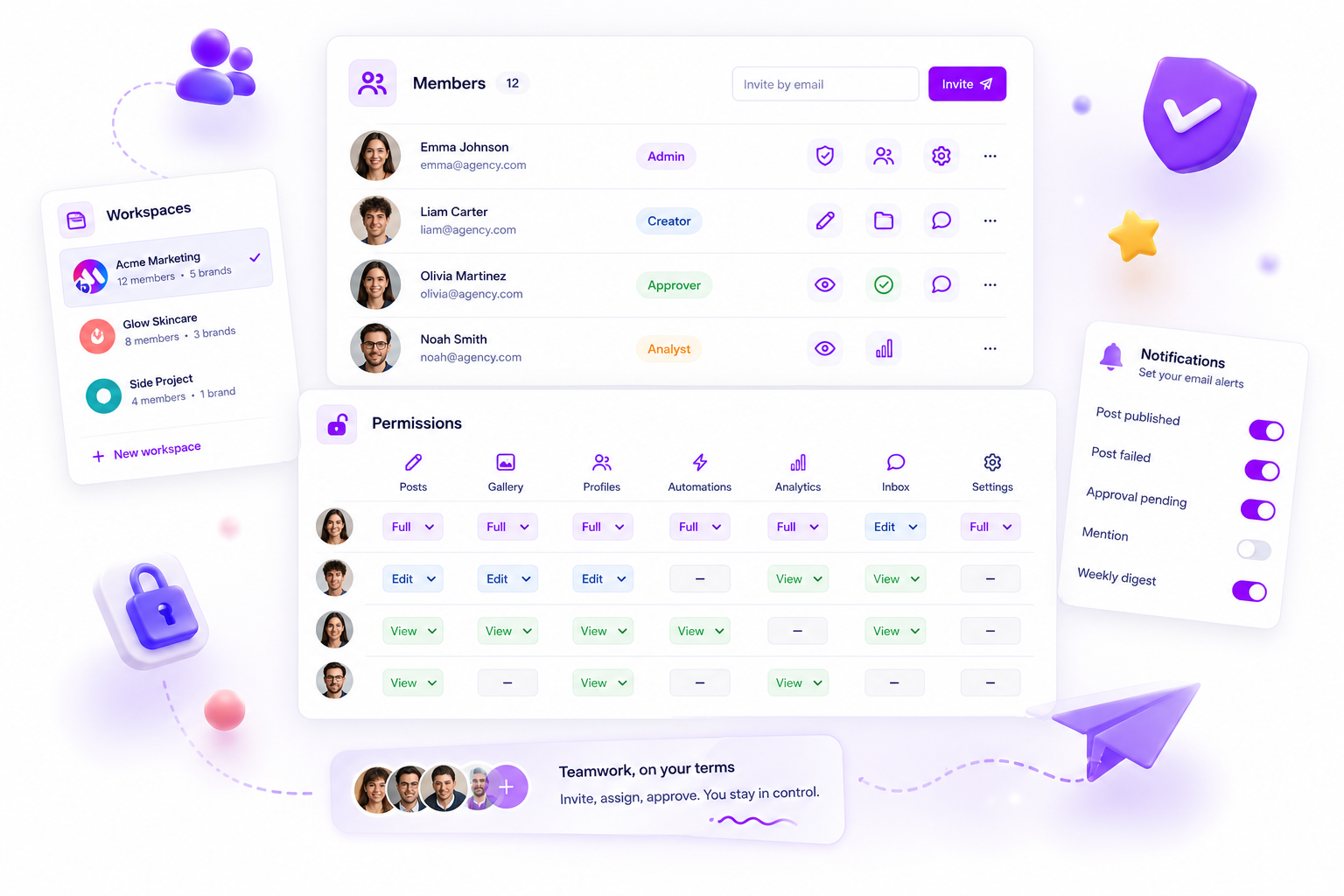
The most efficient teams stop treating access as a binary switch between full admin rights and total lockout. Instead, they map permissions to the specific tasks a person actually performs, which prevents the usual scramble where everyone ends up with more access than they need just to get their work done. When you link access to roles rather than job titles, you remove the reliance on a single gatekeeper who has to manually push every single button.
We have all been there. It is 6 p.m. on a Friday, your campaign is ready to go, but the only person who can hit "publish" is out to dinner. You are stuck, frustrated, and realizing your internal process is doing more to slow you down than the competition ever could. It is a classic trap: in the name of security, we build a system that essentially guarantees things will get stuck.
Where the handoff is actually breaking

When we look at how most marketing teams are structured, the breakdown almost always happens at the point of transition. You have brilliant creatives building assets, but they lack the keys to verify them in a live staging environment. You have analysts who understand the data perfectly, but they are stuck waiting on someone with higher permissions to extract the reports.
This friction creates a hidden tax on every single campaign.
| Potential Friction Point | The Usual Result | What Actually Breaks |
|---|---|---|
| Approval Bottleneck | Everything waits on one "Admin" | Post timing misses the peak window |
| Visibility Gaps | Teams work from outdated data | Budget is wasted on low-performing ads |
| Asset Overload | Everyone can delete anything | Shared assets get wiped by accident |
| Config Chaos | New users mess up channel settings | Profiles disconnect, requiring manual repair |
The real danger here is not malicious intent; it is accidental disruption. When someone has "just enough" access to stay dangerous-like being able to modify workspace settings or delete profiles-you are one wrong click away from a complete operational halt.
At Mydrop, we often see teams try to fix this by adding more managers, but that just creates a crowded room where nobody is actually driving. Instead of giving everyone a master key, you should define your team roles based on the specific resources they need to touch.
Operator rule: If a team member only needs to preview content, they should not have the ability to modify the workspace configuration. If they only need to analyze performance, they should not have access to the post-creation interface.
By isolating these actions, you protect the core workspace setup while ensuring that the actual creative work keeps moving forward. The goal is to make the "right" action the "easiest" one for your team to take, without giving them the power to accidentally delete the entire foundation you have spent months building.
The coordination debt checklist

Most of the time, the slow-down you feel isn't because your team lacks talent; it is because the structure you built is suffocating your output. If you feel like you are chasing down approvals at 6 p.m. or playing professional gatekeeper for every single post, it is time to audit your setup.
Use this checklist to identify where your permission structure is actively holding you back.
| Audit Point | Red Flag (High Friction) | Green Flag (Operational Flow) |
|---|---|---|
| Approval Path | Only one person can hit "Publish." | Approval roles are distributed by brand or region. |
| Asset Access | Everyone has access to every draft. | Permissions are locked to specific workspace resources. |
| Role Clarity | Team members ask "Who do I send this to?" | The workflow clearly maps roles to action stages. |
| New Joiner Setup | Onboarding takes days of "permission fixing." | Roles are assigned via clear, pre-defined templates. |
| Notification Overload | Everyone gets alerts for every single change. | Notifications are tuned to specific user needs. |
If you find yourself nodding at three or more red flags, you have likely built a "permission fortress" instead of a workflow. You have accidentally created a system where nobody can move without asking for a key, and that is a massive tax on your team’s collective brainpower.
Decision check: If your "Admin" role is performing daily tasks like drafting or scheduling, you have over-permissioned your users. Admins should handle exceptions, not day-to-day operations.
How to move decisions closer to the work
To fix the friction, you have to invert how you think about access. Instead of granting blanket rights based on seniority, assign access based on the specific actions required for the job.
In Mydrop, we see the most successful teams utilize a granular permission map to ensure people only touch what they need to touch. When you remove the ability for a creator to accidentally delete a brand profile or change a workspace setting, you don't just gain security; you gain the confidence to let them move fast.
Here is how to reorganize your team’s access for maximum velocity:
- Segment by Capability: Stop assigning "Admin" to everyone. Use role templates that distinguish between those who create, those who curate, and those who certify content.
- Standardize Action Maps: Use Mydrop to define what each role can do within a specific resource. A creator should be able to create and edit posts but have zero access to workspace settings or platform-wide integrations.
- Automate the Notification Stream: Don’t let your managers drown in noise. Encourage team members to tune their own notification settings so they only see the events that actually require their input-like an approval request-rather than every single edit made to a draft.
- Delegate the Guardrails: When you trust your leads to manage their own local approval workflows, you stop being the bottleneck. Your job transitions from "doing the work" to "validating the output."
By pushing these decisions down, you empower your team to own their part of the process. They stop feeling like they are just waiting on you to give the green light, and you stop feeling like you are the only one capable of keeping the lights on. It is a win-win that turns your social media engine from a stalled, top-heavy mess into a responsive, distributed machine.
The roles and rules that reduce rework
The most effective way to shrink your backlog is to shift from static roles to task-based access. When you pin permissions to a specific job function rather than a person's seniority, you stop the constant cycle of manual requests.
At Mydrop, we see teams that manage hundreds of profiles handle this by building a custom permission map for every new member. They don't just assign "Creator" or "Admin"; they map access to the actual workspace resources-like specific social profiles or analytics views-that person needs to do their work. This keeps the workspace clean and prevents unauthorized tweaks to global settings, which is usually where things break.
Workflow check: If a team member can break your global workflow or accidentally delete a cross-brand campaign, they are over-permissioned. Audit access based on what they must do, not what they might need to do.
This granular approach creates a predictable flow. When your creators only see the tools required for drafting and the approval team only sees the final review queue, you remove the clutter that distracts them.
The weekly habit that keeps the system honest
Permission sprawl is sneaky; it grows one invite at a time until you wake up and realize your workspace has become a security risk. You need a rhythm to prune the access list just like you prune your content calendar.
Try a simple 15-minute audit every Friday afternoon. It sounds like a chore, but it prevents the "who has access to what" panic when a partner agency cycles off your account or a team member changes roles.
The Weekly Permission Cleanup
- Active Member Review: Scan the list for anyone who has left the team or switched departments. Remove their access immediately.
- Access Level Check: Verify if anyone is still carrying "Admin" status for a project that ended last month. Downgrade them to "Read-only" or remove them.
- Notification Audit: Ensure your core team isn't drowning in irrelevant alerts. Have them toggle their notification settings so they only get the operational emails that matter to their current projects.
- Partner Handoff: If a contractor is finished with their campaign, revoke their profile access before the weekend starts.
By doing this, you turn a potential security liability into a simple administrative habit. You are not just cleaning up a list; you are ensuring that your team has a clear, distraction-free environment to work in.
Conclusion
Operational speed in social media does not come from removing all controls; it comes from putting the right barriers in the right places. By operationalizing the principle of least privilege, you enable your team to move fast without the constant fear of breaking the brand.
Most teams do not actually have a shortage of creative ideas. They have a decision blockage that slows everything down. When you map specific actions to the right team members and keep your access lists lean, you stop fighting your own tools. Your team can focus on the content that resonates, knowing the system has their back.
If you're still chasing approvals at 6 p.m., stop auditing your content and start auditing your permissions. You will likely find the extra hours you've been looking for.