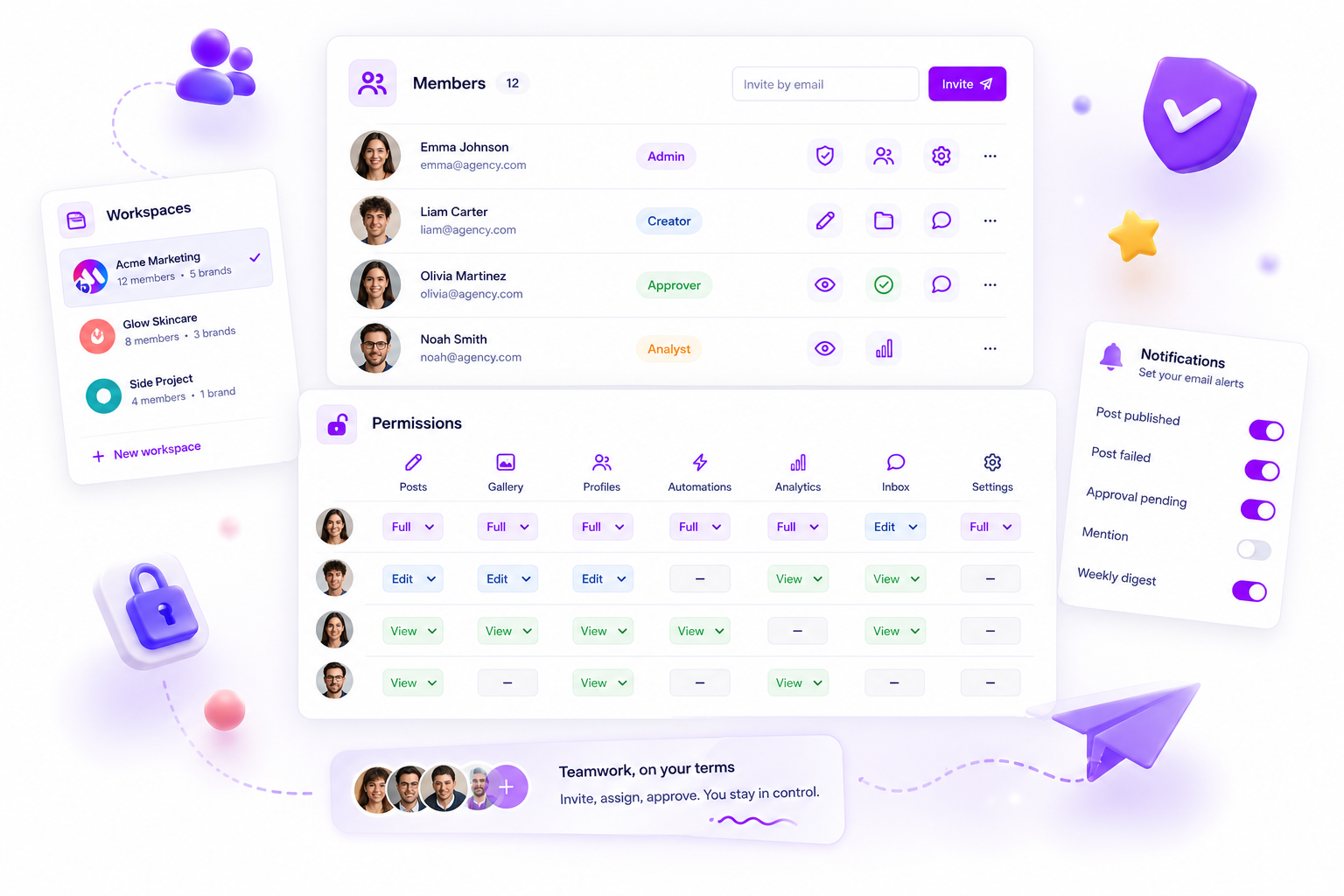
The best time to audit team permissions is not after a security incident, but the moment you onboard a new agency partner or re-align your social media reporting structure. If you cannot describe exactly what a teammate can delete or approve without checking the settings, you are already operating in a state of administrative bloat that is actively hindering your team’s velocity.
We get it-team scaling is messy, and permissions are often set to "everything" just to get the work done. But that temporary convenience quickly calcifies into a permanent workflow bottleneck where nobody knows who owns the final approval, and the legal reviewer is buried under alerts for minor edits they have no business touching.
Where the handoff is actually breaking

Most permission sprawl isn't malicious; it is a byproduct of growth without intentionality. When you have five markets, three agency partners, and a dozen stakeholders, the "Just make them an Admin" trap becomes the default. It feels faster in the moment, but it creates a world where every minor change requires a consensus-driven conversation. This is the hidden cost of coordination debt.
If your approval loop is stalling, it is rarely because your team is slow. It is because your permission architecture forces a bottleneck. When a Creator has 'approve' rights, you lose the safety of a review stage. Conversely, when a Manager is buried in low-level notifications, they stop engaging with the content that actually moves the needle.
Operator rule: If your team spends more than 10 minutes debating who has the rights to perform a specific action, your permission structure is too opaque for the scale you are operating at.
Here is how to spot the friction points before they become a crisis:
| Symptom | Hidden Cost | Diagnostic Question |
|---|---|---|
| Silent Overlap | Duplicated work/edits | Do two people frequently "fix" the same post? |
| Approval Fatigue | Missed publishing windows | Does every stakeholder get a ping for every single change? |
| Access Ambiguity | Security/Compliance risk | Can an external contractor delete a profile by mistake? |
| Notification Noise | Reduced focus on strategy | Are teammates drowning in alerts for resources they don't manage? |
At Mydrop, we designed our permission map to be granular because we know that "Creator" means something very different in an agency versus an in-house team. We have seen thousands of workflows across brands and agencies, and the teams that move the fastest aren't the ones with the most admins-they are the ones that enforce the principle of least privilege. This keeps the workspace clean, the accountability clear, and the creative throughput high.
If you are currently treating your access list like a revolving door, you are sacrificing speed for a false sense of flexibility. It is time to treat your permission architecture like the critical infrastructure it is.
The coordination debt checklist

When your team scales, permissions stop being a technical setting and start becoming a tax on your creative velocity. Every extra person with "Admin" rights is a potential point of accidental failure, but more importantly, it is a source of coordination debt. You are paying in extra meetings, redundant Slack pings, and the "who touched this?" uncertainty that kills a morning.
Run this simple audit to see if your workspace architecture is actually helping you move or just slowing you down.
| Audit Point | Red Flag (High Debt) | Healthy State (High Velocity) |
|---|---|---|
| Delete Authority | Anyone can delete a primary brand profile. | Only workspace leads can modify core assets. |
| Approval Loops | Every post requires a "manual ping" sign-off. | Roles define the path; creators draft, managers approve. |
| Access Visibility | You see inactive contractors in your member list. | Access is pruned quarterly or at project end. |
| Notification Flow | Members receive every alert for every channel. | Notifications map to the resource they manage. |
Common mistake: Granting "Admin" as a shortcut to fix a permission error. It feels like a quick win, but you are trading long-term governance for a five-minute fix that eventually forces you to redo the entire permission map from scratch.
How to move decisions closer to the work
The secret to moving faster is not removing controls; it is pushing them to the edge. You want your creators to own their drafts and your local market leads to own their approvals, without needing to escalate to the "Global Admin" group for every minor edit.
If you are using Mydrop, this is why we designed our granular permission map. Instead of relying on a rigid, top-down hierarchy that breaks the moment you add a new brand or regional team, you can assign access based on the specific resources a teammate needs-whether that is specific social groups, analytics reports, or just draft creation rights.
Here is how to reset the dial:
- Map by Role, Not by Person: Define what a "Regional Manager" or "Junior Content Creator" actually needs to do. If they do not need to delete a group, do not give them the key.
- Prune the Ghost List: If a freelancer finished a campaign three months ago, remove them. It keeps your workspace clean and minimizes the risk of someone accidentally editing a live calendar.
- Customize Notification Noise: Overloaded inboxes are a major cause of missed approvals. Encourage team members to toggle off alerts for resources they aren't actively managing.
- Delegate the Approval: If you find yourself personally approving every post for ten markets, you are the bottleneck. Assign "Approve" rights to the lead of each specific market.
At Mydrop, we often see that the best teams aren't the ones with the most restrictive settings, but the ones that have clearly defined "guardrails" for every role. When everyone knows exactly where their authority ends, you stop needing to have a meeting every time someone needs to upload a new asset.
Most teams do not have a content problem; they have a decision bottleneck. Stop treating your permissions like a static configuration and start treating them like a living part of your operating system. When you align access with actual work, the team stops asking for permission and starts shipping.
The roles and rules that reduce rework
The fastest teams we work with have one thing in common: they treat roles as a contract, not a hierarchy. When you assign someone an "Editor" or "Contributor" role, it should be an explicit agreement on exactly what that person is responsible for, not just a badge of status.
Most rework happens because of "permission ambiguity"-that silent friction where a creator isn't sure if they can hit publish, or an agency partner is afraid to touch a profile because they might accidentally delete a connection. You can stop this by aligning roles with the actual stages of your production pipeline.
Decision check: If a teammate's role description contains the word "everything," you have a bottleneck waiting to happen.
At Mydrop, we designed our permission map to be granular because we know that "Creator" means something very different in an agency vs. an in-house team. Instead of broad strokes, map your team's access to the specific resources they touch daily:
| Resource | Action | Role: Junior Creator | Role: Lead Approver |
|---|---|---|---|
| Posts | Create / Draft | Yes | Yes |
| Posts | Approve | No | Yes |
| Profiles | Read / View | Yes | Yes |
| Profiles | Update | No | Yes |
| Analytics | Access | Yes | Yes |
By stripping away the "Approve" capability from your day-to-day creators, you don't just protect the brand; you give your team the psychological safety to move fast within their lane. They know exactly where the guardrails are, so they don't have to pause and ask for permission for every minor edit.
The weekly habit that keeps the system honest
Permissions rot. Just like your content calendar, if you don't prune your workspace access regularly, it will eventually become a liability. We see agencies that have dozens of "Active" members who haven't logged in for months, each still holding keys to profiles they no longer manage.
The fix is a 15-minute Friday audit. It is not about policing; it is about keeping your workspace clean so that the right people get the right notifications.
Your Friday Permission Sweep Checklist:
- Cross-reference the roster: Are all listed members still actively working on your active campaigns?
- Update departed partners: Remove access for any agency contractor or freelancer whose project wrapped up this week.
- Check notification noise: If someone is getting overwhelmed by alerts for resources they don't manage, switch off their irrelevant notification toggles.
- Validate the resource map: Did you add a new social channel or group this week? Check that the right people can actually see and interact with it.
When you make this a standing habit, you stop viewing security as a heavy, "break-glass-in-case-of-emergency" event. It just becomes part of the operational maintenance that keeps the machine humming.
Conclusion
The goal of a healthy permission architecture isn't to lock down your team; it is to unleash them. When you stop using global admin rights as a shortcut for efficiency, you remove the guesswork from your workflow. Your creators gain the autonomy to move through drafts without fear, your approvers can focus their energy where it actually adds value, and your entire team stops drowning in accidental errors.
Start by auditing the roles of your three most active partners today. You will likely find that they have access to resources they don't need, which is currently costing them - and you - valuable time in decision fatigue. Take back that time by tightening the access map. Your workflow, and your team's sanity, will thank you.