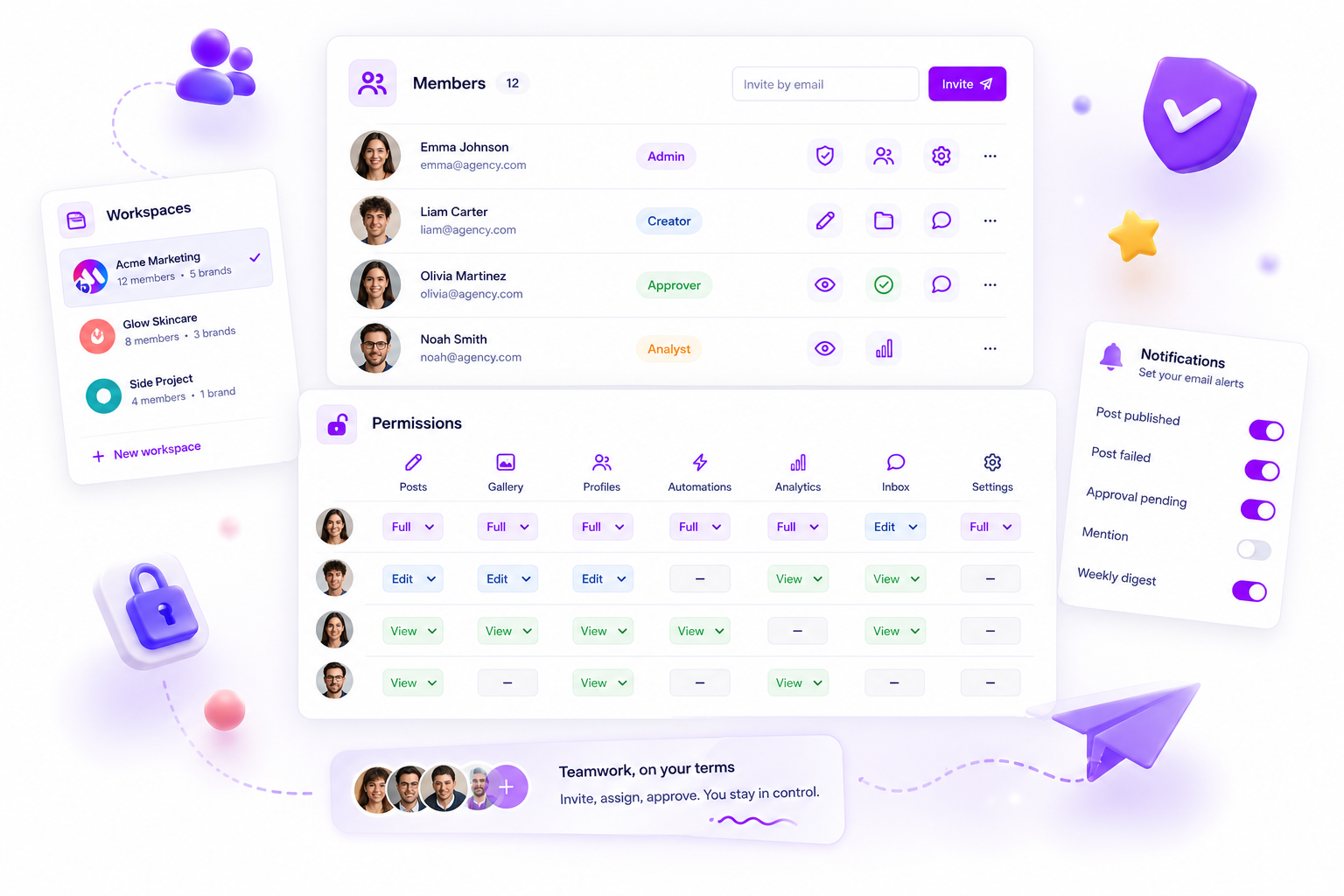
The most effective way to audit your social media permissions is to stop treating them as a one-time security setup and start managing them like a living operational asset. When you audit your team access maps, you aren't just locking doors; you are clearing the traffic jams that force creative teams to wait on managers for every minor approval. If your workflow involves chasing a stakeholder to "approve that one tweet" at 6 p.m. on a Friday, your permissions are working against your output, not for it.
We get it. You have agency partners, brand-specific creators, and freelance contractors cycling through your workspaces every week. Keeping track of who has the power to publish versus who can only draft feels like a full-time job. Most teams lose hours weekly not because of malicious access, but because of "permission creep"-where teammates retain access they no longer need, creating decision paralysis and accidental rework.
Where the handoff is actually breaking

In our experience, coordination debt rarely stems from a lack of talent. It usually stems from a mismatch between your org chart and your software settings. Teams often start with broad, open access to ensure everyone can move fast, then slowly patch on restrictions as the team grows, resulting in a fragile, confusing web of "who can do what."
Here is where the handoff usually breaks down:
- The Approval Bottleneck: Creators are blocked by managers because the system doesn't differentiate between "creating a draft" and "publishing live."
- Asset Inconsistency: A brand-specific contractor accidentally edits a profile or settings for an entirely different brand because access is set at the workspace level rather than the brand-asset level.
- Ghost Access: Former agency partners or departed team members still occupy active seats, cluttering the approval flow and creating unnecessary security risk.
- Feature Blindness: You roll out new automations or analytics tools, but your team can't use them because their existing role permissions weren't updated to include the new resource map.
When you look at your team, you shouldn't see a giant bucket of users. You should see a set of task-based conduits. At Mydrop, we see teams managing hundreds of profiles successfully not by micromanaging individuals, but by aligning their member resource-action maps to their specific brand roles.
If your team is asking "Can you approve this?" more than twice a day, your permission structure is actively shrinking your throughput. The fix is moving decisions closer to the work by granularly updating your access maps so that those who create the content can also validate it, while keeping the "big red button" for publishing locked to the right seniority level.
The coordination debt checklist

You are likely deep in coordination debt when your team’s output feels manual, repetitive, and plagued by "wait-times" that don't seem to correlate with actual content complexity. If you feel like a high-level babysitter rather than an operations lead, start here.
Check these signs. If you hit more than two, your permission architecture is actively slowing your team down.
| Symptom | The Operational Reality |
|---|---|
| The "Can you approve?" ping | You are personally approving low-risk posts because the creator lacks approve access. |
| Ghost accounts | Freelancers from six months ago still show up in your active member list. |
| Inbox chaos | You receive every single notification because your team’s notification settings aren't filtered by specific project scope. |
| Profile sprawl | Creators can see every brand profile in the workspace, even the ones they never touch. |
| Hard-coded bottlenecks | Only one person can modify settings, so every small change turns into an urgent ticket for you. |
At Mydrop, we often see teams trying to solve these issues with more meetings. But adding a meeting to fix a process problem is like trying to fix a leak by painting the wall. If your inbox is full of "please approve" requests for minor copy changes, you have a configuration issue, not a communication one.
How to move decisions closer to the work
The goal of a healthy permission map is simple: decentralize the work, but keep the governance centralized. You want creators to move fast for 90% of their day, while keeping the high-stakes "save the brand" power held by a few trusted reviewers.
Start by auditing your member roles against the task-need principle. Instead of giving everyone a broad "Manager" or "Editor" badge, map their access to exactly what their daily workflow requires. If a designer only needs to upload to the gallery and tag assets, they don't need create or approve access on the live social profiles.
Operator rule: If a team member has to ask you to perform an action more than twice in one week, they lack the correct permission mapping. Give them the access or change the workflow.
In Mydrop, this happens through granular resource action maps. Instead of a hard-coded global role that is either "on" or "off", you can customize access for each resource-posts, gallery, profiles, and automations.
Here is a sample workflow shift:
- Separate the roles: Define a "Brand Creator" role that has
createandupdaterights for drafts, but noapproveorpublishrights. - Enable self-correction: Give this role
readaccess toanalyticsso they can see how their own content performs without needing you to pull a report. - Scoped visibility: Use the member management settings to ensure they only see the profiles and groups relevant to their specific brand pod.
This setup prevents the "accidental publish" risk while removing you from the tactical minutiae of every post. The best operators spend their time building the system, not approving the individual components of it. Once your creators can manage their own drafts and view their own data, you are free to focus on the high-level strategy that actually drives the business forward.
The roles and rules that reduce rework
The best way to stop the "can you approve this?" message flood is to stop assigning permissions by generic job title and start assigning them by task-need. When you use Mydrop to build a member profile, don't just click "Manager" or "Editor" and call it a day. That is how you end up with three people who can delete your entire brand history and zero people who can fix a typo in a live draft.
Instead, look at the actual actions required for the daily grind. Does your freelance designer need to see analytics? Probably not. Does your community manager need to approve posts for a market they don't oversee? Definitely not. By mapping access to specific resource actions-like posts(approve) vs posts(create)-you align your team structure with the reality of your operations.
Decision check: If a teammate is asking for help to perform a basic action, your permissions are the problem, not their training.
Giving people just enough power to do their work-and nothing more-is the ultimate shortcut to speed. When a creator knows they can push their own work to "Scheduled" for a specific brand without an extra Slack thread or manual nudge, they stop waiting on you. They start executing.
The weekly habit that keeps the system honest
Most teams let their permission sets rot until a compliance audit forces a panic cleanup. Avoid that headache by turning your audit into a 15-minute Friday ritual. This isn't about being a micromanager; it is about keeping your workspace from becoming a digital junkyard of "ghost" accounts.
Use this simple Friday Permission Sweep to keep your team lean and your operations secure.
| Action | Check Frequency | Goal |
|---|---|---|
| Verify active seats | Weekly | Remove former contractors or agency partners. |
| Review role mapping | Bi-weekly | Confirm creators still only see their assigned brand assets. |
| Reset notification noise | Monthly | Ensure managers aren't getting alerts for brands they don't own. |
| Audit approval flows | Quarterly | Ensure new resource types (like forms or new channels) are covered. |
If you catch yourself scanning a list of fifty names and don't recognize three of them, you are already behind. Go into your Mydrop settings, clear those accounts, and breathe a sigh of relief. A clean workspace isn't just about security; it is about visibility. When you know exactly who is in the room, you stop worrying about who might accidentally break the furniture.
Conclusion
The messy truth is that your social media operations are only as fast as your least-defined approval. You can pour money into content creation and beautiful creative assets, but if your internal permissions are a tangled web of legacy access and ambiguous roles, you will still be the bottleneck.
Most teams do not have a content problem. They have a decision bottleneck.
Start by auditing who can do what this week. Move the power to act as close to the work as possible, trim the "ghost" accounts that have been lingering since the last agency contract, and enforce a rhythm that prevents the sprawl from returning. Your team will stop waiting for your thumbs-up, and you will stop feeling like the ghost in the machine. Get your permissions right, and the rest of your operation finally has the room it needs to breathe.