Stop relying on team discipline to prevent cross-brand posting; start demanding workspace tools that force brand-specific context at the UI level. If your current platform allows you to view profiles for Client A and Client B in the same global list, you are already one misclick away from a crisis. Preventing these errors requires architecting your environment to make the wrong choice literally impossible, moving far beyond the unreliable assumption that your team will always stay hyper-focused under pressure.
We have all felt that heart-stopping moment. The cursor hovers over Publish for a campaign meant for a lifestyle brand, but you are currently staring at the dashboard for a fintech client. It is the stuff of nightmares, yet it is also a statistical inevitability when your team is managing dozens of accounts under a relentless time crunch. Human error is not a lack of professionalism. It is the natural result of tools that treat your entire roster of brands as one giant, permeable sandbox.
What the best tools need to handle

When you manage multiple brands, the biggest operational threat is context blindness. You need a platform that does not just promise safety but physically enforces it through your daily workflow. The best tools understand that if you have to choose between two brands in a dropdown, you have already created an opportunity for a high-stakes mistake.
Look for platforms that prioritize persistent brand isolation over flexible, all-access navigation. You need a system that anchors every action, from content creation to report scheduling, within a single, locked-in brand environment.
The Brand Safety Checklist
Use this rubric to audit your current social media management tool. If you check No for more than two of these, your operation is likely leaking risk.
| Feature Requirement | Why It Matters |
|---|---|
| Hard-Locked Focus Mode | Prevents navigating to or posting from any brand outside the current session. |
| Per-Member Persistence | Allows teammate A to work on Client A while teammate B works on Client B without interference. |
| Automatic Profile Scoping | Dynamically includes new profiles into the lock automatically; no manual refreshes. |
| UI-Level Suppression | Entirely removes non-relevant brand assets, reports, and profiles from the sidebar and search. |
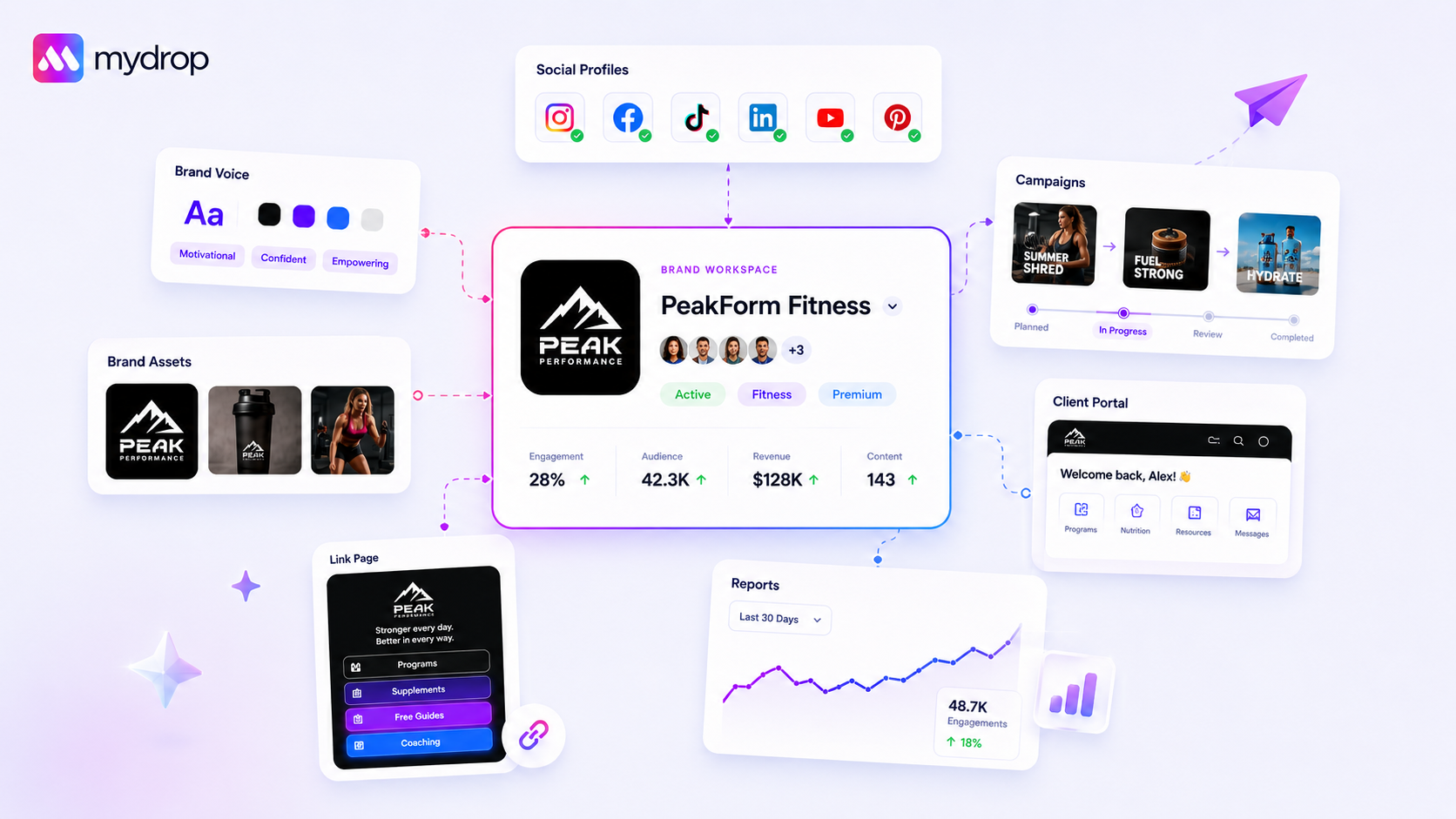
When you enable a feature like Mydrop's Brand Lock, you are not just adding a filter; you are fundamentally changing the workspace architecture. It creates a dedicated sandbox for the selected brand, ensuring that every selector, dashboard, and analysis tool only pulls data from that specific context. This is not about restricting access; it is about reducing the cognitive load on your team so they can move fast without needing to constantly triple-check their destination.
Most teams do not have a content problem; they have a decision bottleneck. When your tools force you to constantly toggle back and forth, you increase the likelihood of fatigue-driven errors. The goal is to move from a trust but verify model to an impossible to fail architecture.
Where basic tools start to break

Most social tools were built for a world where you manage maybe two or three accounts. That is not your world. When you manage a complex portfolio, the everything-everywhere dashboard becomes a trap.
It works fine until the afternoon slump hits, or when you are rushing to get a campaign live for five different clients at once. That is when your brain starts auto-filling information, clicking the first profile that looks familiar, and suddenly, you are looking at the wrong account entirely.
This is UI fatigue, not a lack of diligence. Most platforms handle this by relying on human attention, giving you a master dropdown that lists every single profile your team manages. The problem? That list is a minefield. You are forced to scan, filter, and remember which profile belongs to which brand, every single time.
In our experience at Mydrop, we see teams that have built elaborate internal spreadsheets or complex naming conventions just to compensate for the fact that their software treats all accounts as one big, undifferentiated blob. If you are relying on your team to remember to switch contexts, you are building a process that is designed to fail.
The buying criteria that matter
If your goal is to make the wrong choice impossible, you need to demand more than just search## Where basic tools start to break
Most software handles multi-brand management by giving you a giant, "flexible" list of every profile you have access to. It sounds convenient-you can jump from your tech client to your lifestyle brand with one click. But this is exactly where the trouble starts.
When your UI treats every profile as equally accessible at all times, it relies entirely on your brain to keep the contexts straight. That works for a quiet afternoon. It fails completely on a Tuesday at 4 p.m. when you have twenty tabs open, a Slack notification pinging, and a high-stakes campaign deadline looming.
In our experience, these "flexible" tools suffer from context-bleeding, where the master dropdown becomes a minefield of near-identical names. Your team isn't making mistakes because they are careless; they are making them because the interface doesn't physically distinguish between Brand A and Brand B during the critical path of creation.
| Vulnerability | Why it fails under pressure |
|---|---|
| Global Profile Dropdowns | The "master list" approach exposes every profile to every click, maximizing the surface area for a mis-selection error. |
| Uniform UI States | When the interface looks the same regardless of which brand you are handling, you lose the visual cue that you have switched contexts. |
| Search-Based Access | Relying on typing a name to find a profile creates a bottleneck where a typo or a partial match can pull up the wrong client's account instantly. |
| Flat Permissions | If your tool only separates by user access, you have zero safety once someone is inside the workspace. Every authorized user is one wrong click away from a public embarrassment. |
The buying criteria that matter
Stop evaluating tools based on how many profiles they show in a list and start looking for how effectively they restrict your field of view. When you are auditing platforms, use this scorecard to measure if a tool is built for scale or just built for convenience.
The Brand-Safety Scorecard
Use this to pressure-test your current setup or any vendor you are considering. If a tool fails more than two of these, it is a high-risk liability for a growing agency.
| Criterion | What you need to see | Why it matters |
|---|---|---|
| Physical Isolation | The UI must hide unauthorized profiles entirely. | If you can still see it, you can accidentally click it. |
| Persistent Focus | Selection must persist through page refreshes. | Prevents "session drift" where the UI resets to an all-profile view. |
| Dynamic Membership | New profiles added to a brand automatically enter the lock. | Stops you from having to manually "update" the lock every time a campaign expands. |
| Per-Member Context | Teammates must be able to lock to different brands simultaneously. | You shouldn't have to wait for someone else to finish to work on your own client. |
At Mydrop, we designed Brand Lock to solve this precisely because we saw teams getting burned by the "everything, everywhere, all at once" interface pattern. It doesn't just filter the list; it removes the irrelevant profiles from the entire app experience. When you turn on Brand Lock, the sidebar, the selectors, and the main dashboard effectively stop existing for anything other than your selected brand.
Operator rule: If your team can still see a profile they shouldn't be posting to, you haven't fixed the risk. You’ve just hidden it behind a filter they can turn off.
Ultimately, real governance isn't about setting stricter permissions that annoy your team; it’s about making the right choice the easiest one to make. Architecture beats discipline every time.
How Mydrop supports this workflow
At Mydrop, we built Brand Lock because we saw too many teams treating "don't post to the wrong account" as a training issue rather than a structural one. You can train your team until they are perfect, but at 4 p.m. on a Friday during a crisis, they are still human. We designed Brand Lock to shift the burden of safety from the human operator to the application architecture.
Brand Lock functions as a physical UI gatekeeper. When you enable the feature in your workspace settings, the entire interface transforms. A dedicated, always-visible brand selector appears in your sidebar, and the moment you lock onto a brand, everything else simply disappears from view. It is not just hiding a few menu items or adding a filter layer; the profiles selector, the calendar, the analytics dashboard, and even the automation triggers shrink down to only show the accounts belonging to your selected brand.
Decision check: If your team members are constantly switching tabs or scrolling through massive lists to manage different accounts, you are paying a hidden tax in cognitive load and error risk.
This focus is persistent at the individual level, which is a major win for larger teams. If you are managing the enterprise fintech brand, your workspace is locked to that brand. Meanwhile, your colleague in the same workspace can be focused entirely on a different client. It saves you from the "flat list" trap, where you scroll through dozens of accounts hoping to click the right one, creating that lingering anxiety before you hit 'Publish'.
The most powerful aspect, however, is the dynamic nature of the lock. You do not just create a frozen snapshot of profile IDs. When you lock onto a brand group, any new profiles you add to that brand later-perhaps because you just launched a new regional channel or added a TikTok account-are automatically included in your view. You do not have to remember to update your focus. It just works, ensuring that your safeguards scale automatically as your portfolio grows.
A simple shortlist checklist
Before you sign your next contract for an agency management platform, run this quick check. If the answer to any of these is "no," you are inheriting operational risk that will eventually cost you a client or a reputation.
- Structural Isolation: Can I physically isolate a brand's entire context-profiles, posts, and reports-within a single, persistent session?
- UI Enforcement: Does the UI force me to select a brand context before I can even see a 'Create' or 'Publish' button, making accidental cross-brand posting a literal impossibility?
- Dynamic Membership: If I add a new profile to a brand next month, does it automatically show up in my 'locked' brand view without manual reconfiguration?
- Personal Persistence: Can my team members set their own personal focus context, allowing teammates to work simultaneously on different brands without interfering with each other?
- Downstream Filtering: When I select a brand, does it filter everything-not just the profile selector, but analytics, intelligence reports, and scheduling calendars?
If your current tool relies on "careful selection" from a master dropdown list, you are operating with an structural vulnerability.
Conclusion
The best way to stop cross-brand posting is to make the wrong choice literally impossible.
When you stop relying on team discipline and start demanding workspace architecture that enforces boundaries, you buy yourself more than just safety. You buy peace of mind. You allow your team to stop worrying about clicking the wrong button and start focusing entirely on the craft of the work itself. Most teams do not have a content problem; they have a decision bottleneck, and adding friction to the publishing process is the only way to clear it.
If your agency or brand operation has scaled past the point where a single, unmanaged list of profiles makes sense, do not wait for the inevitable mispost to change your stack. Fix the architecture, and the errors will vanish on their own.