You should enable Brand Lock the moment your team spends more time verifying account selection than they do editing a caption. If your creative leads are treating the account-picker like a high-stakes bomb defusal-triple-checking every toggle before they dare hit schedule-you have already outgrown your current setup.
We get it. The everything-everywhere dashboard is a seductive illusion of efficiency. It feels powerful to see your entire empire at once, but that persistent, low-level anxiety of checking which brand you are logged into drains the creative energy your team is actually paid for. You are not hiring strategists and designers to be better at clicking the right box; you are hiring them to be better at storytelling.
Where the handoff is actually breaking

The account selector is the most dangerous user interface element in your stack. It is a deceptively simple dropdown that acts as a gatekeeper to your entire reputation. In a high-volume shop, this component creates a persistent friction point where technical capability and human focus collide.
Here is why that single, unified list of profiles becomes a liability:
- Visual fatigue: When you support dozens of disparate accounts, they all start to look identical in a flat list. Your brain glosses over the labels during a late-afternoon rush.
- Contextual spillover: A brief written for a luxury retailer is fundamentally different from a tone-of-voice guide for a discount grocer. When they live in the same unshielded workspace, the mental context switching is not a minor task; it is a full-scale cognitive reload every five minutes.
- The "Assume-by-Default" trap: Most users rely on visual memory to find their account. When you add a new profile or reorganize your groups, muscle memory leads to the wrong selection.
In our experience across hundreds of brand profiles, the failure is rarely a lack of diligence. It is a failure of environment. When the workspace shows you everything, you are forced to filter out the irrelevant noise yourself every single time. That is an unnecessary tax on your team’s mental capacity.
At Mydrop, we see this breakdown most often when teams reach a certain scale of "active brand switching." You are likely in the danger zone if your team meets these criteria:
| Threshold | Indicator |
|---|---|
| Account Diversity | You manage more than three distinct brand identities. |
| Operating Rhythm | Your team produces posts for multiple brands in the same session. |
| Error Frequency | You have had at least one "near-miss" in the last quarter. |
| Task Velocity | You are running more than twenty content cycles per week. |
Operator rule: If your team has to ask "Wait, am I in the right brand?" even once a week, you have a broken operating boundary. Automate the safety zone so your team can focus on the work, not the navigation.
The coordination debt checklist

Most teams treat "attention to detail" as a personal virtue, but in high-volume social operations, it is actually a systemic design requirement. If your team is relying on human willpower to ensure the right content hits the right account, you are one bad morning away from a public relations nightmare.
Run this audit against your current weekly operations to see if you are operating on a foundation of luck rather than a structured process.
| Diagnostic Question | If you answer YES, you are... |
|---|---|
| Do you have a "pinned" post in your team chat warning everyone which brand is currently active? | Operating with a high-risk manual handoff. |
| Has any team member accidentally posted a creative asset to the wrong brand in the last quarter? | Paying a steep, recurring price for lack of guardrails. |
| Are your community managers constantly checking the top-right profile icon before hitting 'Reply'? | Draining cognitive bandwidth on trivial verification. |
| Is your reporting process slowed down by having to manually strip out "leaked" data from other brands? | Introducing unnecessary friction into your analytics workflow. |
| Do you have a "triple-check" culture rather than a "trust the platform" culture? | Forcing your best people to act as glorified quality-assurance bots. |
If you answered yes to more than two of these, your current workflow has hit its limit. You are essentially paying for human vigilance that eventually fails. It is time to replace that fragile "manual check" habit with a permanent, system-level focus.
How to move decisions closer to the work
The most effective way to eliminate these near-misses is to push the safety boundary directly into the workspace. Instead of forcing team members to constantly toggle through an endless list of accounts, you should empower them to establish their own visual and operational focus.
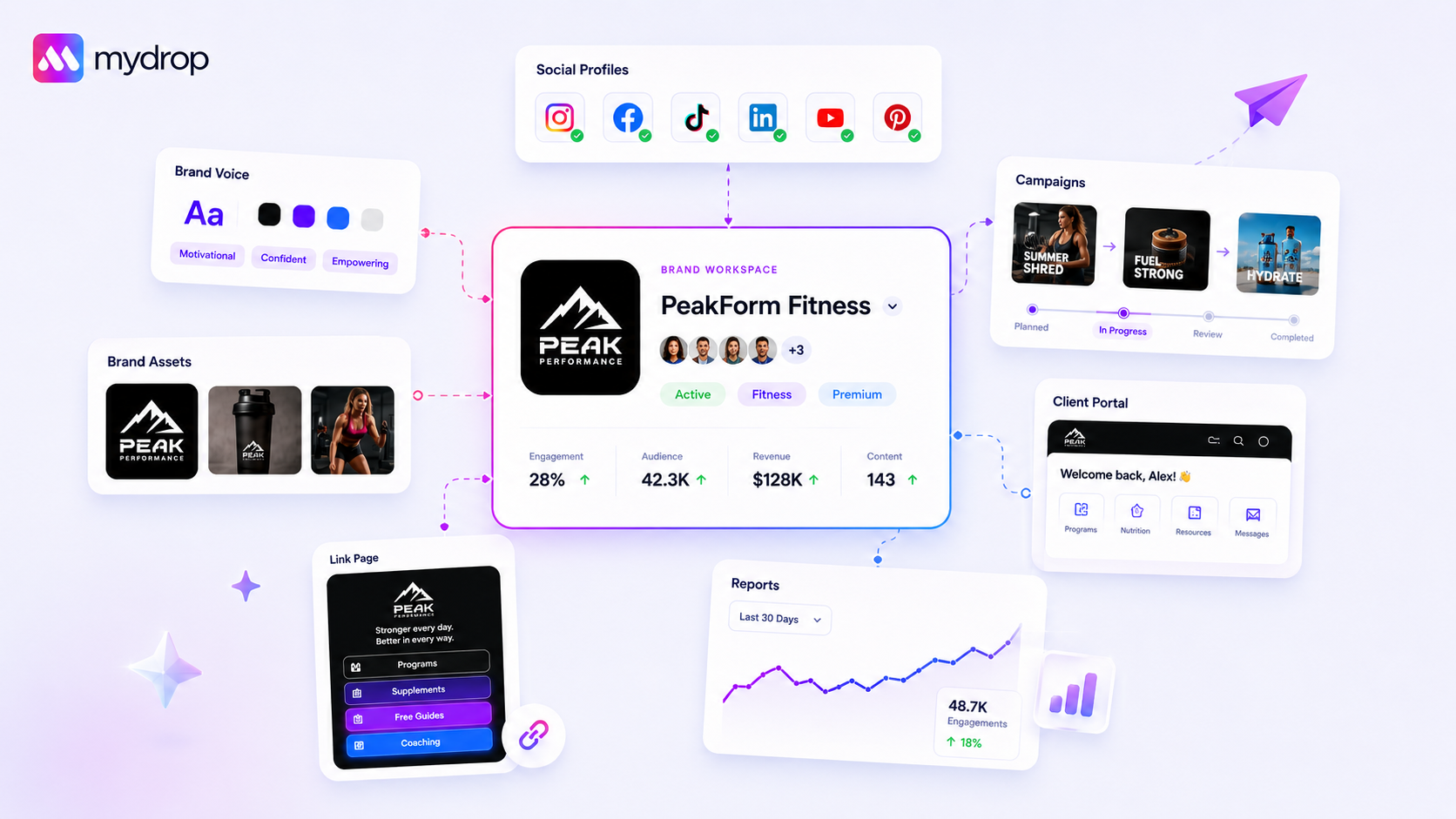
When you use Brand Lock to isolate a specific brand, you aren't just cleaning up a sidebar. You are carving out a cognitive safety zone. Every selector, calendar view, and reporting loop automatically masks data for brands you aren't working on right now.
Decision check: A workspace should only ever show the data relevant to the task currently at hand. If your dashboard shows more than the context you are managing, you are creating a workspace that is designed for distraction.
At Mydrop, we see teams achieve a new level of flow once they make this shift. Because selection persists per person, a creative lead can lock into a flagship brand for a deep-work session, while a community lead monitors a local market account in the same workspace without the two contexts ever bleeding together.
This removes the pressure to be a "perfect" operator. By narrowing the scope of what is visible, you effectively lower the risk surface area to zero. When you add a new profile to a locked brand, it rolls into that context automatically, keeping the focus sharp without requiring constant admin maintenance.
You are effectively trading manual anxiety for built-in, predictable safety. You stop asking your team to be vigilant and start trusting the environment to keep them on the right path. It is a subtle shift, but it is the difference between a team that is constantly bracing for an error and a team that moves with actual speed.
The roles and rules that reduce rework
The real secret to high-output teams is not hiring people with superhuman focus; it is designing a workspace where they cannot accidentally drift. If you force your designers or community managers to rely on constant self-correction, you are effectively paying them to double-check their own cursor placement rather than refine your creative strategy.
We have found that the most reliable teams treat focus as a structural choice rather than a personal virtue. By shifting responsibility from the individual to the workspace configuration, you free up the mental bandwidth required for actual creative work.
Workflow check: If your team members are spending more than 5 minutes a day filtering account lists or clearing alerts to find their relevant brands, your workspace is currently working against them.
At Mydrop, we see that per-member persistence is the missing link here. When a user locks their view to a specific brand or portfolio, that state should live with them, not the whole team. This allows your community lead to be fully immersed in the daily engagement loops of one brand while your campaign manager tracks analytics for another, without either of them colliding with the other’s workspace.
The weekly habit that keeps the system honest
A technical guardrail is only as good as the process wrapped around it. If your team is constantly rotating between brands, you need a recurring checkpoint to ensure your digital environment reflects your current priorities.
Most enterprise teams we work with fall into the trap of "set it and forget it," which leads to confusion when a new campaign launches or a profile changes hands. Make it a ritual to align your workspace state with the week ahead.
Weekly Alignment Checklist
Use this 5-minute Monday sync to ensure your team is set up for success:
- Clean Slate Audit: Have each team member clear their current focus and re-select the brands they are actively working on for the next 72 hours.
- Onboarding Check: Are there new profiles added to the portfolio? Ensure they are correctly mapped to their respective brand groups so they show up automatically in the correct locks.
- Threshold Review: If a team member feels they are "context switching" too much, check if their current locked scope is too wide. Sometimes, narrowing to a single campaign rather than an entire brand is the fix.
- Visibility Sync: Confirm that sensitive brand accounts are properly scoped. If a team member is moving to a project that requires a different set of permissions, verify their access levels before they apply their new workspace focus.
- Report Validation: Ensure that your analytics reports are pulling from the correct brand-context filters.
By making this a quick, repeatable habit, you stop viewing settings as a one-time setup and start treating them as part of your team's tactical gear.
Conclusion
The goal is to get to a point where your workspace is invisible. When your team can move from strategy to execution without that split-second hesitation of Am I in the right dashboard?, you have finally moved past the friction that holds back so many modern marketing organizations.
Stop hiring for "attention to detail" when you could be designing for operational safety instead. The best way to keep your brands separate is to make the separation the default state of your tools. By enforcing focus through workspace boundaries, you stop the leakage, remove the repetitive stress, and give your team the quiet they need to actually do their jobs.
It is time to stop apologizing for your team's mistakes and start building a platform that makes them impossible.