
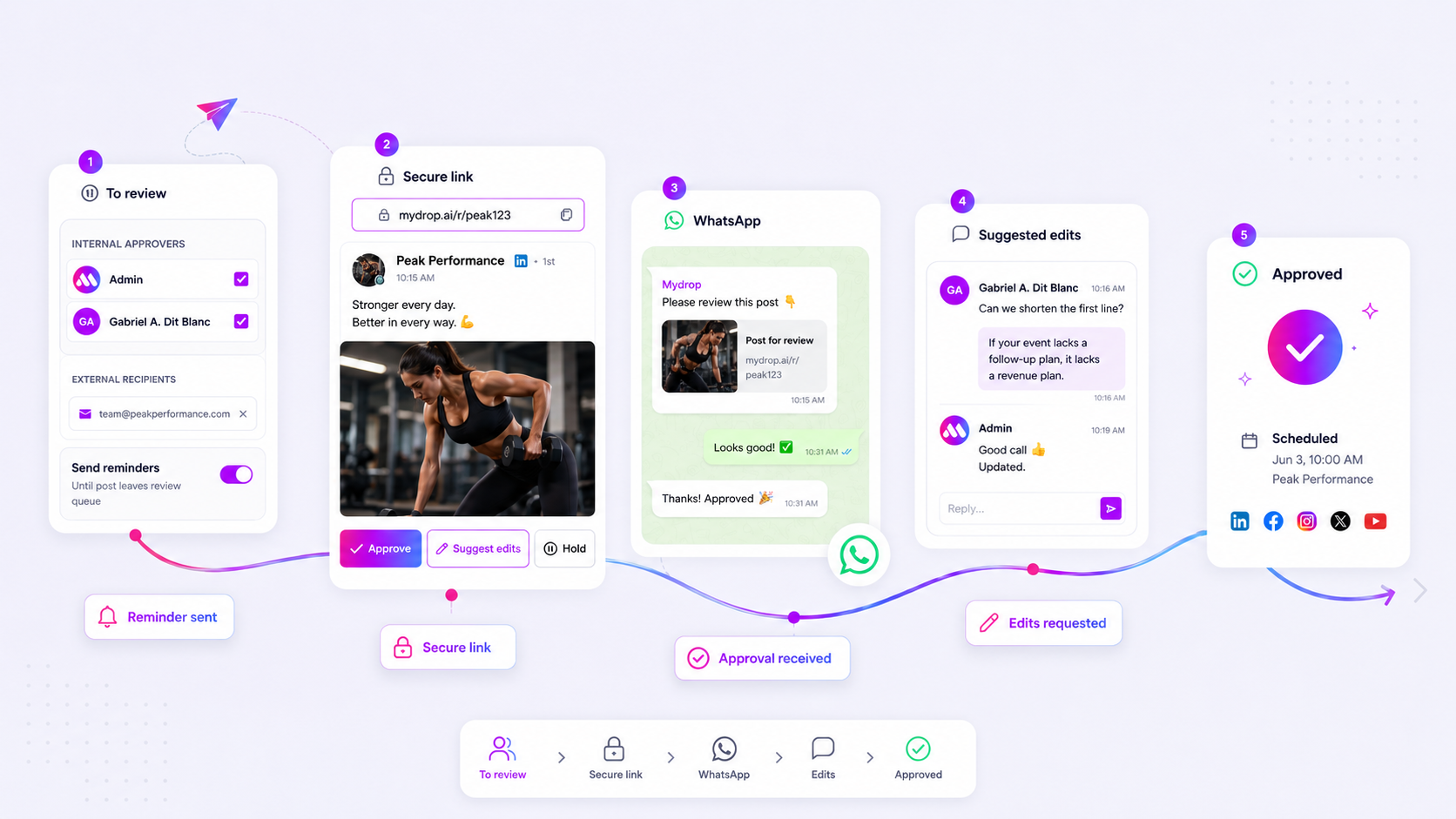
The fastest way to break a campaign bottleneck is to stop treating approval as a series of administrative tasks and start treating it as a state-based system. If your process requires a login, a chain of long email threads, or manual Slack pings, you have not built a workflow; you have built a digital waiting room that drains your team's energy.
We get it. You have a high-performing creative team, but every piece of content feels like it needs a dozen "Okay" stamps before it can go live. It is the messy, soul-crushing middle of marketing that turns a two-day campaign into a two-week marathon. You are stuck in a loop of chasing feedback while the content becomes increasingly stale.
To move from waiting to scheduled, you must replace those manual, email-dependent sequences with tokenized links and clear permission states.
Where the handoff is actually breaking

When a post leaves the creator's desk, it often enters a black hole. The breakdown usually happens because the review step is decoupled from the content management system. If your team has to export a preview, attach it to an email, and wait for a reply, you have introduced three points of failure: lost context, fragmented feedback, and the dreaded "Who has the latest version?" paradox.
Most teams assume the issue is a lack of communication. In reality, the issue is structural friction.
Here is how the common manual approach stacks up against a state-based system, like those we often see integrated in Mydrop.
| Metric | The Email Chain | The State-Based Portal |
|---|---|---|
| Access | Requires login or file attachment | Tokenized, instant web link |
| Feedback | Scattered across Slack/Email | In-line suggested edits |
| State | Ambiguous (Pending vs. Ready) | Locked (Pending until Approved) |
| Cycle Time | 24 to 72 hours (on average) | Under 4 hours (typical) |
The email chain invites the "approver's paradox." When you loop in six stakeholders on a single email, no one feels individually responsible for the final output. They assume someone else will do the deeper review. This is why you end up with "looks good to me" replies that miss obvious errors, only to have a senior leader catch a typo ten minutes before the campaign launches.
Decentralizing the review while centralizing the state is the only way to scale. You need a setup where the review link is sent directly to the stakeholder-via WhatsApp or a direct portal-without requiring them to log into your primary system. This keeps the review fast, mobile-friendly, and tied directly to the post.
Operator rule: Never move a post to a "Scheduled" status until the system receives a hard "Approved" signal. If a creator lacks approval permissions, the post should remain in a persistent "Pending" state, effectively forcing the review rather than hoping for it.
When you remove the friction of logging in and consolidate feedback into the preview itself, you stop chasing people and start managing outcomes. The goal is to make the review feel like a natural extension of the creative process, not a barrier to it.
The coordination debt checklist

When your review process relies on informal pings and scattered threads, you are likely accumulating hidden friction that slows down your entire marketing machine. Use this scorecard to audit your current state. If you answer yes to more than two of these, your current process is the primary reason your campaigns are stalling.
| Audit Item | Why it signals trouble |
|---|---|
| Email threads exceed 5 replies | Feedback is getting buried, and context is being lost in long scrolls. |
| Logins are required for reviewers | Friction at the point of action kills urgency; stakeholders will simply delay. |
| Approval status is ambiguous | You are guessing if a post is "ready" or just "reviewed by one person." |
| Feedback is out-of-band | Comments in Slack or email are disconnected from the actual visual asset. |
| Reminder pings are manual | If a human has to remember to chase approval, the process isn't automated. |
If these symptoms feel familiar, you are paying a high price for a process that feels like work but produces nothing. We see this across hundreds of brands: the effort spent chasing down a "thumbs up" often exceeds the time it took to create the content itself.
How to move decisions closer to the work
The most effective way to stop the cycle of endless waiting is to strip away every layer of friction between the asset and the decision. You want to bring the review directly to the stakeholder-whether they are sitting at a desk or checking their phone on the go-and ensure the post state reflects that reality immediately.
When you move from email chains to tokenized approval portals, you change the behavior of your stakeholders. Instead of navigating a complex interface or digging through an inbox, they receive a direct, secure link to a live preview. At Mydrop, we see teams slash their turnaround time by routing these requests via WhatsApp or email, allowing approvers to tap a button to sign off or request specific edits instantly.
This transition requires clear rules of engagement:
- Decentralize the review: Use public-facing links that require no account access, ensuring your stakeholders-be they legal, brand leads, or external clients-can view the exact post, including media and platform-specific formatting, without a barrier to entry.
- Centralize the state: Keep## The coordination debt checklist
When your approval process lives in scattered email threads, Slack pings, and version-controlled spreadsheets, you are likely paying "interest" on every piece of content. You might not see it on a P&L statement, but it shows up as missed cultural moments, fatigued creative teams, and high-stakes compliance errors.
Use this scorecard to diagnose if your current setup is quietly draining your team's momentum. Score each item 0 (we do this well) to 2 (this is a constant battle).
| Friction Point | Signal | Impact Score (0-2) |
|---|---|---|
| Authentication Barrier | Reviewers must log in or request account access just to see a draft. | |
| Feedback Dispersion | Comments live in email, Slack, and Word docs simultaneously. | |
| Visibility Gap | Stakeholders can't see the full visual context of the post or profile. | |
| Manual Pushing | The creator must manually ping an approver to nudge a pending post. | |
| Role Ambiguity | Anyone can "suggest," but no one is explicitly authorized to "finalize." |
How to interpret your score:
- 0-3: You have a stable operating habit.
- 4-7: You are losing hours of billable or productive time every week to administrative friction.
- 8-10: Your workflow is a bottleneck. You are likely sacrificing post quality just to get the approval chain to close.
How to move decisions closer to the work
The most effective teams treat the approval stage as a clear, state-based system rather than a conversation. Instead of chasing stakeholders through three different communication apps, you want to bring the decision to where they are already working, while strictly locking the post state to Pending until the final sign-off is received.
At Mydrop, we see the highest-performing teams stop the "ping-pong" effect by using tokenized, link-based portals. These portals allow an external stakeholder to review the exact post, media, and profile preview without needing a single login. When that stakeholder is mobile, they can even handle the review via WhatsApp, tapping a button to approve or request an edit.
Decision check: Never ask a senior stakeholder to log into your CMS to review a post. If they have to download an app or remember a password, they will treat the request as a task to be deferred, not an action to be taken.
By decoupling the review process from your internal CMS, you achieve three things:
- Reduced cognitive load: The reviewer sees only the post and the decision buttons.
- Centralized feedback: Any suggested edits flow directly into the post conversation, eliminating the need to search through Slack threads.
- Automatic progression: Once the approver clicks "Approve," the post state shifts from
PendingtoScheduledwithout a single manual touch from your team.
This structure forces a clean handoff. If the post is Pending, the creative team knows exactly where it sits in the queue and who is holding the key. You aren't just speeding up the process; you are establishing a repeatable, high-reliability habit that protects your team from the chaos of last-minute scramble.
The roles and rules that reduce rework
The reason so many campaigns feel like they are stuck in quicksand is usually a lack of clear ownership. When you send a draft to a group of five people without defining who actually holds the veto power, you get feedback designed to please everyone-which inevitably pleases no one.
The fix is surprisingly mechanical: explicit state-based permissions.
In our experience, the most resilient teams treat "Approved" as a hard, system-level flag, not a casual email reply. If a content creator does not have explicit authorization to push a post to "Scheduled," they shouldn't be able to bypass that gate. This creates a clear, binary status for every piece of work. Either a designated stakeholder has signed off, or the post stays in the queue.
By using systems like Mydrop, where we bake these roles directly into the post state, you remove the guesswork. The post simply cannot go live until an approved user flips the switch. This forces a culture of accountability. When people know their approval is the literal key to the lock, the quality of their feedback improves-they stop suggesting minor tweaks just to feel involved and start focusing on compliance and strategy.
The weekly habit that keeps the system honest
Even the best workflows rust if they aren't maintained. You need a simple, recurring ritual to flush the system and ensure nothing is trapped in a state of purgatory.
Every Friday, spend 10 minutes performing a "bottleneck sweep" using this simple operational cadence.
| Stage | Action | Success Threshold |
|---|---|---|
| Clear | Identify pending items older than 48 hours. | Zero items > 48h pending. |
| Query | Pinpoint why they are stuck (e.g., missing sign-off). | Assign a single accountable owner. |
| Nudge | Use automated reminders to prompt late reviewers. | Completion within 24h of nudge. |
| Archive | Purge or archive expired campaigns. | Clean calendar view for next week. |
Workflow check: If a post has been sitting in "Pending" for more than three days, it is effectively dead. Don't waste time fixing it-archive it and move the team to the next priority.
This keeps your dashboard clean and forces you to confront the reality of your team's throughput. If you find yourself doing this every single Friday, you aren't just managing social media; you are actively trimming the friction that keeps your team from doing their best work.
Conclusion
At the end of the day, your campaign performance is gated by how fast you can make decisions, not by how many hours your team spends inside the editor. If you replace the endless back-and-forth threads with a structured system where roles are clear and the state of a post is always visible, you stop chasing approvals and start executing on strategy.
Real efficiency for large teams isn't about working harder; it is about building a system that makes the right process the only path. Take the time to audit where your handoffs are breaking, set those hard permissions, and start treating your approval flow as a core piece of your technical infrastructure. Once you do, you might find that you actually have the time to dream up the next campaign, instead of just trying to get the current one out the door.