
The bottleneck slowing down your social media calendar is not your client, your stakeholders, or a lack of creative vision. It is the delivery method. When your review process relies on long, disjointed email chains, every round of feedback accumulates a silent operational liability that compounds over time. This makes even a simple, three-day content schedule drift into obsolescence before it ever hits the feed.
We have all felt that familiar, sinking sensation when 5 p.m. hits and your calendar is still full of "pending" statuses. Instead of focusing on your next campaign, you are playing detective, digging through sent folders to track down a single "looks good" reply. It is exhausting, it feels like constant firefighting, and it makes your best work feel like a slog. The good news is that you do not have to live in this state. You can swap the fragmented inbox hunt for a unified, high-velocity review loop.
Where the handoff is actually breaking

When feedback lives inside a thread, it is effectively invisible. The moment you press send on an email, the context starts to leak. Images get detached, file versions become ambiguous, and the original, approved intent becomes lost in a sea of reply-all noise.
In our experience, teams managing dozens of brand profiles often see the same failure patterns repeat. The context switching tax is what kills your momentum-the mental energy spent jumping from your planning tool to your inbox just to verify if an image was approved or if a caption was tweaked.
Here is how the breakdown usually manifests:
- Version Drift: You attach a draft to an email, but the client saves a local copy, edits it, and sends it back. Suddenly, you are managing three different versions of the same file.
- The "Black Hole" Effect: An urgent feedback request gets buried under 50 other emails. The client forgets, your post misses its slot, and the entire calendar shifts.
- Approval Ghosting: There is no formal way to see if a stakeholder has even opened the request, forcing you to send follow-up emails that feel more like pestering than professional collaboration.
Common mistake: Using email subject lines like "RE: RE: RE: Campaign Launch" to track project status. If you are searching for approval as a keyword in your inbox, you are already behind.
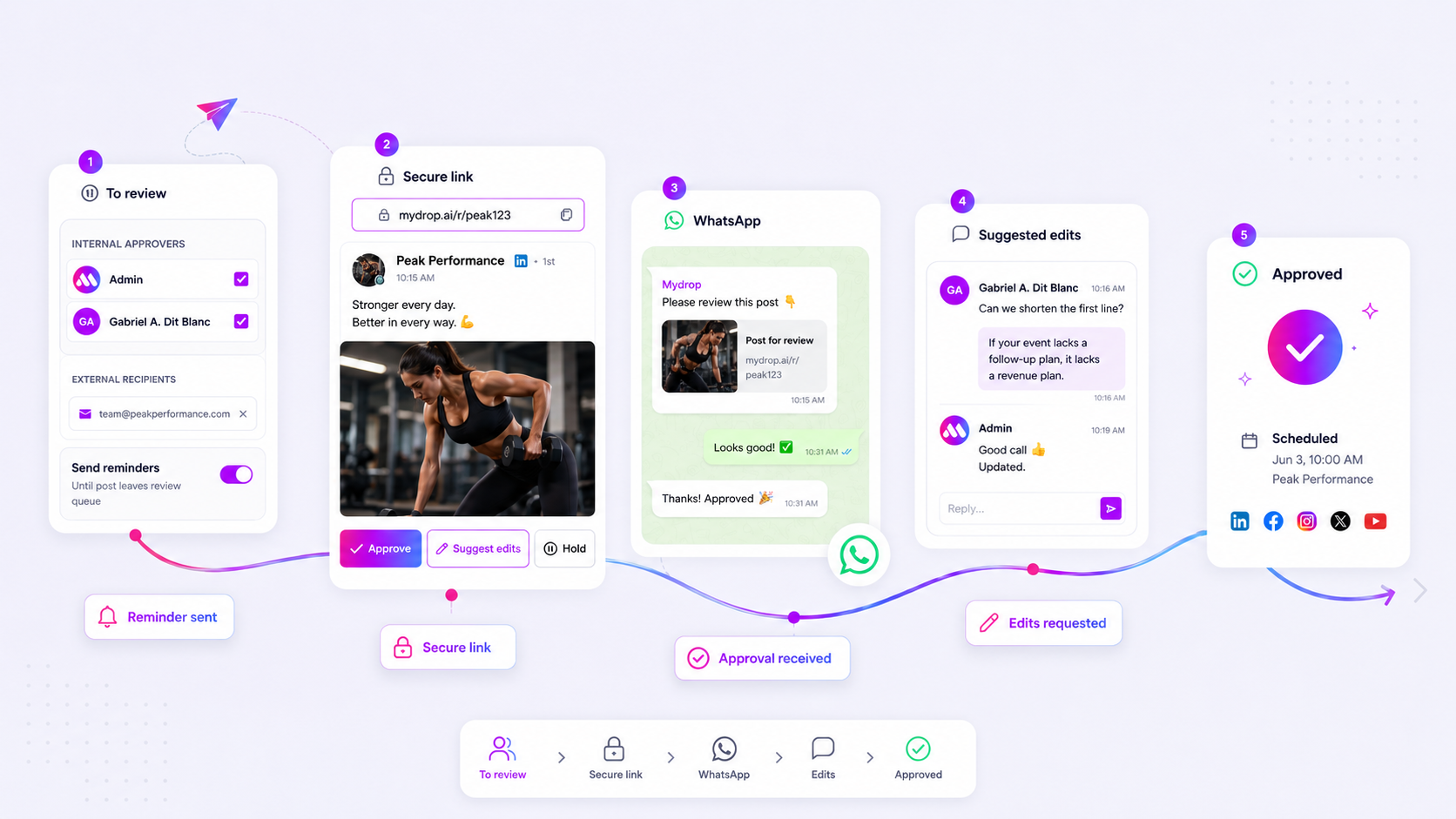
When decisions are disconnected from the work, they become isolated tasks rather than a natural part of the publishing flow. Teams that succeed here bring the decision to the asset. By using a centralized portal-like the ones we see in Mydrop-clients review the post as it will actually appear, complete with media and profile context, all without needing to remember another password. This turns a multi-day delay into a fifteen-minute, final-confirmation step.
The coordination debt checklist

Most of us treat feedback loops as an informal conversation, but that approach is exactly why your team feels like it is constantly putting out fires. When you hunt for approvals in your inbox, you are not just losing time; you are actively creating a backlog of unresolved tasks that multiply every time a thread branches.
If you are not sure if your current process is healthy, this checklist might be a reality check. If you answer "yes" to more than three of these, your current setup is likely the single biggest drag on your team output.
- The Search Party: Do you frequently use "Approved" or "Pending" as search terms in your inbox to track post status?
- The Version Gap: Do you have multiple attachments named "Final_v2" or "Final_FINAL" floating across different chat or email chains?
- The Context Hunt: Do you have to copy-paste the post copy, link the asset URL, and summarize the goal in a separate email just to explain what needs review?
- The Ghosting Effect: Does your team have a dedicated "approver" who consistently misses deadlines because your email alert blended into their mountain of other alerts?
- The Stale Queue: Is your publishing calendar filled with posts that are technically "done" but held back by a single unanswered email?
If these sound familiar, you are spending more energy managing the flow of information than actually creating the content. It is a classic trap: the more people you add to a project, the more fragmented the communication becomes, until the act of getting a "thumbs up" becomes more expensive than the creative work itself.
How to move decisions closer to the work
The most effective teams stop treating approvals as a separate communication task. Instead, they embed the decision right where the asset lives. When you force a reviewer to open an email, scan a thread, and then hunt for the attachment, you are asking for friction. You need a system that meets them in the middle, allowing them to see the final output exactly as it will appear, without the digital noise.
Moving decisions closer to the work means providing a clean, single-point-of-truth portal where the asset, the intent, and the decision are inseparable.
Comparative Workflow Audit
This table helps you diagnose the efficiency cost of your current review method.
| Metric | Email/Thread Method | Centralized Portal |
|---|---|---|
| Review Context | Disjointed (Subject lines + attachments) | Unified (Visual preview + metadata) |
| Login Requirement | Often requires credentials/account | Guest access via secure token |
| Feedback Loop | Fragmented (Multiple threads) | Threaded at the post level |
| Status Accuracy | Manual/Spreadsheet tracking | Real-time state (Approved/Hold) |
| Latency | 12-48 hours (Inbox clutter) | Minutes/Hours (Focused notification) |
By using a centralized review environment, you replace a "search and request" cycle with a simple "review and act" habit. For example, at Mydrop, we see teams use tokenized, no-login links for external stakeholders. Because the reviewer does not have to log in or download anything, the barrier to approval drops significantly. They see the exact profile, the final creative, and the scheduling intent in one glance.
Operator rule: If a reviewer needs more than ten seconds to find the "approve" button, your workflow is too complex. If they have to search their inbox for the original request, you have already lost the momentum.
When feedback is required, ensure it is anchored directly to the post. When a client or stakeholder suggests an edit, it should trigger a conversation thread attached to that specific asset. This keeps the "why" and the "what" together. You stop playing detective across Slack, email, and project management tools, and start treating your content review as a structured, repeatable operation.
The roles and rules that reduce rework
The best way to stop the feedback merry-go-round is to treat approval as a formal project task rather than a chatty request. If everyone is an approver, no one is responsible. We have seen teams attempt to solve this by adding more people to the email chain, which only ensures that the final "yes" is impossible to find.
Instead, define clear lanes for every stakeholder:
- The Creator: Owns the post until the first submission. They must verify all assets match the brand guidelines before it leaves the internal queue.
- The Editor: Focuses on brand voice and strategic alignment. This person should be the primary user of
suggested editsin your workflow, turning vague feedback into actionable, locked-in changes. - The Client/Stakeholder: Holds the final authority. They should never need to log into your primary system to sign off; they just need a clean, tokenized portal where they can
approve,request changes, orput on holdwith a single click.
Decision check: If a stakeholder provides feedback via email or phone, the person managing the calendar must manually transcribe it into the project conversation before acting on it. If it is not in the system, it does not exist.
This structure creates a clear paper trail and stops the habit of "drive-by feedback" that ruins your team's focus. By centralizing the conversation, you ensure that when a post finally gets the green light, it is actually ready to publish.
The weekly habit that keeps the system honest
High-volume operations often fail because they treat every post as a unique negotiation. You need a rhythm that assumes the work will stall unless you actively push it through.
A simple weekly heartbeat prevents the backlog from becoming a graveyard of stale posts. At Mydrop, we suggest setting a 48-hour auto-reminder for any post stuck in a pending state. If your stakeholders are busy-and they always are-the system should do the chasing for you, freeing your team from the soul-crushing task of sending "checking in on this" emails.
| Stage | Action | Cadence |
|---|---|---|
| Intake | Review pending posts | Monday morning |
| Notification | Send automated reminders | Every 48 hours |
| Validation | Final check of approved content | Friday afternoon |
| Escalation | Resolve 'on hold' items | Monday morning |
Every Monday, look at your "on hold" list. If a post has been held for more than three days, it is officially a blocker. Pick up the phone or schedule a quick sync to kill the post or refresh the asset. Do not let it sit in the calendar, taking up space and creating a false sense of security.
Conclusion
The reality of managing social media for a serious team is that your calendar is only as good as your process. When you remove the friction of disjointed threads and empower stakeholders with clear, no-login review tools, you reclaim the hours lost to administrative drag.
Stop managing your calendar through an inbox. Move the decision-making directly to the preview itself, lock your feedback loops into a single source of truth, and start treating your approval workflow as the most important part of your creative output. Your team will stop firefighting, and your content will finally start moving as fast as your ideas do.