The best way to stop posting to the wrong social media account is to stop relying on human vigilance and start enforcing hard UI boundaries that hide the accounts you should not be touching. You are currently paying your best people to perform a manual safety check that software should be doing for them. When you are toggling between five different browser tabs and two separate client strategies, the mental math required to ensure you have selected the right profile is a massive, unnecessary liability. By moving from manual checks to a persistent focus mode, you can make the error of posting to the wrong brand physically impossible.
We have all been there: the gut-dropping realization that you just sent a high-budget boutique campaign to your corporate brand’s main feed. It takes three seconds to happen and four hours to write the apology. That adrenaline spike is not a sign of poor training; it is a sign of a flawed operating environment that demands constant, perfect attention from tired people.
Where the handoff is actually breaking

The mistake usually happens at the intersection of high-frequency publishing and context switching. When your team manages dozens of profiles across multiple markets, the "context leakage" happens because the interface treats every profile as equally accessible at all times.
Here is how the breakdown looks in the wild:
- The Tab Trap: You have three different social media managers working in the same browser, constantly refreshing pages. One person thinks they are working on the lifestyle brand, but the shared UI context has drifted.
- Visual Fatigue: When your asset library or profile thumbnails look similar across brands, the human eye eventually stops registering the difference. You are effectively playing a high-stakes game of "spot the difference" during every single scheduling session.
- The Rapid-Response Rush: High-velocity teams often need to pivot from a planned post to a real-time reply. In that moment of urgency, the UI gives you access to every single handle you have permission to touch, rather than just the one you are currently paid to manage.
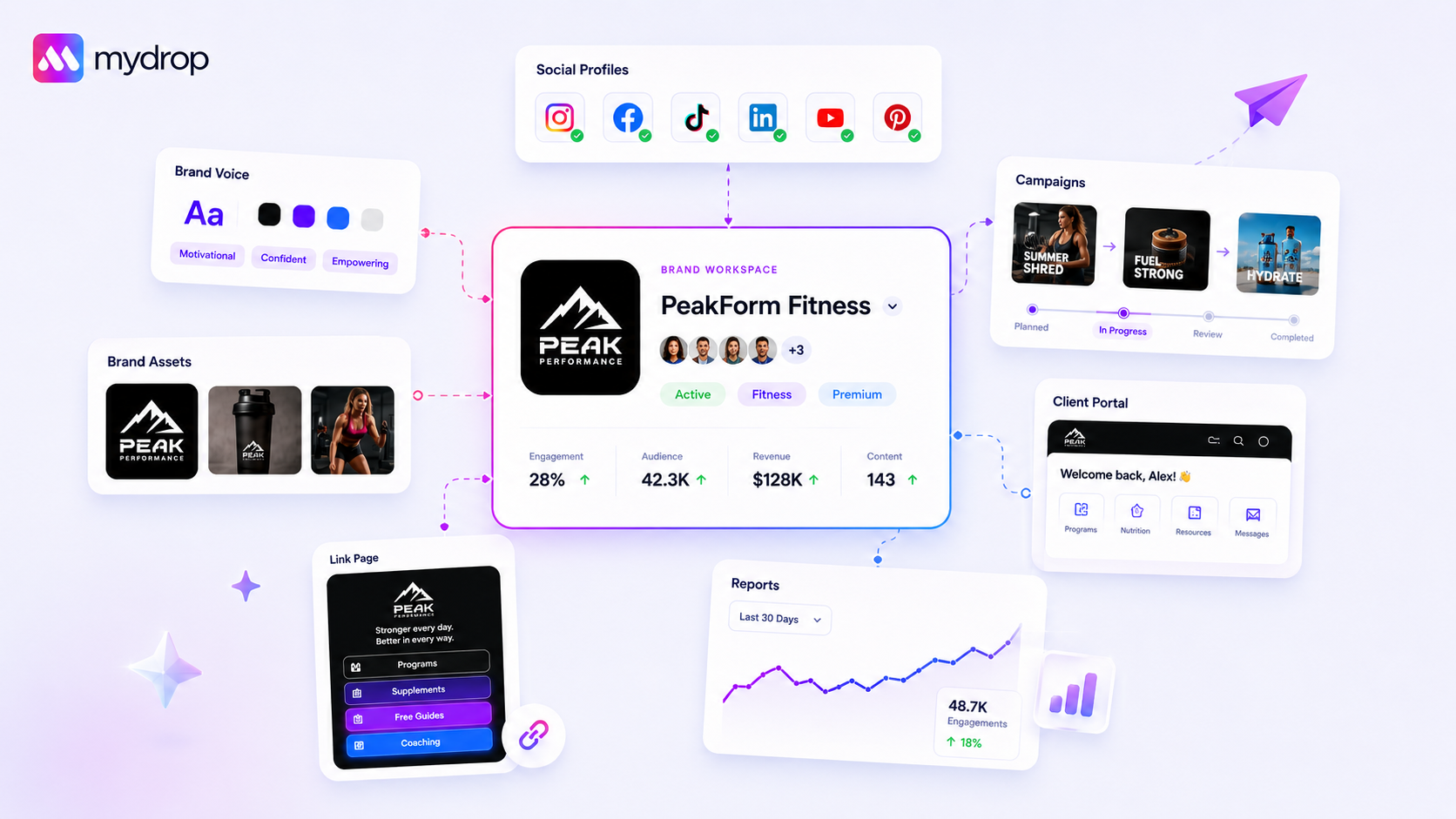
At Mydrop, we built Brand Lock because we kept seeing agencies burn precious hours correcting preventable errors. Instead of relying on a mental checklist, you set a workspace-wide boundary that restricts your entire view to one specific brand. Once active, the sidebar selectors and profile pages hide everything outside your selection. You cannot accidentally target the wrong account because the app literally stops offering it to you as an option.
Operator rule: If your team has to triple-check a dropdown menu before every post, you have already lost. The goal is to make the safe path the only visible path.
The coordination debt checklist

Most teams do not have a content problem. They have a decision bottleneck. When your team is toggling between five different brands and a dozen profiles, you are not just managing social media; you are performing an expensive, high-stakes game of memory.
If you find yourself constantly double-checking your browser tabs, that is a clear signal that your current workflow is forcing your best people to act as manual filters. We call this excessive mental load a failure in your operating architecture.
Use this audit to see if you are running a sustainable team or just managing a series of near-misses.
| Diagnostic Area | Early Warning Signs | Operational Risk |
|---|---|---|
| Context Switching | Team members have 5+ tabs open for different clients. | High probability of "Reply All" posting errors. |
| Profile Selection | You rely on manual memory for brand-to-profile mapping. | Inconsistent brand voice; high rework costs. |
| Approval Flow | Approvers are checking profile handles instead of content. | Bottlenecks; missed publishing windows. |
| System State | No visual confirmation of which brand is currently "live". | Invisible drift between personal and corporate accounts. |
If you checked more than two of these, your team is likely spending more time on safety checks than on actual strategy. It is not their fault; the UI you are using is likely fighting them.
How to move decisions closer to the work
The only way to scale without sacrificing accuracy is to offload the safety checks to the platform itself. You want to make it physically impossible to target the wrong brand by building hard boundaries into the workspace.
At Mydrop, we built Brand Lock because we kept seeing agencies burn precious hours correcting preventable errors. Instead of relying on a human to remember "which brand am I working on right now," the system handles it for you.
When you enable Brand Lock in your workspace settings, you define the perimeter. Once a member selects a brand or specific profile set in the sidebar, the entire application-every selector, every report, and every scheduling tool-updates to mirror that choice. Everything else is hidden.
Decision check: If a member cannot see the profile, they cannot post to it. By filtering the source of truth, you eliminate the need for manual vigilance.
This approach succeeds because it respects the reality of high-volume work. Your team members have different focus areas at any given time. Because this is per-member, one person can be locked into a luxury boutique account while another simultaneously manages your corporate feed in the same workspace.
The system tracks the selection, ensuring that even if you add new profiles to a brand later, they are automatically included in the lock. You never have to worry about stale profile lists or missing a new account because of a static configuration.
The goal is to move the decision of "which brand am I working on" from the moment of publication to the start of the shift. Once you set that focus, the rest of the day is just about the work.
The roles and rules that reduce rework
The tension usually peaks when your team grows. You have one person handling the flagship brand, another running three regional accounts, and a third drafting experimental content for a new subsidiary. If everyone operates from a single, unfiltered pool of profiles, errors are not just possible; they are statistically inevitable.
The most effective way to scale is to separate workspace governance from individual focus. You need a system that defines the sandbox but lets each person build their own walls.
At Mydrop, we suggest an administrative rule: use workspace-wide settings to establish the boundaries, but leave the actual focus selection to the individual. When an admin enables a feature like Brand Lock, they are essentially saying, "We have too many accounts to keep safe manually." By turning this on, they give every team member the ability to create a personal filter.
Workflow check: Administrative controls should provide the safety net, while individual settings should provide the speed.
When your team can lock their entire app interface to a single brand, they stop worrying about whether they are in the "main" account or the "test" account. Every selector, calendar view, and reporting dashboard hides everything outside of their chosen context. It removes the need for constant, manual double-checking.
The weekly habit that keeps the system honest
High-volume publishing is a grind. If you do not have a ritual for resetting your workspace, the "context leakage" starts to creep back in by Wednesday afternoon.
We recommend a simple, two-minute Monday Morning Sync or a shift-start ritual. If you are part of a team handling dozens of profiles, make it a habit to confirm your active filter before you open your first brief or draft your first post.
Here is a simple checklist for your team to adopt this week:
- Audit your active profile set: Ensure your sidebar filter is currently showing only the brand you are actually working on for this shift.
- Clear the cache: If you are jumping from a regional project back to the global account, clear your selection and re-lock your view.
- Verify the draft: Before you hit send, check the top-right indicator to see exactly which profile group is active.
- Post-shift reset: Clear your active lock when you sign off so your workspace is clean for tomorrow morning.
This is not about being paranoid; it is about protecting your focus. When you treat your workspace configuration like a piece of high-stakes equipment, you treat your publishing process with the same level of professional rigor.
Conclusion
The goal of any social media team is to move faster, but speed without guardrails is just an invitation for a PR nightmare. Most mistakes we see-the off-brand tweet, the misplaced campaign, the wrong audience reach-happen because we expect our teams to be perfect under heavy cognitive load.
Stop asking your team to be constantly vigilant. Instead, build an environment where the wrong choice is physically filtered out of the interface before it can ever happen. When you eliminate the burden of choice, you leave your team free to focus on the actual content. You aren't just saving yourself from an embarrassing mistake; you are building a professional standard that allows your brand to scale safely, one post at a time.