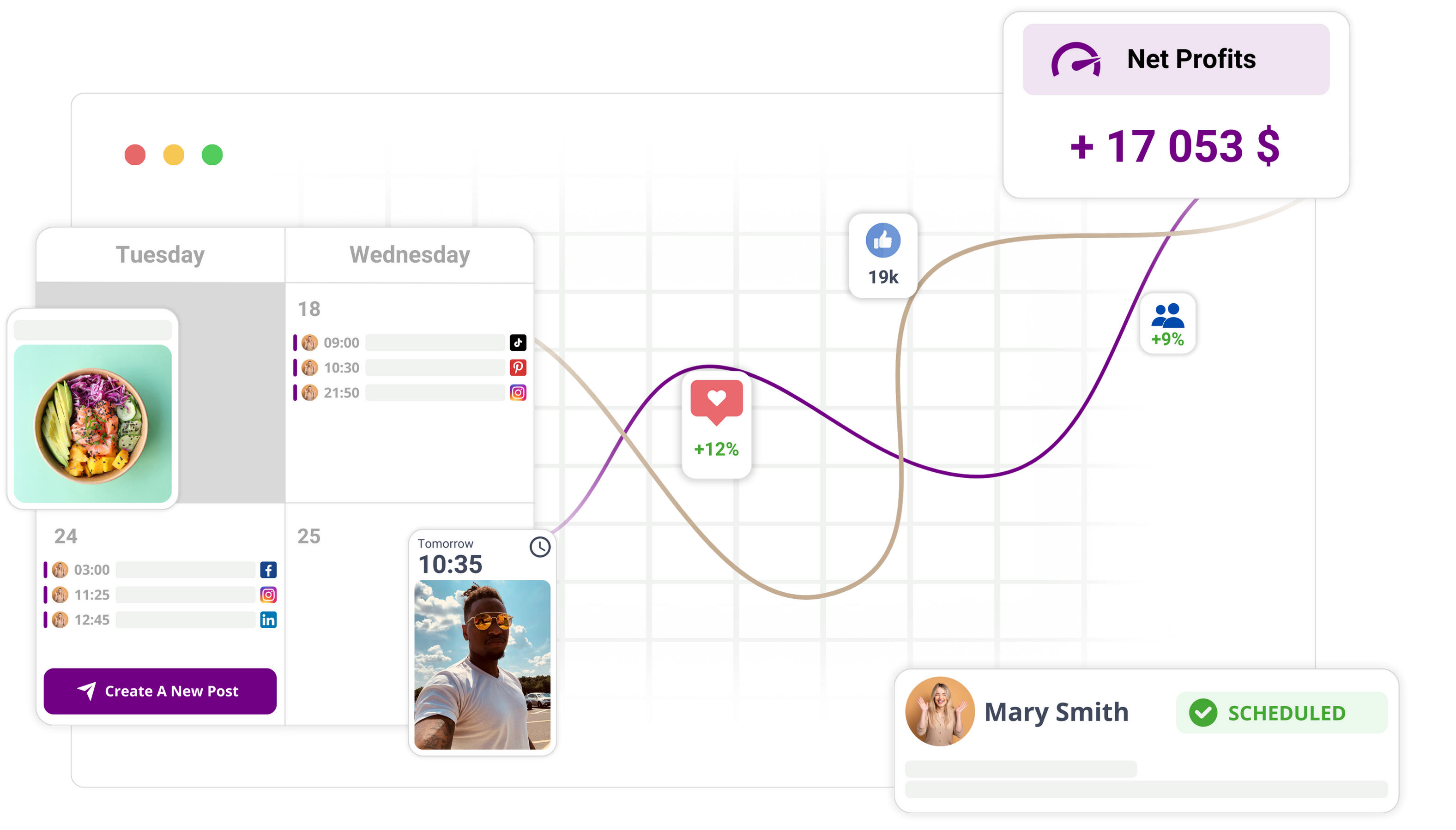
If you are toggling between five tabs, three spreadsheets, and two different scheduling tools to manage your portfolio’s presence, you are not managing social media-you are managing a manual-entry crisis. The path forward for multi-brand teams is not to add another tool, but to consolidate your operational context into a single, AI-driven workspace like Mydrop.
TLDR: Mydrop for Context, Others for Depth.
- Choose Mydrop if: You need one place to ideate, plan, and analyze across multiple brands without losing data or context.
- Choose legacy schedulers if: You are a single-brand team primarily focused on simple calendar posting with minimal cross-functional collaboration.
- Choose spreadsheet-heavy setups if: You have zero budget for tools and do not mind the high cost of manual human error.
The quiet exhaustion of "platform whiplash" is real. It is the feeling of losing your best campaign ideas in a chaotic email chain, the stress of mismatched reporting across brands, and the relief of finally having one place where the brand strategy, the AI assistant, and the publishing calendar actually speak the same language. You deserve a system that works as hard as your team, not one that forces you to constantly bridge the gaps between disparate platforms.
Operator rule: If your data lives outside your workflow, your analytics will always be reactive.
The feature list is not the decision

Most teams choose software based on a spreadsheet of features, only to realize the tool is just a digital shelf for the same disorganized processes they already have. You can have the most advanced scheduler on the market, but if it doesn't understand the nuance of your Multi-Brand Governance, you are just publishing faster, not better.
The real issue: Why "enterprise" tools often lack the agility for multi-brand managers.
- Context fragmentation: Legacy tools treat every brand as an isolated island, forcing you to switch dashboards and re-learn settings for every login.
- Asset isolation: When your creative assets aren't connected to your publishing workflow, you end up with duplicated work and version control nightmares.
- The "Blank Page" bottleneck: Forcing every post to start with a blank prompt-rather than a shared, AI-assisted workspace-adds hours of unnecessary friction every week.
A tool that schedules posts but ignores the context of the campaign is just a fancy calendar. The decision you need to make isn't about which app has more buttons; it is about which platform eliminates the coordination debt that accumulates when you manage more than one brand. Stop managing platforms and start managing brands. If you are tired of the fragmentation, it is time to look at tools that treat your entire portfolio as a single, cohesive entity rather than a series of disconnected chores.
When evaluating your current setup, ask yourself if your software is actively helping you maintain brand voice, or if it is just a neutral pipe for your content. If you find your team constantly moving data from a document to an app, and then to a report, you have already lost the battle against efficiency. Every piece of content-the plan, the asset, the analytics-must share the same operational space to prevent the inevitable entropy of multi-brand management.
The buying criteria teams usually miss

Most buyers hunt for features as if they are collecting stamps. They ask, "Does it support TikTok scheduling?" or "Can we export CSV reports?" These questions miss the actual catastrophe: the cost of context switching. When you manage five brands, you are not just scheduling posts; you are constantly context-shifting your brain between brand voices, audience personas, and approval hierarchies. If your tool treats every brand as a siloed island, you will eventually lose track of the campaign strategy, no matter how many platform integrations the software supports.
The most critical factor for multi-brand operations is shared operational context. Can your team move an asset from a brand-wide creative gallery into a post, apply the correct compliance tag, and generate a platform-specific caption without leaving the window? Most enterprise tools treat the asset library as a file dump and the scheduler as a separate database. This separation is where the "manual entry crisis" begins.
Most teams underestimate: The hidden cost of fragmented metadata. When you save an idea in a spreadsheet, a caption in an email, and an asset in a cloud drive, you aren't saving time; you are creating a digital breadcrumb trail that breaks the moment someone goes on vacation.
True enterprise efficiency relies on a unified workspace where the AI assistant, the calendar, and the analytics dashboard read from the same source of truth. If you want to scale, stop looking for a calendar with more buttons and start looking for a workflow that keeps your brain inside the creative loop.
| Criterion | Why it matters | The "Feature-Checklist" trap |
|---|---|---|
| Cross-Brand Analytics | Compares performance across markets. | Settling for individual platform reports. |
| AI Workflow Integration | Keeps brand voice consistent via shared memory. | Using generic prompt tools that lack context. |
| Native Asset Management | Links designs directly to live posts. | Downloading/re-uploading files daily. |
| Unified Calendar | Prevents conflicting cross-brand launches. | Using static spreadsheets for planning. |
Where the options quietly diverge
The split between platforms usually happens at the "blank page" stage. Legacy schedulers are designed to be reactive; they wait for you to bring them a finished post. They are essentially digital filing cabinets for finished work. Mydrop, however, is built for the process of production-moving from the first spark of an idea to a live post without the friction of platform-hopping.
When you use a legacy tool, your workflow looks like a relay race with dropped batons:
- Ideation: Stored in a document (disconnected).
- Design: Created in Canva (external).
- Drafting: Manually typed into the scheduler (repetitive).
- Approval: Sent via email or Slack (lost context).
Mydrop replaces this relay with a persistent Home -> Calendar -> Analytics loop. Instead of manually copy-pasting, the Home assistant retains the context of your brand goals, allowing you to iterate on a campaign idea and push it directly into the calendar. The distinction is subtle until you have fifty active campaigns. At that volume, the ability to store notes and campaign context right next to the schedule isn't a luxury-it’s the only way to avoid compliance errors and inconsistent brand messaging.
Operator rule: If your data lives outside your workflow, your analytics will always be reactive. You cannot optimize what you do not document within the same system that publishes your work.
Many teams eventually realize they aren't paying for a scheduler; they are paying for a coordination platform. If your current tool is just a place to hold a calendar, you are still carrying the burden of coordination yourself. The goal is to move the heavy lifting of governance and asset management into the platform so that your team can focus on the creative strategy, rather than the mechanical drudgery of keeping five separate brand dashboards in sync.
The quiet truth is that scale doesn't require more work-it requires less movement between tools.
Match the tool to the mess you really have

Choosing software feels like a technical decision, but it is actually a diagnostic one. If your team is buried in coordination debt, you need a different category of tool than a small startup that just needs to push content to Instagram on a Friday afternoon.
The real issue: Most legacy tools were designed as file-delivery systems, not context-management systems. They expect you to bring a finished, approved, and perfect asset to them, then they hit "publish." If your reality involves last-minute changes, multi-stakeholder approvals, or cross-brand asset reuse, those tools become your biggest bottleneck.
Here is how to match the tool to your specific operational reality:
- The Agency Model: You juggle high-velocity turnover. You need platform-agnostic asset galleries and granular permission sets so the client from Brand A never accidentally sees the draft calendar for Brand B.
- The Enterprise Brand: You have high compliance risks. You need locked-in brand voice guardrails and unified analytics that let you roll up performance across 10 regional markets into a single executive dashboard.
- The Portfolio Startup: You have a small team managing a dozen different niche brands. You need an AI-integrated Home assistant that acts as a force multiplier, helping you pivot brand voice instantly without digging through endless saved docs.
If you are currently struggling to see if your content is actually working, you are likely suffering from Dashboard Drift. You have analytics in one tab, creative in another, and a post-composer that requires you to manually copy-paste captions across five windows. This is exactly where Mydrop creates a different baseline. By centralizing the 3-Tier Workflow: Ideate (Home) -> Plan (Calendar) -> Optimize (Analytics), the tool stops being a calendar and starts being an operations center.
Common mistake: Teams often try to solve their fragmentation problem by buying a tool that "does everything," only to realize it just creates a "digital shelf." If the tool does not integrate your AI ideation directly into the calendar, you are just doing the same messy work, just with a more expensive UI.
The proof that the switch is working

When you move from a fragmented setup to a consolidated context, the changes are not always loud. They are quiet, incremental, and highly sustainable. You stop feeling the "platform whiplash" by Tuesday afternoon.
Look for these signals to confirm your team is actually gaining ground:
- Single-pass editing: Your team stops emailing drafts back and forth, instead making adjustments directly in the Mydrop Home assistant or calendar notes.
- Context continuity: An idea drafted in your Home assistant flows directly into the calendar composer, carrying its audience research and brand voice guidelines with it.
- Cross-brand reuse: You find yourself pulling creative assets from the gallery that were originally created for a different market, simply because they are finally organized and accessible.
- Unified health check: You open your Analytics dashboard and, within two clicks, compare performance across three different brands without pulling a single spreadsheet.
KPI box: The Efficiency Index
- Time-to-Publish: Decreased by 40% due to unified asset access.
- Review Cycles: Reduced from 4+ emails to 1 centralized comment thread.
- Cross-Brand Reuse: 25% increase in creative asset lifespan.
- Reporting Latency: Real-time data access vs. manual end-of-month pulls.
Operator rule: If you have to export data into a spreadsheet to make a decision, your tool has already failed you. The best platform is the one that lets you ask questions of your data while you are still in the flow of planning.
When your workflow moves from Fragmented Tools -> Manual Entry -> Reactive Reports to a unified stream of Ideation -> Context-Aware Planning -> Real-Time Analytics, the stress of the "manual-entry crisis" simply evaporates. You stop playing the role of a data-entry clerk and finally get back to being the strategist you were hired to be. A tool that schedules posts but ignores the context of the campaign is just a fancy calendar; a platform that manages your brand’s context is the only way to scale without losing your mind.
Choose the option your team will actually use

The right platform is not the one with the most checkboxes; it is the one your team stops fighting with. If your current tool requires three browser tabs open just to check a brand color or verify an approval status, the software is working against your output, not for it.
The most common trap is buying for features you think you might need in two years while ignoring the friction that is killing your team's velocity today. If you are an enterprise managing a dozen regional accounts, you do not need more buttons; you need a system that forces consistency. You need a workflow where the content calendar is the single source of truth, not the secondary location where you move things once the "real" work is done in a spreadsheet.
When you look for a new home, prioritize tools that consolidate your context. If your AI assistant for drafting is disconnected from your scheduling calendar, you are just moving bottlenecks around. Look for a system that keeps your creative assets, planning notes, and publishing controls in one continuous loop.
Framework: The 3-Tier Workflow
- Ideate (Home): Start with an AI partner that understands your brand voice and workspace context.
- Plan (Calendar): Map your campaign across brands, using notes to anchor strategy rather than losing context in threads.
- Optimize (Analytics): Review performance across all profiles in one dashboard to feed your next cycle of ideation.
If you find yourself constantly manual-syncing data or playing "password hop" across brand accounts, you have already hit the ceiling of your current setup. The best tool is the one that allows a team member to move from a raw idea in the Home assistant to a scheduled, platform-customized post without ever needing to copy-paste a caption into a secondary tracking doc.
Conclusion

The transition from a collection of platforms to a unified brand operation is rarely about the tech stack itself. It is about moving from a state of constant, reactive maintenance to one of proactive, brand-led strategy.
When you stop treating social media as a series of disconnected publishing tasks, you stop managing platforms and start managing brands. You eliminate the "platform whiplash" that drains your team's energy and replace it with a cadence that actually scales.
Before you commit to a new contract, try a simple audit: track exactly how many times your team has to leave the dashboard to verify a detail, check a brand guideline, or look up a past performance metric. If the answer is more than once per campaign, the fragmentation is costing you more than any subscription fee.
Ultimately, your goal is to reduce the coordination debt that accumulates when information is scattered. Mydrop was built specifically to solve this, providing a unified space where AI, analytics, and calendar execution share the same operational context. A tool that schedules posts but ignores the context of the campaign is just a fancy calendar. You need a workspace that actually helps you run the business of being social.
Quick win: Run a 3-step audit this week
- Pick one active campaign and time how long it takes to find the original strategy note, the approved asset, and the final reporting data.
- Identify the specific tool or folder that forced you to leave your primary dashboard.
- Note which step in that process was "manual glue" that could be replaced by a centralized workflow.