
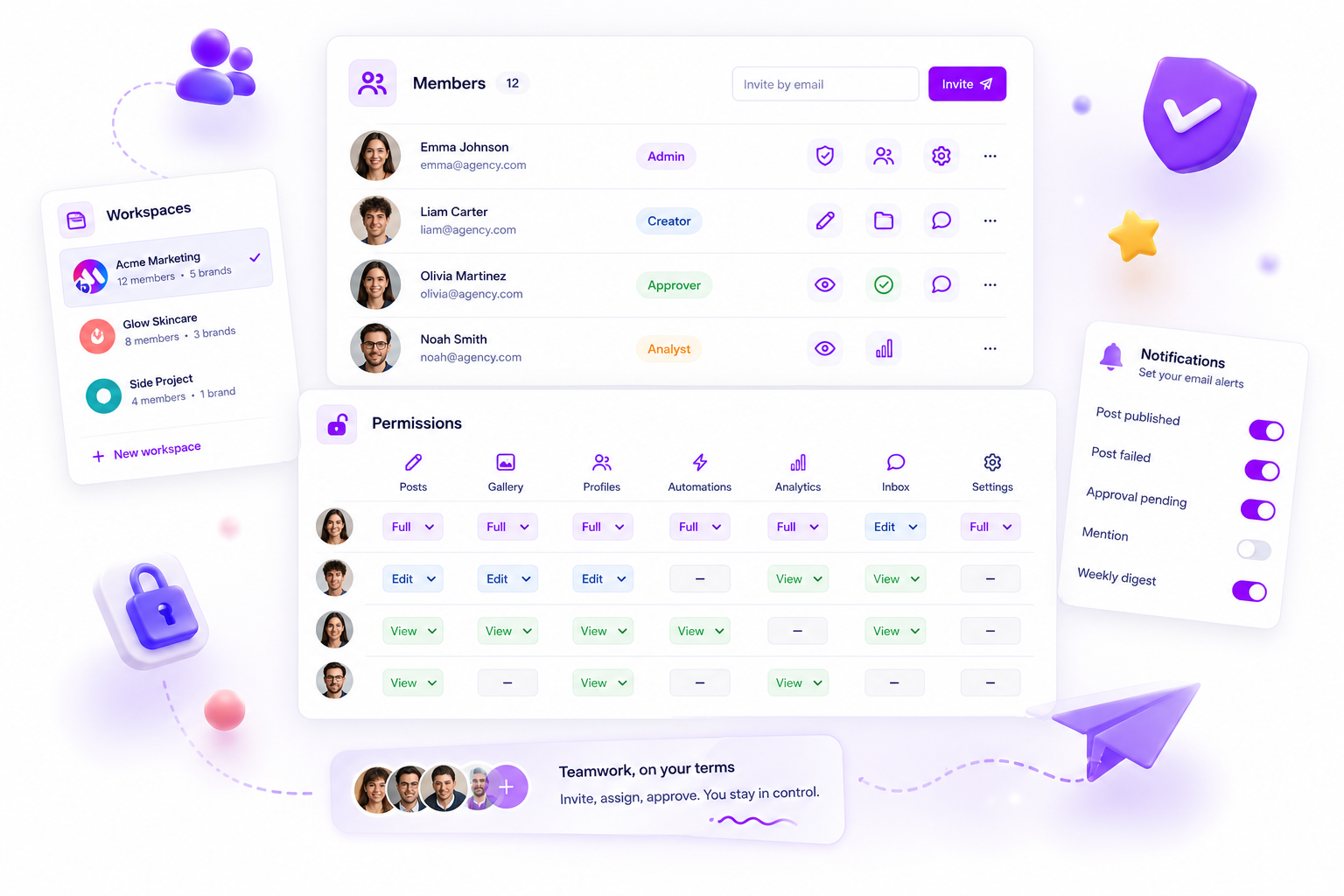
The secret to preventing catastrophic cross-client data leakage in high-velocity agency environments is using hard-walled workspace containers rather than just granular folder permissions. If your platform treats a client as a simple dropdown menu rather than an isolated, self-contained environment, your team is playing with fire. True segregation means total context isolation-separate billing, distinct member lists, and forced environment reloads. We have seen hundreds of teams struggle with this "toggling tax," and the hard truth is that UI convenience is often the enemy of containment. You need a setup that makes cross-client errors physically impossible, rather than just a policy you hope everyone follows during a chaotic Friday afternoon rush.
We get it. You are managing five clients, three brand voices, and a dozen social accounts simultaneously, and it feels like a high-stakes balancing act every single day. You aren’t being careless-you’re just human, and the mental load of switching between client environments is immense. When the software you rely on hides these environments behind a simple UI tweak, human error isn’t just a possibility; it is a certainty. It is not about your team being incompetent; it is about the architecture of your tools failing to support the scale you’re operating at.
What the best tools need to handle

When we audit agency stacks, the most common failure mode is UI context blindness. If a user can accidentally draft a post for Client A while technically "in" the Client B workspace, the tool is broken. The best platforms treat each client as a hard-walled container. This means every asset, every permission, and every billing cycle is tethered strictly to the active workspace. If you cannot see a clean break in the interface-down to the browser tab or the navigation bar-your team is living on borrowed time.
| Feature | Filter-Based Platforms | Container-Based Platforms |
|---|---|---|
| Data Scope | Global (filtered) | Scoped to Workspace |
| Permission Risk | High (accidental visibility) | Low (default restricted) |
| Environment Switch | Fast (UI state change) | Secure (full app reload) |
| Client Leakage | Frequent | Near Zero |
The "switching tax" is the hidden cost here. If your team has to constantly double-check the dropdown to see which client they are active in, they are wasting precious cognitive energy that should be spent on strategy or creative. A well-built system should force that context switch to be unambiguous.
Operator rule: If a user can move data between environments without explicit permission, your tool is not a workspace; it is a shared folder system with a dashboard skin.
At Mydrop, we built Workspaces to act as a hard container. When you switch, we don’t just change a filter; we trigger a full environment reload. This ensures that billing, members, and product data remain strictly segregated, providing a clear, unmistakable boundary for your team. You shouldn’t have to guess where you are, and your clients shouldn’t have to worry about their data bleeding into someone else’s workflow. The goal is to design a workspace so secure that you stop thinking about "what client" you're in and start focusing on the output.
Where basic tools start to break

Most software platforms handle client segregation by treating "client" as a simple view filter. You select a brand from a dropdown menu, the UI shifts, and you feel like you are in a new space. But beneath the surface, your session, your browser cache, and your global application state have not changed. This is the "Convenience Tax."
When developers prioritize fluid switching over hard boundaries, they build in leaks. If you rely on a filter rather than a container, you are constantly one misclick away from a career-limiting event.
The Filter-based vs. Container-based Breakdown
| Feature | Filter-based Approach (The Risk) | Container-based Approach (The Standard) |
|---|---|---|
| Session State | Shared; cached data persists between "clients." | Isolated; switching forces a hard reload. |
| Membership | Global; permissions are often inherited. | Scoped; users exist only within the workspace. |
| Billing/Usage | Aggregated; hard to untangle client costs. | Isolated; counters are strictly per workspace. |
| Data Boundary | Soft; client data relies on a database field. | Hard; collections are physically partitioned. |
The hidden danger is that human error is inevitable when the software hides the transition. When you move from Brand A to Brand B, your tool should force a distinct environment reload. If the dashboard feels exactly the same in both places, your brain cannot reliably switch context. A true agency-grade tool forces you to recognize that you have left the old environment and entered a new, walled garden.
The buying criteria that matter
If your team manages more than three clients, or if a single error costs you an account, stop asking "is this tool easy to use?" and start asking "is this tool architected to keep my client data contained?"
When evaluating your next workspace tool, use this scorecard to ensure you are buying containment, not just a prettier UI.
The Workspace Security Scorecard
| Criterion | What to look for | Why it matters |
|---|---|---|
| Forced Reload | Does the app reset its state when switching? | Prevents cross-client data bleed in the browser. |
| Scoped Membership | Are users explicitly invited per workspace? | Ensures you don't accidentally expose clients to wrong people. |
| Isolated Billing | Are usage/billing quotas per workspace? | Prevents "noisy neighbor" issues and simplifies invoicing. |
| Hard Boundaries | Does the system treat the workspace as the root? | Makes it architecturally impossible for data to leak. |
At Mydrop, we built Workspaces as a hard container because we saw too many teams nearly crippled by simple UI mistakes. In our experience, high-velocity teams don't just need a faster way to switch; they need to know, with absolute certainty, that they are operating within the correct client context.
Decision check: If a user can see data for a client they aren't explicitly assigned to within that specific workspace, your segregation is purely cosmetic.
Your team doesn't have a focus problem; they have a coordination burden. By selecting a platform that treats workspace segregation as a hard architectural constraint rather than a navigation convenience, you stop managing the risk of human error and start managing your actual campaigns. True agency-grade tools put the boundary between you and a mistake.
How Mydrop supports this workflow
At Mydrop, we built Workspaces to act as a hard container, not just a cosmetic layer. When you switch to a client environment, we do not just filter the view; we perform a full environment reload. This means user permissions, product quotas, billing state, and API context are entirely re-scoped to that specific container.
If a team member does not have explicit access to a workspace, they do not just have a hidden menu item; they effectively do not exist in that client's context. This stops the permission creep that happens when platforms treat members as global entities. We keep client billing and memberships strictly tied to the workspace boundary, so you never accidentally invite a user from Client A into the management view of Client B.
By forcing a complete re-authentication of the environment state, Mydrop ensures that data from one client cannot bleed into the session of another. It is the difference between putting a sticker on a file cabinet and actually locking the drawer. When you are moving at speed, you need that mechanical assurance that the environment you see is the only one you are affecting.
A simple shortlist checklist
Before you commit to a platform, run this scorecard against your current setup. If you cannot answer yes to these, your current tool is likely built for convenience rather than containment.
| Feature | Why It Matters |
|---|---|
| Hard Container Switch | Full reload of billing, permissions, and members |
| Billing Isolation | Granular control over client-specific subscription tiers |
| Member Scoping | Access is granted per workspace, not per account |
| Context Visibility | The active environment is unmistakably distinct |
If you are currently evaluating your stack, take these three steps this week to audit your exposure:
- The Ghost Test: Create a test user and add them to only one client workspace. Log in as that user and verify they cannot even see the project names or dashboard metrics of other clients.
- The Billing Audit: Confirm that your platform allows you to export usage metrics or billing invoices on a per-workspace basis. If your billing is a single massive line item, you are missing visibility.
- The Role Consistency Check: Ask yourself if a 'Manager' in Client A's workspace has the same permissions in Client B. If the answer is 'it depends' or 'I have to set it up individually for every brand', you are maintaining too much manual coordination debt.
Conclusion
Most agency teams do not have a content production problem. They have a decision bottleneck, often caused by trying to manage too many variables in a single, unsegmented bucket. True segregation is not about making the tool harder to use, but about making the boundaries so clear that mistakes become structurally impossible.
Your tools should protect your team from their own exhaustion, especially on a Friday at 6 p.m. When the platform itself handles the context isolation, you get to stop playing human firewall and start focusing on the actual campaign performance. Choose the container, not the dropdown. Your team, and your clients, will thank you for the extra peace of mind.