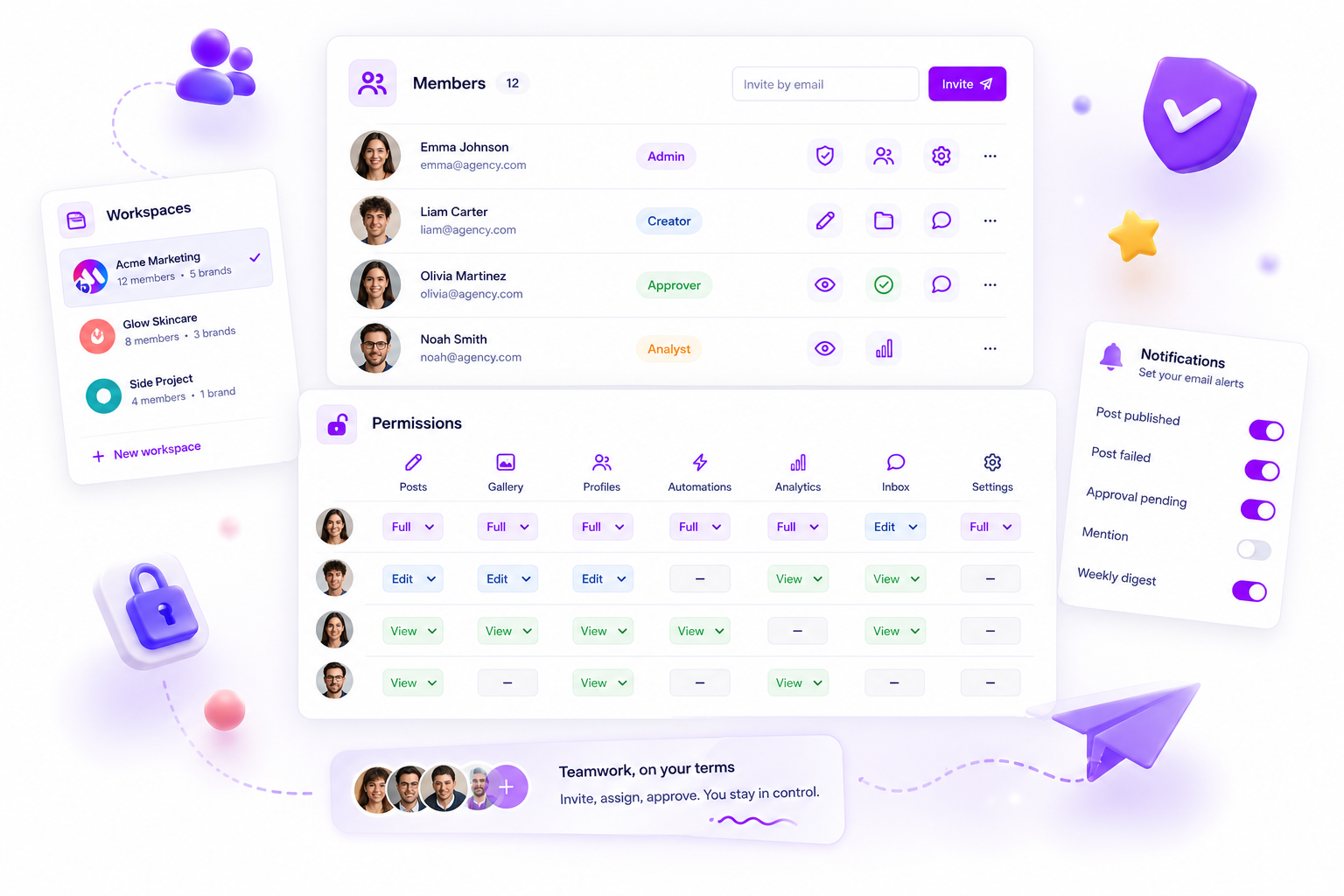
You should create a new workspace whenever a client requires independent billing, operates in a distinct timezone for scheduling, or necessitates strict permission gating where accidental visibility between brands poses a legal risk. Consolidation is for sub-brands under a single corporate umbrella; isolation is the mandatory baseline for client-agency relationships. If they do not share a legal team and a budget, they should not share a workspace.
We have all been there. You are staring at three browser tabs, juggling two different brand voices, and feeling that constant, low-grade dread that you are about to post a "buy one get one" offer to the wrong client account. Managing multi-brand operations is inherently messy. The "all-in-one" dream often turns into a permission-management nightmare where you are one misclick away from a serious breach of trust. By the end of this, you will have a clear decision matrix to determine exactly when to spin up a new Mydrop workspace and when to keep things under one roof.
| Decision Driver | Consolidate (One Workspace) | Isolate (New Workspace) |
|---|---|---|
| Billing | Shared budget or single invoice | Client pays directly or needs separate billing |
| Timezone | Same region and unified calendar | >4 hour difference or distinct local holidays |
| Permissions | Shared creative and social team | "Need to know" access and external contractors |
| Data/Legal | Non-competing sub-brands | Strict NDAs or competing brands in the agency |
The operating problem this solves

The "Efficiency Trap" is the belief that putting ten clients into one workspace saves time. It feels intuitive to want everything in one view, but in reality, it creates a massive "blast radius." If a billing issue hits a shared account or a rogue intern with global permissions makes a mistake, your entire agency output can freeze instantly.
Over-consolidation builds what we call coordination debt. Instead of shipping content, you spend your Friday afternoons auditing who can see what. At Mydrop, we have seen this across agencies managing hundreds of profiles. The teams that scale without losing their minds are those that treat the workspace as an operational firewall, not just a folder.
When you isolate brands, you remove the "accidental visibility" risk that keeps legal teams awake. If Client A and Client B are competitors, having their data in the same container is an unnecessary liability. A simple mistake during a data export or a shared asset library could leak metadata from one to the other. Isolation ensures that permissions are resolved against a clean, dedicated membership list. It is the only way to move fast while keeping the legal "clean exit" always available.
The minimum system that works

The safest baseline for any growing agency is the one legal entity, one workspace rule. If the check comes from a different bank account or the legal department requires a separate NDA, they deserve their own environment. It sounds like more work upfront, but it prevents the specific type of nightmare where you accidentally tag a luxury car brand in a post about budget insurance because the handles were sitting in the same dropdown menu.
At Mydrop, we see teams thrive when they treat the workspace as a hard boundary for permissions. If you have an external contractor who only needs to see "Brand X," do not try to manage that with complex folder-level permissions in a shared space. It is too easy for a "Global Admin" toggle to be flipped by mistake during a frantic 6 p.m. push. When a client lives in their own workspace, their data, assets, and scheduling logic are physically separated from everyone else.
Operator rule: If a data leak between two brands would result in a lawsuit or a lost contract, they belong in separate workspaces.
This isolation also saves you from the "Timezone Trap." If you are managing a global brand's European wing and their North American wing, trying to sync calendars in a single workspace is a recipe for missed windows. By splitting them, you can set the Workspace Timezone in your settings to match the client's local market. This ensures that a "10 a.m. Tuesday" post actually goes out when the audience is awake, not at 3 a.m. while your team is asleep.
Where teams overbuild the process
The flip side of the coin is "Workspace Bloat." We have seen well-meaning teams create a new workspace for every seasonal campaign or every minor sub-product. This is where efficiency goes to die. Every time you add a workspace, you add "switching cost." Your team has to jump between environments, wait for the loader to refresh, and re-orient their brains.
If you find yourself spinning up a new workspace for a "Summer 2026 Sale," you have overbuilt the system. That is what tags, folders, and campaign labels are for. You want your team focused on the creative work, not acting as part-time system administrators. Use a single workspace for all sub-brands that share a creative team and a budget. If the same group of people is approving the work for five different snack brands, keep them in one place.
The real test of your setup is the "Clean Exit." Eventually, every client relationship ends or evolves. If you have consolidated ten clients into one workspace, offboarding Client A is a manual, high-risk surgery. You have to scrub permissions, export specific data, and hope you did not leave a stray API key active. If they have their own workspace, you just hand over the keys and walk away.
The "Clean Exit" Scorecard
Use this matrix to evaluate how your current setup handles the inevitable moment a client leaves your roster.
| Offboarding Factor | Consolidated Setup (The "Messy" Way) | Isolated Workspace (The "Clean" Way) |
|---|---|---|
| Handover Speed | 4 to 6 hours of manual data export | <15 minutes to transfer ownership |
| Security Risk | High; risk of leaving "ghost" users active | Zero; user access is killed at the source |
| Asset Integrity | Hard to separate shared library files | Clean break; all assets stay in the container |
| Audit Trail | Shared logs make history hard to parse | Dedicated workspace logs for compliance |
| Billing Transition | Requires manual invoice adjustments | Simple billing handoff or cancellation |
Decision check: If you cannot imagine handing over the entire environment to a client tomorrow morning without revealing another client's secrets, your current "consolidation" is actually a liability.
Managing scale is not about seeing everything at once; it is about knowing exactly where the walls are. A well-defined workspace structure turns a chaotic agency into a repeatable machine. It gives your team the confidence to move fast because they know the "blast radius" of any single mistake is contained. Before you click "Create Workspace" for the next project, ask if you are building a necessary wall or just adding another door to walk through.
How to run the cadence
Setting up the right architecture is only half the battle. The other half is ensuring that your pristine "one workspace per client" system doesn't turn into a digital junk drawer over the next six months. Permissions drift is real, and it usually happens when a freelancer finishes a project but stays in the workspace "just in case," or when a client stakeholder changes roles but still receives every approval notification at 11 p.m.
We recommend a Quarterly Workspace Audit. This isn't a deep forensic investigation; it's a 15-minute hygiene check to ensure your isolation boundaries are still holding firm.
If you are managing dozens of environments, your audit should focus on these four signals:
- The "Ghost" Check: Open your Settings > Workspace view and look at the member list. If you see names of people who haven't touched a campaign in 90 days, remove them. In a consolidated setup, this is a nightmare. In an isolated Mydrop workspace, you can prune users without worrying if you are accidentally cutting off their access to a different client.
- The Billing Alignment: Is this client still on a retainer that covers their seat count, or have they scaled down? If the workspace usage no longer matches the contract, it's time to adjust the billing and quotas.
- The Timezone Pulse: For global agencies, engagement windows shift. Check if the workspace timezone still aligns with the client's primary audience. A mismatch here is how "morning" posts accidentally go live at 3 a.m.
- The Handoff Readiness: Ask yourself: "If this client left tomorrow, could I hand over this environment in one click?" If the answer is no because their assets are tangled with another brand, you have "coordination debt" to pay down.
The proof that the habit is working
How do you know if this extra bit of operational discipline is actually paying off? It’s rarely about a single metric on a dashboard. Instead, it’s about the absence of drama. You’ll know the "Isolation Habit" is working when your Monday mornings start feeling a lot quieter.
The real proof is found in these three operational wins:
- The Zero "Near-Miss" Rate: You stop getting those panicked Slack messages asking, "Wait, did we just post the luxury car creative to the discount pizza account?" When the environments are physically separate, that error becomes technically impossible.
- The 24-Hour Onboarding: A new account manager joins the team. Instead of giving them a 40-page manual on which folders to avoid, you simply invite them to the specific client workspace. They can't break anything else because they can't see anything else.
- The Clean Exit: When a contract ends, offboarding takes 60 seconds. You revoke access to one workspace, and the "blast radius" is contained. There is no manual scrubbing of shared folders or triple-checking that they didn't take another client's strategy docs with them.
Decision check: If you have to ask "Which client is this for?" more than twice while looking at a single screen, your workspace is overcrowded.
At Mydrop, we have seen that the most resilient agencies aren't the ones with the most complex## How to run the cadence
Setting up a workspace is the easy part. The hard part-the part that actually saves your sanity during a chaotic launch week-is not letting that workspace turn into a digital storage unit filled with "ghost" users and leftover permissions.
We recommend a Quarterly Workspace Audit. This isn't just about cleaning up files; it's about verifying your legal and operational boundaries still make sense. If your agency is scaling, a lot can change in 90 days. People leave, roles shift, and "temporary" contractors have a way of sticking around far longer than their SOW intended.
The 15-Minute Audit Workflow
- Ghost Hunting: Open Settings > Workspace and look at the member list. Is that intern from last summer still there? Did the client contact change roles? If you don't recognize a name, kill the access. You can always re-invite them, but you can't "un-see" a data leak.
- The Timezone Check: Is the workspace timezone still accurate? If your client moved their social team from London to New York, your scheduling calendar might be a ticking time bomb.
- The "Brand Creep" Review: Check if any new sub-brands or experimental projects accidentally got dumped into the main client workspace. If a project now has its own budget or a separate legal reviewer, it’s time for a new workspace.
- Quota Triage: Look at your usage counters. If one client is hogging 80 percent of your account capacity, they probably need their own dedicated environment (and perhaps a budget conversation).
Workflow check: Security is a trailing indicator of culture. If your team feels "bad" about removing access for a former colleague, your culture is prioritizing politeness over client safety. Make the audit a standard, emotionless process.
The proof that the habit is working
How do you know you've actually won? It’s usually a "non-event"-the crisis that didn't happen. You’ll know your workspace strategy is solid when you can pass the "Clean Exit" Test.
Imagine your biggest client calls tomorrow and says they are moving their social operations in-house. In a messy, consolidated setup, this is a nightmare. You would spend days scrubbing permissions, worrying about what they might see in the "shared" folders, and manually export data while praying you didn't miss a metadata field.
In an isolated setup, it is a non-issue. You hand over the keys to that specific workspace or export the scoped data, and you walk away knowing the rest of your agency's work is physically untouched.
| Signal | The "Messy" State | The "Clean" State |
|---|---|---|
| Onboarding | New hires spend a day figuring out where they are allowed to click. | New hires get one invite and see exactly what they need. |
| Errors | "Sorry, posted the wrong link to the wrong brand" happens once a quarter. | Brand-crossing errors drop to zero because the environments are physically separate. |
| Offboarding | A "security audit" takes three people, two cups of coffee, and a spreadsheet. | You remove a user from the workspace in two clicks. |
| Reporting | You are manually filtering data to hide "Client B" from "Client A" in exports. | Each report is natively scoped to the specific client environment. |
In our experience at Mydrop, the teams that scale the fastest are not the ones with the most complex "all-in-one" folders. They are the teams that respect the hard boundaries of their work. They understand that a workspace is not a folder-it is a vault.
Conclusion
The "Efficiency Trap" is a seductive lie. It whispers that you will save time by keeping everything in one tab, but it ignores the high price of a single mistake. When you are managing multi-million dollar brands, "Oops, wrong account" isn't just a typo--it is a breach of trust.
True efficiency isn't about saving five seconds on a login screen; it is about reducing the cognitive load on your team. When an account manager enters a workspace, they should feel the relief of a "clean" environment where every asset, every profile, and every team member belongs to the same mission.
Stop fighting the "all-in-one" chaos. Treat your client boundaries with the respect they deserve. By isolating your workspaces, you are not just organizing your work; you are protecting your agency's reputation and giving your team the focus they need to actually do the work. The goal is to spend your energy on the creative, not on wondering if the "Global" permission setting just gave your client a peek at their competitor's holiday strategy.