
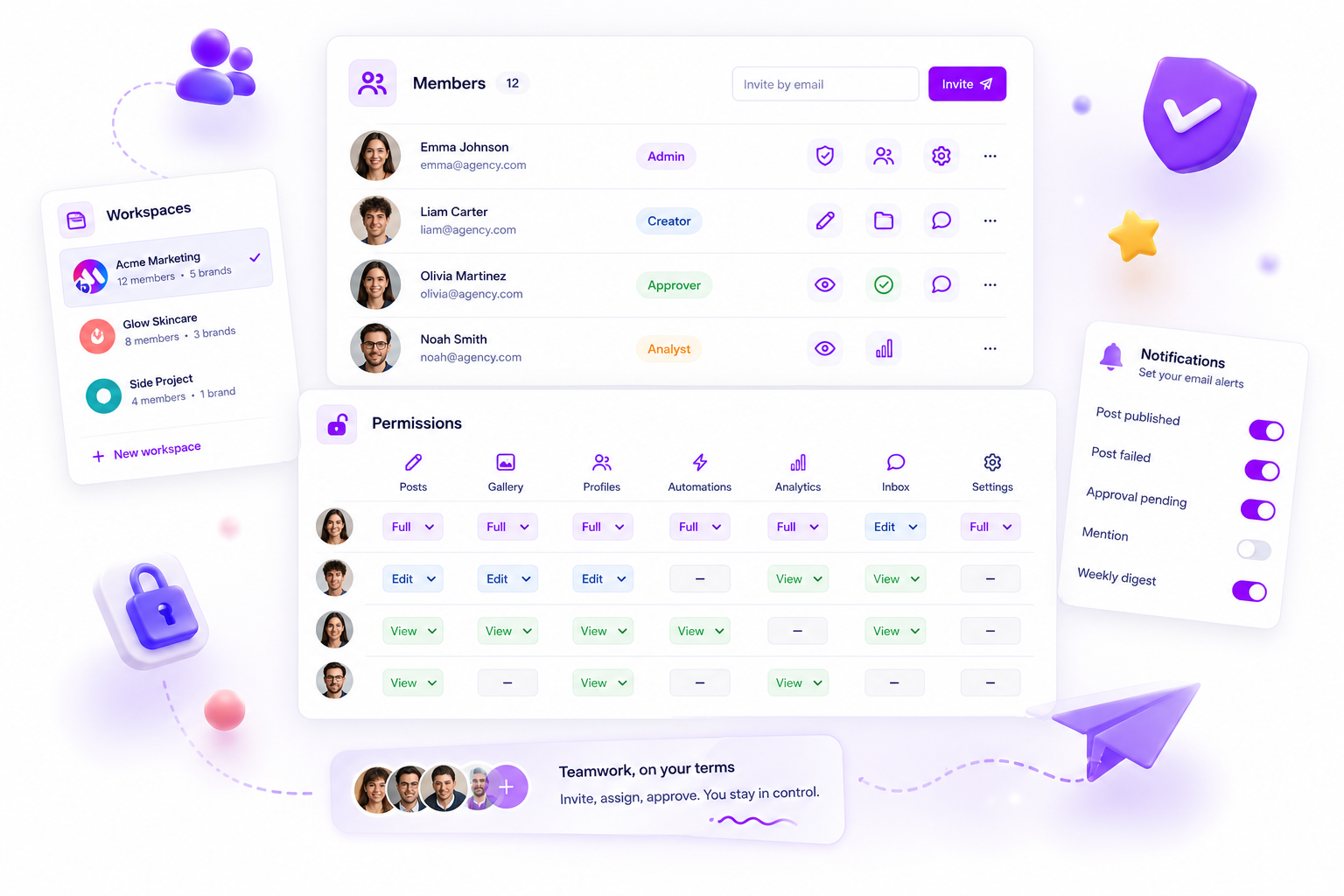
You should spin up a new Mydrop workspace for every client that requires unique billing, restricted team access, or siloed social analytics. While it is tempting to keep every account under one roof for simplicity, that "unified" approach is usually a ticking time bomb for data leaks, billing headaches, and team-wide permission errors.
We get it. You are trying to move fast, and juggling different log-ins or platform instances feels like a tax on your productivity. But at Mydrop, we have seen this play out across thousands of brand profiles; the moment you grow past a handful of clients, the shared-workspace model turns into a minefield. You are not saving time; you are just deferring the inevitable friction of untangling who can see what.
The operating problem this solves
The core issue here is what we call coordination debt. It is the hidden cost of "simple" setups that lack hard boundaries. When you lump multiple clients into a single workspace, every new team member you add creates a security risk, and every reporting request becomes a manual exercise in exclusion. You end up spending more time managing permission groups and cleaning up accidental cross-posting than actually crafting strategy.
Most teams assume that using granular roles-like "Editor" or "Viewer"-within a shared workspace is enough to keep things safe. But roles are soft barriers. One misclick in a settings menu or one oversight in a platform-wide filter, and a freelancer meant for a boutique brand can suddenly access the full analytics dashboard of your enterprise client.
Operator rule: If the cost of a single accidental post or data leak exceeds the effort of managing a new workspace, you have already outgrown your current structure.
The goal is to move from reactive permission management to proactive isolation. By treating workspaces as hard boundaries, you gain several operational wins instantly:
| Feature | Shared Workspace | Isolated Workspace |
|---|---|---|
| Onboarding | Requires per-asset permission pruning | Add user once; full access guaranteed |
| Reporting | Manual filters to hide client A from client B | Automatic data siloing |
| Billing | Shared budget; hard to attribute costs | Clear per-client subscription logs |
| Compliance | Audit risk across all assets | Built-in audit trail for one client |
When you stop fighting your own infrastructure, your team finally gets to focus on the work that actually moves the needle. You aren't just adding a container; you are installing a repeatable habit that keeps your agency's reputation and your client's trust locked tight.
The minimum system that works

The safest default for any agency is to treat a new client as an isolated, standalone workspace from day one. By enforcing a one-to-one mapping between the client and the workspace, you neutralize cross-contamination risk before it ever happens. When you build this way, you are not just organizing folders; you are establishing a firewall around your team’s most sensitive assets and billing data.
In our experience, the teams that struggle the most are the ones trying to play "Tetris" with permissions inside a single, overloaded workspace. They spend more time managing who can see what than actually crafting strategy. A clean workspace separation turns that complex access dance into a simple, binary state: you are either in this workspace or you are not.
Decision check: If a client requires their own MSA, their own seat on the bill, or access to sensitive analytics that your other clients should not touch, they need a dedicated workspace. Period.
To help you decide when it is time to move a brand into its own container, use this scorecard. If you answer "Yes" to two or more of these criteria, the "Single Workspace Trap" is already costing you.
| Decision Factor | Threshold for Separation | Risk of Ignoring |
|---|---|---|
| Team Membership | 2+ internal staff overlap | Higher chance of accidental post-leakage |
| Data Visibility | Client requires 1:1 reporting | Data leakage between brand metrics |
| Billing/Usage | Monthly quota > 50 posts | One client drains the common bucket |
| Asset Security | NDA-sensitive creative files | Unintended exposure to unauthorized users |
At Mydrop, we designed workspaces to act as hard boundaries. When you move a client into a separate workspace, you are not just cleaning up a menu; you are resetting the entire product context-from the active timezone to the team list-so you can operate without the constant fear of a misfire.
Where teams overbuild the process
It is tempting to try to fix every coordination problem with software settings. We have seen teams create elaborate "permission tiers," manual approval chains, and external spreadsheet trackers to keep track of who is allowed to touch which brand within a massive, singular account. This is overbuilding, and it is usually a sign that you are fighting the platform instead of using it.
You are likely overbuilding if you find yourself spending more than an hour a week auditing role access or chasing down "who clicked that" after an accidental post. Using granular team-member roles to patch structural flaws in your workspace setup is a classic case of technical debt masked as process.
Common mistake: Using individual role-permissions to simulate isolation instead of just creating a separate workspace.
The reality is that complexity is the enemy of speed. Every custom permission layer you add is a new place for the process to break. When you rely on a single workspace for five different clients, you are effectively creating a "single point of failure." One wrong click in a central settings menu could suddenly expose every client’s draft folder to the entire agency.
Instead of building more fences, simplify the landscape. If the team managing Brand A never needs to touch the data for Brand B, they simply should not have access to that workspace. By keeping the organizational structure lean and distinct, you offload the cognitive weight of "safety" to the system architecture itself. You stop being the gatekeeper and let the workspace boundaries do the work for you.
How to run the cadence
You should perform a workspace audit every quarter, or whenever you take on a new brand identity. Treat it like a housekeeping ritual for your agency. If the setup feels like a drag, it is because your current structure is actively working against your team's velocity.
Here is a simple triage checklist to run during your next monthly review:
- The Billing Scan: Does this brand have a unique cost center or client budget? If yes, move to a separate workspace immediately.
- The Access Audit: Are there team members in your current workspace who don't need to see this brand's analytics or asset library? If yes, you are carrying unnecessary security risk.
- The Approval Check: Does this client have a distinct legal or brand sign-off process? Keeping them siloed prevents the "wrong account" panic that ruins Friday afternoons.
- The Quota Check: Are you hitting rate limits or platform posting caps because one high-volume brand is drowning out the others?
Workflow check: If you have to ask yourself "should this client see that report," the answer is a hard no. Move them to their own workspace and stop worrying about the internal privacy leak.
At Mydrop, we see teams that manage dozens of workspaces simultaneously. The ones who thrive are the ones who treat the Workspace Settings menu not as a place to tinker, but as a critical lever for governance. If you are constantly adjusting member permissions to restrict visibility, you have already lost the battle. Use the workspace as the hard boundary it was designed to be, and your daily operations will immediately feel lighter.
The proof that the habit is working
When you shift from a monolithic structure to a siloed, workspace-centric model, the change in your team's stress levels is measurable. You stop spending time on "Access Management" and start spending it on high-leverage strategy.
Look at this scorecard to see if your new habit is paying off:
| Metric | Messy (Unified) | Scalable (Siloed) |
|---|---|---|
| Permission Overhead | Weekly audits, constant Slack pings | Self-service, zero-inquiry access |
| Accidental Posting | Inevitable "oops" moments | Impossible by design |
| Reporting Speed | Hours of filtering raw data | Instant, client-specific dashboards |
| Team Focus | Distracted by irrelevant brand metrics | Deep, platform-specific context |
When your team can jump into a project without navigating a labyrinth of irrelevant settings or accidental shared access, they move faster. The "proof" is that your lead account manager stops being an amateur gatekeeper and starts being a partner who actually has time to review the content calendar.
Conclusion
The messy middle of social media management is rarely about a lack of creative talent or platform insights. It is usually about coordination debt-the invisible tax you pay for managing multiple brands in a system that doesn't respect the lines between them.
Stop trying to force every client into a one-size-fits-all container. By using workspace boundaries as your first line of defense, you protect your firm's reputation and reclaim the hours you’ve been spending on internal cleanup. Make the move to isolate, automate, and finally get some breathing room. Your clients get better security, your team gets more focus, and you get to stop playing IT administrator during your peak content hours.