
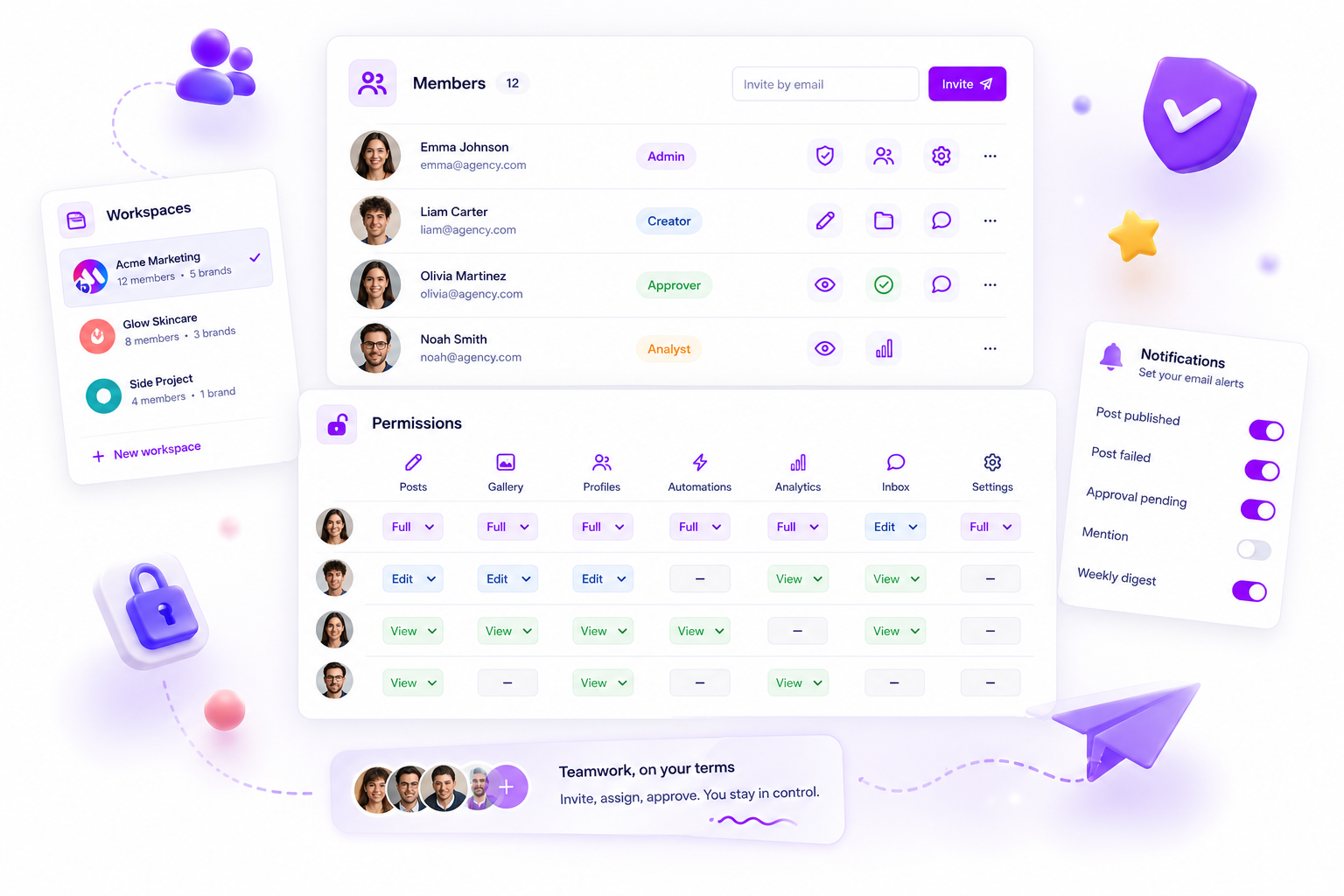
Stop trying to force every client into a single Master workspace. Managing five brands from one dashboard feels efficient until the moment a junior manager accidentally schedules a personal post to a client's feed because the assets are co-mingled. When your setup becomes a catch-all, it stops being a tool for focus and starts being a liability for your reputation.
We get it. The dream of one login to rule them all is incredibly tempting. You want to see everything at a glance, minimize tab switching, and keep team access simple. But the reality of mismanaged permissions, confused billing, and "who actually has access to what" meetings is the hidden cost of convenience. This work is inherently messy, and your tools should help you compartmentalize that mess, not amplify it.
The decision teams usually frame too broadly

The awkward truth is that most agencies hit a wall of operational friction. By the time they realize they need to split environments, they have hundreds of assets, permissions, and historical data points hopelessly tangled in a single, unmanageable account.
This isn't just about interface clutter. It is about governance and safety.
When you operate at scale-managing dozens of stakeholders across different timezones-the lack of an operational boundary creates predictable failure modes. You end up with a permission model that is either too loose (everyone sees everything) or too restrictive (no one can get work done).
At Mydrop, we see this pattern across agencies managing hundreds of brand profiles. Teams often assume that "social management" is a monolithic activity. In reality, it is a series of distinct, high-stakes streams. When those streams merge into one, you lose the ability to apply specific compliance rules or billing logic to individual clients.
Common mistake: Treating a workspace as a digital filing cabinet rather than an active operational container.
The right way to think about this is to stop asking "How many profiles can I cram into this dashboard?" and start asking "Does this client require a unique set of rules to stay compliant and profitable?"
If the answer is yes, you are already past the point where a single container serves your team. A clean split early on saves you from the inevitable, painful migration later. Once you have a separate workspace for a client, you can manage their timezone-specific publishing, independent billing, and unique team access without worrying about cross-brand noise.
You aren't adding complexity; you are adding clarity.
What should stay manual and what can move faster

You should automate your logistics, but keep your judgment human. The trap most teams fall into is trying to automate the approval of the post content itself, rather than the process of getting it there. If you are debating every single comma in a caption across three Slack threads, no amount of software will save you.
Keep these manual:
- Strategic sign-off: The final call on a campaign hook or sensitive brand messaging.
- Tone calibration: Ensuring the voice sounds like the brand, not a generic robot.
- Exception handling: Dealing with real-time PR fires or sudden local news shifts.
Move these to your Mydrop workspace:
- Asset distribution: Stop emailing high-res files; drop them directly into the specific client environment.
- Approval routing: Define who sees what based on their specific role in that account.
- Compliance checklists: Automate the "did we include the legal disclaimer" step by embedding it into the publishing flow.
Operator rule: Never automate a bad process. Fix the human loop first, then use your tooling to lock it into place.
The tradeoff matrix
Every decision to isolate a client into a separate workspace involves a quiet negotiation between administrative overhead and operational safety. You are essentially trading the convenience of a single login for the security of a walled garden.
| Factor | Shared Workspace (The "One-Stop" Trap) | Independent Workspace (The "Clean Room" Approach) |
|---|---|---|
| Setup effort | Near zero (Just add profiles) | Moderate (Roles + Permissions + Timezone) |
| Notification noise | High (Every brand, all the time) | Low (Only what you need) |
| Risk of accidental post | High (Global access levels) | Near zero (Scoped per-user permissions) |
| Visibility | Total (Great for directors) | Limited (Requires account switching) |
| Data integrity | Risk of cross-brand leakage | Fully isolated analytics environments |
If you manage more than three clients, the## What should stay manual and what can move faster
You should automate the logistics of your workspace setup, but never automate the human nuance of brand voice or high-stakes compliance. Teams often mistake the need for a new workspace as a signal to outsource everything to an automated workflow, which only trades one form of friction for another.
Keep the brand voice review and final sign-off manual. Even with a perfectly segmented workspace, a machine cannot tell you if a specific post resonates with a sensitive regional demographic or accidentally misinterprets a local cultural nuance.
Conversely, permissions provisioning and platform-specific settings belong in a faster, repeatable lane. In our experience, once you define a new client as a separate Workspace, you should instantly standardize the onboarding checklist to prevent configuration drift.
Decision check: If a team member has to ask who has access to which channel, you have already lost the efficiency race. Standardize the access map in your Workspace settings before the client's first post goes live.
The tradeoff matrix
Every time you decide between shared resources and a dedicated space, you are choosing where to accept your operational friction. Sharing a space forces your team to live with "noise" and high maintenance overhead, while splitting adds the light burden of managing distinct billing and user lists.
| Strategic Dimension | Keep Shared (Unified Pool) | Split (Dedicated Workspace) |
|---|---|---|
| Maintenance Burden | High (constant sorting/filtering) | Low (isolated, clean view) |
| Context Overhead | Low (single login for all) | Moderate (switching between containers) |
| Risk Exposure | High (accidental cross-posting) | Negligible (hard wall boundaries) |
| Visibility | Aggregated data (one dashboard) | Granular (unit-by-unit reporting) |
The most common trap is the "all-in-one" fallacy. Teams think they are saving time by keeping every asset in a single pile, but they end up spending hours every week manually verifying that the right content is going to the right brand. If you are managing more than three distinct brands or two separate team structures, the manual verification time eventually exceeds the time it takes to simply switch your active container in Mydrop.
The threshold for change is rarely a technical limitation; it is your capacity to manage the mess. When a junior manager tells you they are "scared to post" because they might mix up the clients, that is your signal to stop optimizing the share and start planning the split.
Move the administrative heavy lifting-like timezone normalization and user roles-into a repeatable Mydrop Workspace setup, and spend your saved time on the actual creative work. The goal is to make your operations invisible so your brand performance stays top of mind.
How to pilot the workflow safely
You should never migrate a live client during a high-stakes campaign launch. The risk of breaking an active approval flow is too high when your team is already running on caffeine and stress. Instead, pilot the transition by isolating a low-stakes, internal brand or a single, secondary account that does not require immediate, 24/7 visibility.
Use this three-step migration bridge to ensure nothing slips through the cracks:
- Map the Dependencies: Before moving anything, list every team member, external stakeholder, and asset library currently tied to the account. If you cannot explain why someone has access, now is the time to revoke it.
- The Shadow Setup: Create the new Mydrop Workspace and invite your core team members. Rebuild your approval queues and channel connections. Do not disconnect the old source yet; keep it active as your "read-only" archive.
- The Cutover Day: Schedule a maintenance window-usually a low-volume time on a Tuesday or Wednesday-to revoke access in the old container and finalize your team permissions in the new one.
Workflow check: If your team has to ask "wait, which workspace is this in?" more than once a week, you have already waited too long to split.
Remember that Mydrop defaults to the lastWorkspaceId a user visited. This is a massive quality-of-life feature for your team, but it creates a momentary risk during the first week of a transition. Tell your managers to double-check the header indicator before they hit "Publish" until the muscle memory kicks in.
The operating rule to keep
Complexity in social media management usually stems from trying to force different business rhythms into the same operational bucket. You might have one client that operates on a strict, legal-heavy, three-tier approval process, while another thrives on rapid-fire, real-time community engagement. If you force them to share a container, one will eventually slow the other down, or worse, one will accidentally inherit the other's lax compliance standards.
Treat your workspace boundaries as a digital firewall for your brand reputation. When you maintain a clean separation, you can customize your workspace timezone, team roles, and quotas to match the specific needs of that brand without worrying about side effects on your other accounts. Keep the "Master" account for your internal agency assets and use dedicated containers for the heavy lifting. Your team will stop apologizing for "missing" notifications, and your clients will appreciate the dedicated focus.
Conclusion
The goal of your tools should be to make the right action the easiest one to take. When you finally stop trying to pack every client brand into a single shared space, the constant fire-drills about missing assets and permission errors will evaporate. You will gain back the time you currently spend chasing down approval statuses or manually filtering through cross-brand noise.
Start by auditing your current team access today. If you find yourself constantly adding, removing, and re-adding people just to keep their "client view" clean, you aren't managing a platform-you are just managing a mess. Split the workspace, set your boundaries, and let your team get back to the actual work of building a brand.