If you are managing more than one client or brand, your workspace platform must treat them as isolated, independently configurable silos, rather than just tagged projects within a shared pool. True multi-brand scalability isn't about organizing folders; it is about enforcing hard boundaries between billing, data, and permissions. Anything less invites catastrophic client cross-contamination.
We know the adrenaline spike that happens when a client accidentally sees a dashboard, internal note, or asset meant for their direct competitor. Managing multi-brand operations is inherently messy, and one slip-up in settings can ruin a hard-earned reputation. We get it-this work is high-stakes. The goal here is simple: stop relying on hope and start relying on structural architecture to keep your client relationships safe.
What the best tools need to handle

The most robust platforms for agencies and large teams treat "workspaces" as the absolute highest level of containerization. When you are operating at scale, you cannot afford "soft" boundaries where data is merely flagged by a client ID but ultimately lives in the same bucket.
At a minimum, a serious platform must provide hard architectural isolation at the database and container level. This ensures that every configuration-billing, member access, timezones, and product quotas-is scoped exclusively to that specific workspace.
If an action or setting change in Brand A (like a credit card update or a new team member addition) accidentally impacts Brand B, your platform is failing your operational security. We have seen too many teams burn daylight and trust because a "simple" project management tool didn't have the stomach for true multi-brand isolation.
To help you audit your current setup, consider this breakdown of how these boundaries function in practice:
| Feature | Hard Bound (The Goal) | Soft Bound (The Risk) |
|---|---|---|
| Permissions | Users are siloed per workspace. | Users inherit global access; rely on tags. |
| Billing | Separate invoices/cards per client. | One shared bill, manual allocation. |
| Quotas | Limits restricted to the workspace. | Shared "pool" limits; risk of depletion. |
| Timezones | Per-workspace scheduling logic. | Global timezone settings only. |
Operator rule: If your team has to manually "check" or "filter" before hitting publish to ensure they are in the right client environment, your tool is effectively a spreadsheet with a better interface. You need the platform to do the checking for you.
Where basic tools start to break

We have all had that heart-stopping moment: a client sends a slack message asking why their competitor's creative assets showed up in their draft library, or your finance lead flags an overage bill that should have been split three ways but was charged entirely to one brand.
Tag-based systems or simple "project folders" feel clean when you have one or two accounts. You think you have control. But the second you scale to five, ten, or fifty brands, the "soft boundary" model fails. A tag is not a firewall. When the tool relies on a user remembering to assign the right tag to every asset, user, or report, the system will eventually fail. It is not a matter of if your team makes a mistake, but when.
This is what we call "organizational drift." You start with a shared global pool of team members and billing limits. Suddenly, a freelancer hired for Brand A keeps access to Brand B after their contract ends because someone forgot to untag them. Or, a spike in API requests for a viral campaign on one account consumes the entire team’s quota, bringing the other four client accounts to a standstill.
The Structural Divide: Hard vs. Soft Boundaries
To help you audit your current setup, it is useful to map out whether your tools are actually separating your client environments or just masking the chaos.
| Feature | "Soft Bound" (Tag-based) | "Hard Bound" (Workspace-scoped) |
|---|---|---|
| Billing/Quotas | Global (Shared pool, no isolation) | Isolated per client / project unit |
| Member Access | Tag-based (High drift risk) | Permission-gated per workspace |
| Timezone | Single global setting (Conflicts) | Per-workspace configuration |
| Data Integrity | High risk of cross-contamination | Zero leakage by design |
| Asset Security | Shared pool (Permissions per asset) | Enclosed container (Boundary) |
When you are looking at this table, if your current platform lives entirely in the "Soft Bound" column, your team is likely spending more time managing permissions and cleaning up data than they are actually building content.
The buying criteria that matter
When you are evaluating a new platform, stop asking if it has "good organization." That is too vague. Instead, look for structural isolation. You are essentially looking for an architecture that treats every client as a tenant in their own dedicated environment.
At Mydrop, we designed workspaces as rigid containers. We built them so that billing, timezone, members, and product quotas are strictly scoped. If you change a setting in one workspace, it has zero impact on another. This is the only way to manage a complex portfolio without constant anxiety.
Here is the "Fail-Safe" checklist to run during your next tool trial:
- Does the workspace boundary encompass billing? If the platform cannot separate invoice lines or usage quotas by client/workspace, you are managing a spreadsheet nightmare, not a professional workflow.
- Is member access resolved at the workspace level? If a user is added to a brand, does that change grant them access to everything else in the organization by default? If yes, it is not built for secure agency operations.
- Can you force specific timezones per brand? Reporting and scheduling must reflect the brand's local reality. If your scheduling tool assumes the team's HQ time for a global brand, your engagement will suffer.
- Is there an "Active Workspace" context? The best systems force you to explicitly load the workspace context. This makes it impossible to accidentally post content to the wrong brand profile.
- How are destructive actions scoped? If you delete a workspace, does it break the global account, or is it contained to that specific client silo?
Most teams do not have a content problem. They have a decision bottleneck-and that bottleneck is almost always caused by an architecture that makes them fight their own tools just to keep client data separated. Do not settle for "tag-based" safety. Demand architectural boundaries.
How Mydrop supports this workflow
We built Mydrop for teams that have outgrown the "one giant bucket" approach to social media management. When you reach a certain scale, organizing by folders or tags is no longer just ineffective; it becomes a liability.
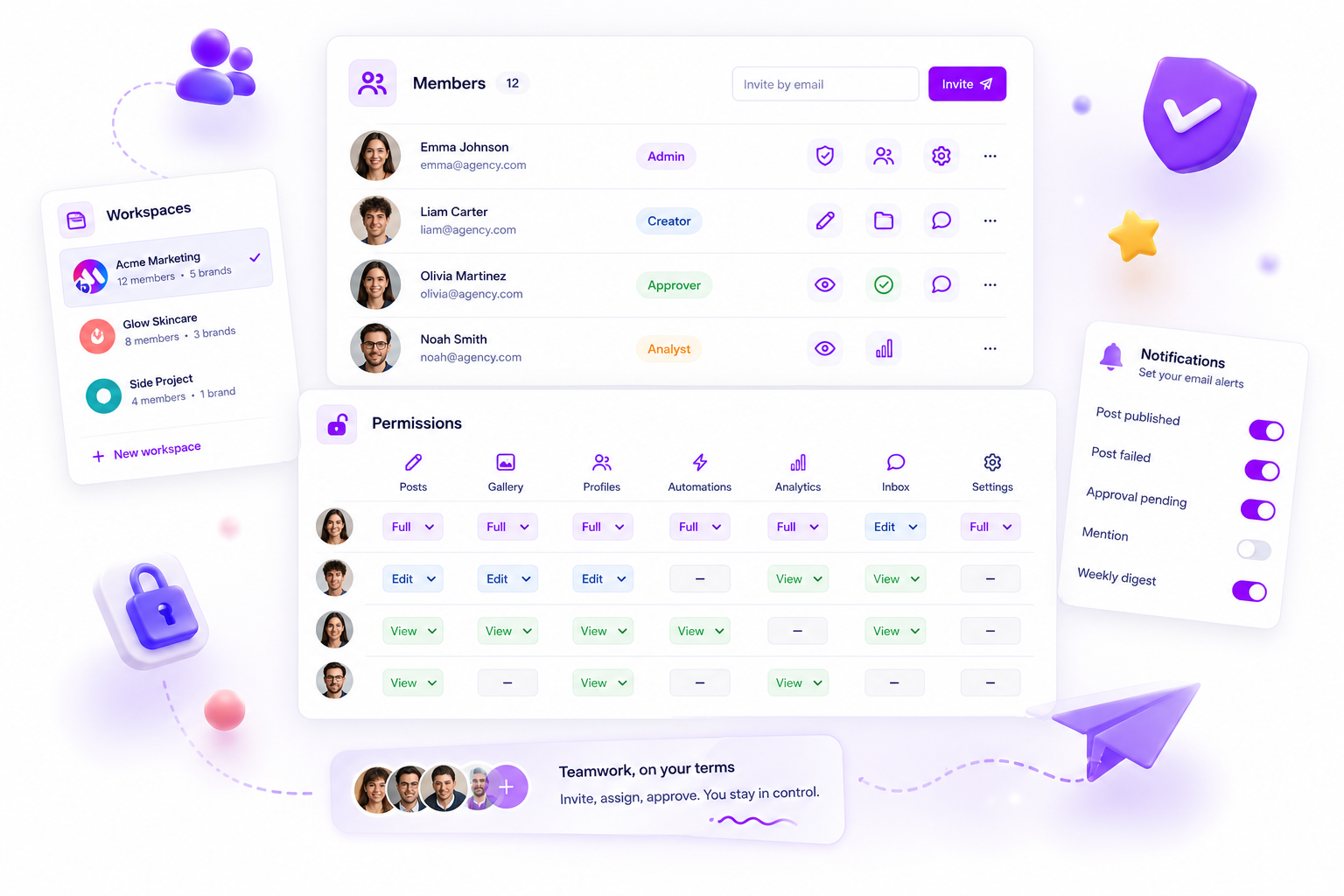
At Mydrop, we designed workspaces as true containers, not just organizational labels. Each workspace manages its own state independently: billing and quotas are ring-fenced, team member permissions are scoped specifically to that environment, and timezones are configured per client. This is how we solve the multi-brand dilemma. When your marketing team in London manages a beauty brand and your team in New York manages a retail client, the platform handles the shift automatically. The London team sees their local hours and their specific assets, while the New York team does the same, all without ever seeing the other team's drafts, internal notes, or analytics data.
Decision check: If an action or setting change in Brand A (e.g., billing, member access, timezone) impacts Brand B, your platform is failing your operational security.
By anchoring product collections to a workspace-scoped boundary, we ensure that permission checks are resolved locally. This means that if a freelancer is granted access to a specific client workspace, they literally do not exist to the system in any other workspace. You gain the operational agility to onboard new clients in minutes, knowing that the structural boundary between them is enforced at the platform level, not just by team policy.
A simple shortlist checklist
When you are trialing a new platform for your agency or multi-brand team, use this checklist to separate "tag-based" systems from true, multi-workspace platforms. If you cannot answer "yes" to these questions during your trial, you are likely looking at a tool that will eventually create a coordination bottleneck.
- Hard Billing Segregation: Does upgrading, canceling, or exceeding usage limits in one client project have zero impact on the billing or quotas of other client projects?
- Localized Context: Can you configure unique timezones, local working hours, and language settings for each workspace without affecting global platform defaults?
- Permission Isolation: If you add a user to Workspace A, are they completely invisible and inaccessible within Workspace B unless explicitly invited?
- Destructive Action Safety: If you delete a workspace or an asset within a workspace, does the platform explicitly confirm that this action is isolated to that specific container and will not purge cross-client data?
- Context Visibility: Does the application UI always show you which workspace you are currently in, and does it force a re-load of all product modules when you switch environments?
Conclusion
The transition from "simple management" to "enterprise scalability" is rarely about adding more features. It is about removing the friction that builds up when your operations are constrained by your tools. We have seen this across thousands of campaigns: the platforms that treat every brand as an isolated, independently configurable silo are the ones that survive the growth phase.
If your team is currently spending more time managing permissions, fixing timezone errors, or explaining why a client saw the wrong dashboard, you are not failing at management. You are experiencing coordination debt. The fix is not to work harder or hire more people. The fix is to ensure your underlying platform enforces the boundaries your business requires. Whether you choose Mydrop or another enterprise-grade solution, the criteria for success remain the same: demand structural isolation, protect your client data, and stop paying the price for tools that treat your diverse portfolio as a shared pool.