
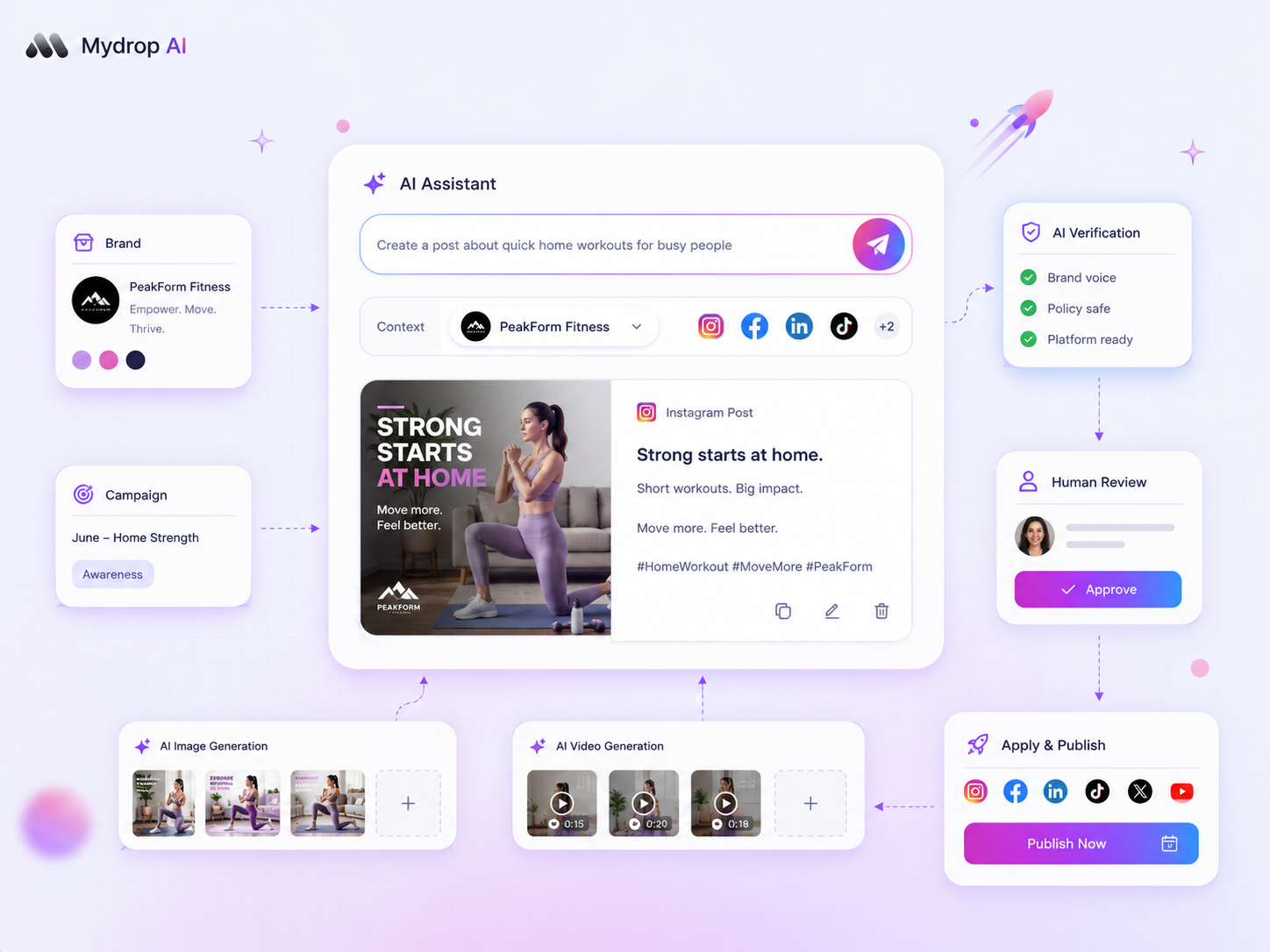
If your AI assistant generates catchy captions but cannot pull your current brand assets, verify a campaign against your existing automation logic, or apply a media plan directly to your dashboard, you are not using an assistant. You are using a chat-bot that adds administrative debt to your day.
We get it. You are juggling three different brand voices, six platform algorithms, and a content calendar that changes every hour. The work is inherently messy, and the "AI promise" of a single button click usually just leaves you with a new pile of generic drafts to copy-paste.
The real differentiator between an AI toy and a tool is the ability to bridge the gap between creative strategy and concrete, verified workspace artifacts. You don't need a "better writer." You need a workspace operating copilot that understands your specific account constraints, assets, and workflows.
Most marketing AI is designed for isolation, but enterprise social media is designed for integration. The hidden cost of "simple" AI tools is the manual labor required to move text from a chat window into your actual product workflows. At Mydrop, we have seen this across hundreds of brand profiles: the bottleneck is rarely the lack of ideas; it is the coordination debt accrued when AI outputs remain disconnected from the final publishing surface.
What the best tools need to handle

When vetting any AI-driven assistant for a multi-brand team, you need to look past the chat interface and examine the technical "plumbing" of the tool. If the AI cannot interact with your actual product objects-like your existing brand guidelines, active automations, or saved media assets-it will always provide advice that is, at best, contextually blind.
The best tools prioritize what we call an Artifact-Verification Loop. They do not just dump text into a chat box; they output structured entities that your team can review, edit, and apply.
| Feature Area | General Content AI | Mydrop Workspace Copilot |
|---|---|---|
| Context Depth | Generic web or training data | Deep-linked to your brands, assets, and analytics |
| Artifact Type | Raw text / Chat response | Executable posts, campaigns, automations, and link-pages |
| Verification | None (Blind paste) | Validation against platform rules and account settings |
| Application | Manual copy-paste | Direct movement to dashboard for review and schedule |
Operator rule: If you have to copy and paste the output into another tab, the AI is not helping you-it is just creating an extra step in your existing workflow.
True enterprise efficiency requires a tool that acts as a conduit between high-level strategy and low-level execution. This means your assistant should be able to load a specific brand blueprint, draft a campaign that respects your predefined automation logic, and then allow you to run a verification check to catch errors before the content reaches your final approval queue. Without this verification layer, you are simply replacing manual writing with manual error checking.
Where basic tools start to break
Here is the awkward truth: your social team's biggest enemy is not a lack of creativity. It is coordination debt.
When you use a generic AI chatbot to generate content in isolation, you are essentially creating a new, disconnected project that someone has to manually bring into the real world. You generate a clever hook in the chat, copy the text, hunt for the right brand asset in your drive, paste it into a scheduler, and then try to remember if that content actually aligns with the campaign you started three days ago.
This is where the cracks appear. Basic tools lack the "connective tissue" to your workspace, meaning they have no idea what you have already posted, which brand voices are currently prioritized, or what your automation rules dictate. You end up spending more time managing the AI's output than you would have spent writing the draft yourself.
We see this across teams managing dozens of brand profiles: the tool becomes a bottleneck rather than an accelerator. If the AI cannot "see" your existing brand groups, media library, or active campaigns, it is essentially hallucinating in a vacuum. You are not building a cohesive narrative; you are just layering on more manual administrative cleanup.
The buying criteria that matter
Stop evaluating AI based on how good the caption sounds. Start evaluating it on its ability to integrate into your actual operating environment. If it doesn't move you from idea to a verified, platform-ready artifact in one session, it is just another tab you will eventually close.
Use this scorecard to vet your next software purchase. This helps you distinguish between a fun toy and a serious workspace copilot.
Workflow Fidelity Scorecard
| Dimension | Standard "Chat-Only" Model | Workspace-Operating Copilot |
|---|---|---|
| Context Depth | Generic, prompt-based only | Real-time workspace entities (assets, analytics) |
| Artifact Output | Raw text in a chat bubble | Structured objects (posts, campaigns, media plans) |
| Verification | Blind trust / User copy-paste | Built-in validation rules & error checking |
| Execution | Manual platform export | One-click application to workspace objects |
Decision check: If you have to move data across more than two tools before hitting "schedule," the AI is just shifting your workload, not reducing it.
Your 5-point vetting checklist
Before signing on the dotted line, ask these five questions to see if the tool respects your team's reality:
- Does it know my brands? Can the agent pull from your existing style guides and asset folders, or does it ask you to "paste your brand voice" every single time?
- Can it build an executable plan? Does it generate a abstract "strategy document," or can it create a structured media plan that maps to your calendar?
- Is there a verification step? Does it have a specific route to flag potential issues-like missing media, broken links, or mismatched campaign tags-before you approve the draft?
- Does it touch the dashboard? Can the tool interact with your actual platform objects, or is it strictly a text-generating service?
- Does it handle artifacts? Does the output look like a draft post, campaign, or automation that you can simply click to apply?
At Mydrop, we usually see that the most successful teams prioritize operational speed over pure creative output. They don't need a robot that writes 10,000 words an hour; they need a partner that ensures the one post they do publish is accurate, approved, and correctly aligned with the brand strategy.
When you finally strip away the generic chat features, you are left with one critical realization: the best tool is the one that minimizes the distance between "I have an idea" and "this is live."
How Mydrop supports this workflow
At Mydrop, we see teams managing hundreds of brand profiles often lose hours just moving text between a chat window and a production dashboard. The goal of our AI assistant isn't to write faster, but to eliminate the manual labor of turning a draft into a ready-to-publish asset.
When you ask the Mydrop agent for a campaign, it doesn't just return a block of text. It generates a structured artifact. Because the agent has access to your workspace context-your specific brand assets, active automations, and even your historical analytics-that draft is already grounded in your reality.
It handles the heavy lifting by:
- Verification: Running the draft against your brand guidelines and platform-specific requirements before you see it, preventing those annoying last-minute edits.
- Direct Application: Allowing you to push the verified draft directly into your composer, link-in-bio page, or campaign dashboard, so you never have to copy-paste between windows.
- Integrated Strategy: Moving seamlessly from high-level brainstorming to creating executable objects, like automation triggers or multi-platform post sets, in a single session.
Essentially, you stop being a manual translator for your AI and start acting as the final editor for your automated systems.
A simple shortlist checklist
If you are evaluating tools, don't get distracted by flashy generative demos. Use this checklist to see if a platform can actually scale with your team.
- Context Injection: Can the tool pull your current brand assets, active campaigns, or internal documents without you manually uploading files every time?
- Artifact Fidelity: Does the AI output a structured object (like a campaign, post, or link page) that your dashboard recognizes, or just a raw text snippet?
- Pre-Publish Safeguards: Is there a dedicated validation step that checks for platform-specific errors before you attempt to save or deploy?
- Downstream Integration: Can the generated content be applied to your live workspaces without leaving the platform's native interface?
- Collaborative Approval: Does the workflow allow you to share the AI-generated artifact with stakeholders for review before the final application?
If a tool forces you to copy-paste content into your scheduler, it is not an enterprise assistant; it is a creative notepad.
Conclusion
Most social media teams do not have a creative problem. They have a coordination bottleneck. When you stop chasing the "next big AI writer" and start looking for a workspace-aware partner, your entire workflow changes. You move from fighting your tools to simply steering them.
The best AI assistant is the one that disappears into your day-to-day work, handling the messy, repetitive assembly of posts and campaigns so your team can focus on the strategy that actually drives brand growth. Stop settling for chat-bots that generate more work. Start demanding a partner that knows your brand as well as you do.