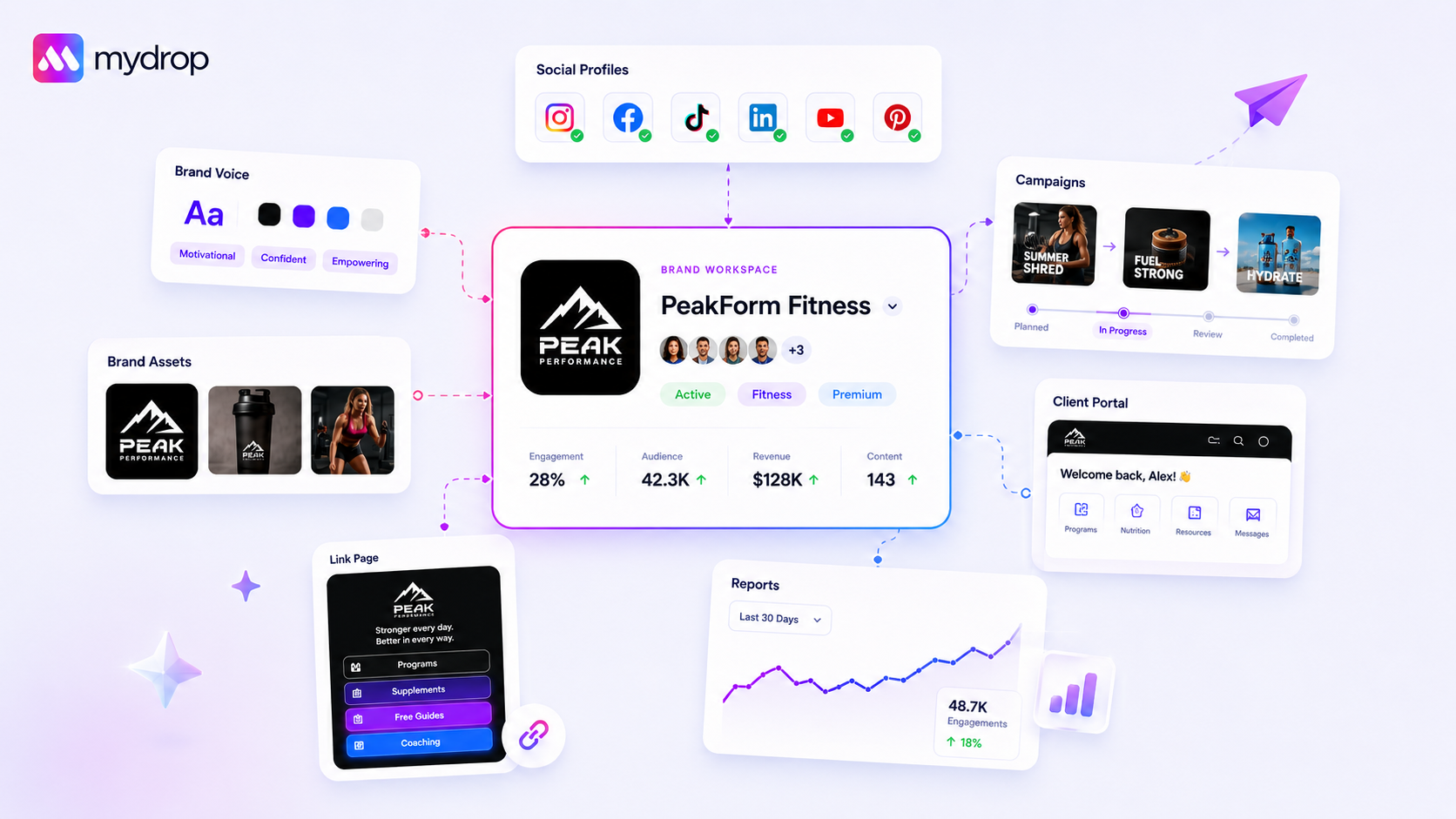
Agencies manage multi-brand complexity not by centralizing accounts, but by isolating them at the structural level. We have all felt that cold sweat when you realize a client campaign is queued for the wrong brand’s profile. It happens when your platform treats every client as just another folder in a shared closet. You need a platform that treats every client as a distinct, fire-walled container. This shift from "unified dashboard" to "containerized workspace" isn't just a technical preference; it is the only way to scale without constant, high-stakes manual intervention. When your infrastructure mimics your organizational structure, permissions become bulletproof and cross-contamination vanishes.
What the best tools need to handle

The core of the problem isn't your team's attention span; it’s the coordination debt built into legacy "all-in-one" platforms. If your tool doesn’t enforce strict data boundaries at the container level, you aren't just working; you are actively maintaining a risk factory.
To stop the bleeding, you need to demand "Isolation by Design, Collaboration by Policy." Here is how to evaluate the structural integrity of your current stack versus where you need to be.
| Feature | Unified Platform (The Risk) | Containerized Platform (Mydrop-Style) |
|---|---|---|
| Access Control | Global, often "all-or-nothing" | Per-workspace, granular membership |
| Data Exposure | Shared database; high risk of leaks | Isolated workspaceId boundaries |
| Billing/Quotas | Aggregated; impossible to audit per client | Client-specific budgets and limits |
| Configuration | Global settings force uniformity | Localized timezones, workflows per client |
When we talk about containerization, we mean that every client environment acts as its own sovereign state. A designer working on Brand A should technically not exist in the context of Brand B unless they are explicitly invited. If a platform doesn't have a concept of a workspace-scoped boundary, every new hire or contractor becomes a liability.
Common mistake: Treating "workspace" as just a label or a folder name, rather than a hard technical boundary for permissions and data scoping.
Basic tools start to fail when they treat the "workspace" as a simple view switcher on top of a shared, flat database. That's why you end up with "accidental cross-pollination." The best tools use workspace-aware architecture, where every single request is validated against your active workspace member document. This means the system doesn't ask if a user has access; it simply refuses to see data that doesn’t belong to the container they are currently in.
This architecture is the difference between hoping your team doesn't make a mistake and structurally guaranteeing that they cannot.
Where basic tools start to break

When you manage one brand, a flat structure feels simple. When you manage ten, it becomes a liability. Most platforms treat your organization as a single bucket, forcing every asset, campaign, and team member into the same global namespace. This is where the coordination debt quietly builds up until it crashes your process.
If your tool lacks true container isolation, you are essentially asking your team to navigate a minefield of shared configurations. We have seen teams where a new hire inadvertently changes the timezone for five global markets because there was only one system-wide setting. Or worse, the "marketing" folder becomes a digital junkyard where an intern accidentally deletes a high-stakes campaign creative for the wrong client because permissions were too porous to restrict access.
Flat structures fail because they prioritize convenience over safety. They assume your agency is a monolith, not a collection of independent, sensitive client environments. When the platform doesn't enforce boundaries at the data level, you spend more energy policing your own team to avoid cross-contamination than actually building strategy.
Operator rule: If you have to rely on a "don't touch that" policy to keep client data separate, your platform is not designed for agencies.
The buying criteria that matter
Stop evaluating platforms by their feature list alone. Start evaluating them by their architectural integrity. You need to know how the platform handles the invisible walls between clients. If you are shopping for a new workspace platform, run every candidate through this decision matrix to see if they are built for scale or just for show.
The Agency Decision Matrix
| Capability | "Unified" Architecture | "Containerized" Architecture |
|---|---|---|
| Data Boundary | Shared, global scope (High risk) | Workspace-scoped (Isolation) |
| Permission Scope | All-or-nothing access | Granular, member-level per space |
| Billing & Quotas | Aggregated, opaque | Client-specific, trackable |
| Configuration | Global settings (Rigid) | Localized, per-workspace |
| Recovery | Destructive & global | Isolated, contained impact |
When assessing your next platform, audit it against these five critical criteria:
- Strict Data Scoping: Can I explicitly see which client environment I am in at all times? Does the platform filter every API request and collection view by a specific ID, or can data bleed across brands?
- Permission Granularity: Can I invite a client’s internal auditor to one specific workspace without them seeing anything else in our organization?
- Localized Timezones: Can I set the operating hours for a workspace in New York, while the workspace for our London client remains synced to GMT?
- Operational Memory: Does the platform remember which workspace I was last in? Constant toggling in a UI creates enough cognitive load to guarantee a human error eventually.
- Billing Transparency: If a client asks why their budget is exhausted, can I pull a usage report isolated solely to their workspace?
The goal is to shift your operational load from human oversight to system-enforced safety. If the platform does the heavy lifting of keeping your client data isolated by design, your team can finally focus on the actual work instead of playing digital babysitter. At Mydrop, we approach this by anchoring every piece of product data to a unique workspaceId, ensuring that you never have to worry about cross-brand leakage-because the platform quite literally wouldn't know how to cross those lines even if it tried.
How Mydrop supports this workflow
When you are juggling five different brand launches, the last thing you need is a platform that treats your entire agency as one big, muddy soup. We have seen teams hit the wall when they realize their unified tool is actually a cross-contamination machine. At Mydrop, we built our architecture around strict container isolation because we know that managing brands requires a hard wall, not a soft filter.
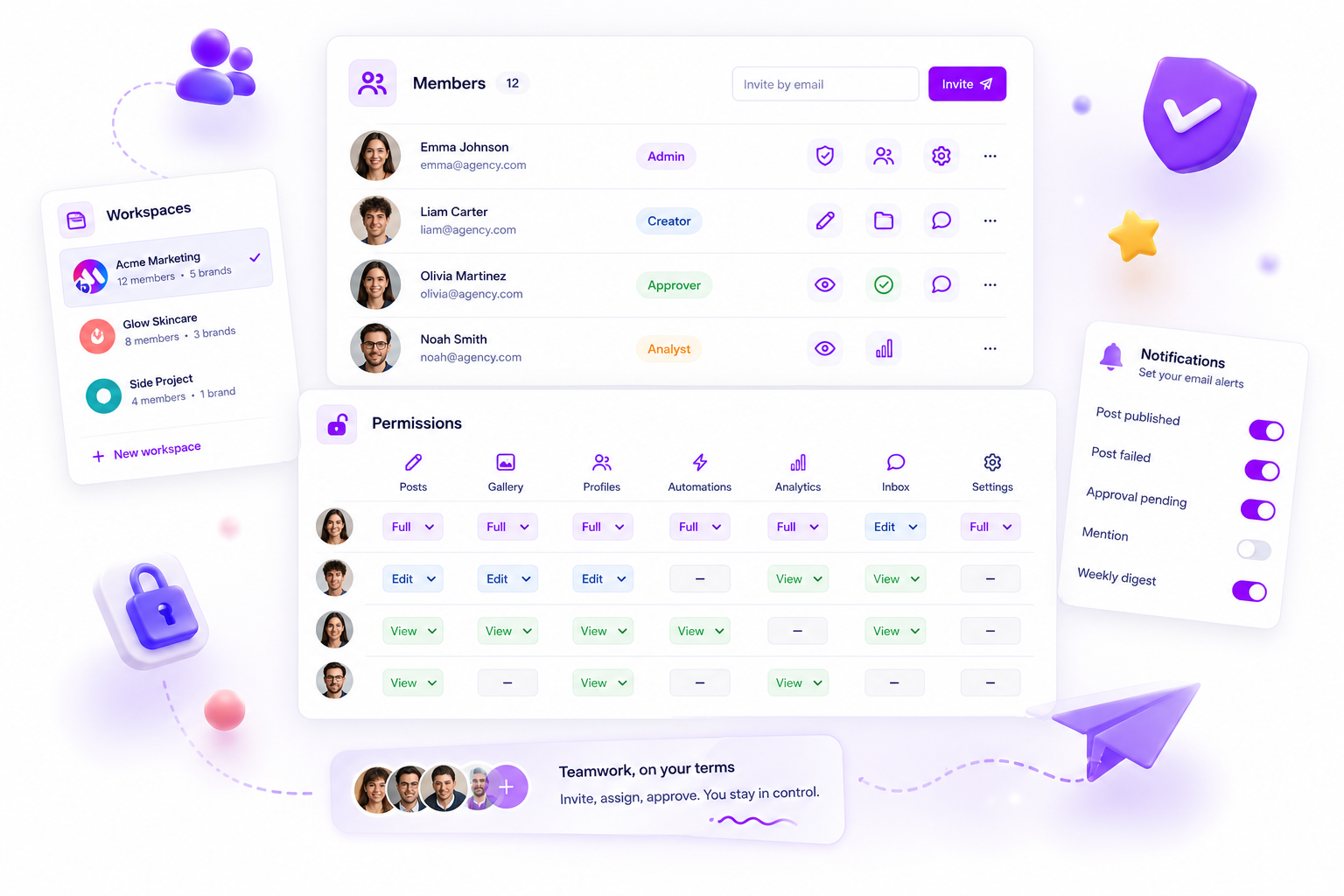
Every Mydrop workspace is a self-contained unit. When you switch environments, you are not just changing the UI view; you are forcing the platform to re-scope every request based on that unique workspace identifier. Permissions are validated locally against that workspace member list, not against a global permission setting. If a contractor is added to the Beauty Brand X workspace, they exist only within that environment. They cannot see your Tech Client Y campaigns, your internal team communications, or your sensitive client billing data.
This structural isolation means you can give your team exactly the access they need, right where they need it. And because we know you are moving fast, we handle the state management for you. The application remembers the last workspace you were working in. When you log in, you are right back in the right client environment. It stops that split-second jolt of panic when you realize you are looking at the wrong calendar.
Decision check: If your team has to constantly double-check if they are in the right client account, your platform has a structural design flaw.
A simple shortlist checklist
If you are ready to stop managing your platform like it is one leaky, global bucket, put your current or potential vendors through this audit. If they cannot answer yes to all five, they are going to cost you more in coordination debt than you realize.
| Audit Criteria | Why it matters |
|---|---|
| Data Boundary Enforcement | Is data containerized by a unique ID, or is it just a hidden UI filter? |
| Permission Depth | Can you restrict team members by client, or is it all or nothing access? |
| Localized Operations | Does each environment support its own timezone, approval loop, and workflow? |
| Billing Transparency | Can you run client-specific usage reports without manual data cleanup? |
| State Persistence | Does the platform reliably keep you in the correct workspace? |
Conclusion
The point of a workspace platform is not to give you more features; it is to give you operational sanity.
If your current tool is forcing you to manually police data boundaries or keep you in a constant state of low-level worry about cross-brand contamination, you are paying a massive hidden tax in cognitive load. You have enough fires to put out on a Tuesday afternoon. Your tools should be the quiet, reliable foundation that holds everything together, not another set of variables you have to manage.
Pick a structure that enforces isolation by design. When your platform handles the boundaries, your team can stop worrying about where they are and finally start focusing on the work that actually builds the brand. The most scalable agencies are not the ones with the most tools; they are the ones with the best-defined containers.