
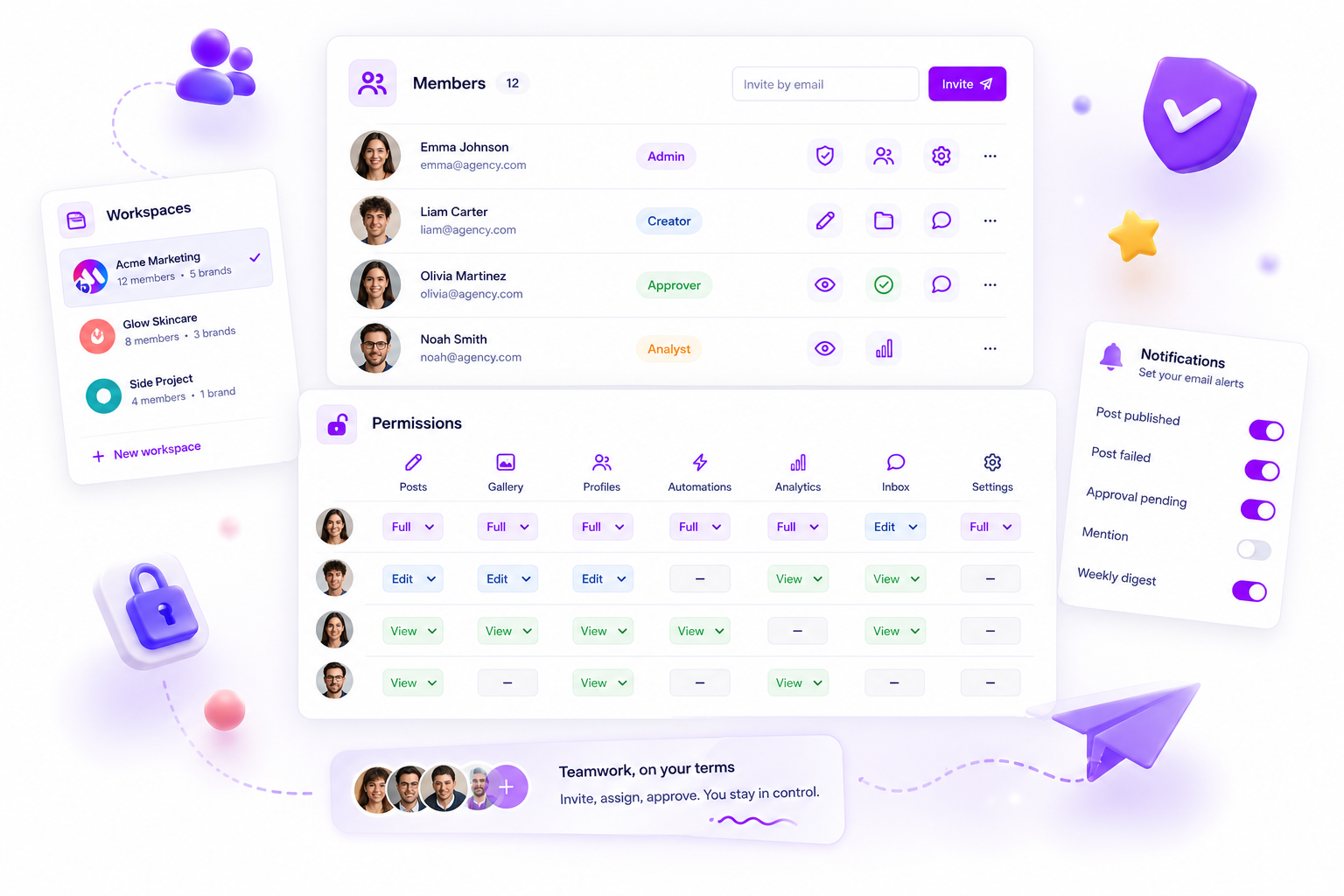
Managing five distinct brands across ten channels isn't just a collaboration challenge, it is a security perimeter challenge. When your publishing velocity increases, the risk of a wrong-brand tweet or a shared asset leaking across client environments grows exponentially. If your platform isn't designed to enforce hard boundaries between those brands from the start, your team is playing a dangerous game of don't click that. We have all been there, hovering over the Publish button, sweating over whether we have the right account selected. That constant, low-level anxiety that you might accidentally dump a draft into the wrong channel is a silent burnout factor. The truth is, the shared everything architecture is a recipe for professional disaster. True multi-brand security does not come from team-sharing settings, it relies on architectural isolation at the workspace level.
What the best tools need to handle

Most platforms market team collaboration as the ultimate operational solution. In reality, for a team managing multiple brands, collaboration without strong isolation is a massive security liability. When you are operating at scale, you need your software to be a guardrail, not just a canvas.
Here is where most generic tools fail: they assume every team member should see every brand, asset, and report. They treat permission as an afterthought on top of a flat, shared database. You need a platform that treats the Workspace as a hard, immutable boundary for data, assets, and permissions.
Common mistake: Relying on user-level tags to hide assets from other teams. If a team member can browse the global media library, your brand boundaries are already broken.
At Mydrop, we see this constantly: the teams that struggle the most are the ones fighting their own software to keep assets separated. To stop the accidental leaks and streamline the chaos, your platform needs to handle these four areas:
| Feature | What it should actually do | Why it matters |
|---|---|---|
| Data Containerization | All assets, drafts, and analytics must be scoped to a specific workspace ID. | Prevents cross-brand data leakage at the database level. |
| Permission Granularity | Role-based access must resolve within the context of an active workspace. | Ensures stakeholders only affect the brands they are authorized to manage. |
| Operational Friction | The UI must force a conscious switch when jumping between different clients or units. | Eliminates wrong-brand publishing errors caused by UI fatigue. |
| Destructive Safeguards | Deleting a workspace or client unit must be permission-gated and irreversible. | Protects against accidental mass-deletions of client production environments. |
When you support thousands of users across hundreds of profiles, this isn't optional, it is the foundation. If your tool doesn't containerize your workspaces, you are likely working harder than you need to, constantly auditing permissions that should be locked by default. The best tools don't just ask you to be careful, they make it impossible to be reckless.
Where basic tools start to break

If your platform treats every team member as a global admin, you are already operating with a "data leak" disaster waiting to happen. We’ve seen this pattern thousands of times: a platform allows everyone in the account to see every asset, every draft, and every channel, regardless of which brand they are actually supporting.
Here is the awkward truth about "shared-everything" platforms: they were likely built for a single brand team and then bolted on "user management" later.
This leads to a specific kind of operational chaos. You end up with:
- Asset Sprawl: Your agency designers upload a graphic for Client A, but it’s sitting in a global library that Client B’s social manager can accidentally pull.
- The "Wrong-Channel" Panic: Because the platform doesn’t enforce strict per-brand containers, a team member switching between brands is just one wrong dropdown click away from publishing a draft to the wrong audience.
- Permission Bloat: You end up giving people "Admin" rights just so they can do their daily work, simply because the platform’s permission system isn't granular enough to restrict them to just one specific brand's assets.
Most teams assume this is just the cost of doing business. It isn’t. It’s a design failure. If you have to rely on your team "being careful" to avoid a brand-damaging tweet, you haven't solved the problem-you've just added more coordination debt to their day.
The buying criteria that matter
When you are ready to move away from the "hope nothing goes wrong" workflow, you need to look for architectural isolation. You aren't just looking for "folders"; you need a platform that treats a brand environment as an immutable container.
At Mydrop, we approach this by using Workspaces as hard, security-boundary containers. When a user is in a specific workspace, they simply cannot see data or assets from another one. The system isolates billing, team members, and product data at that container level.
If you are evaluating tools, use this scorecard to grade your current setup.
The Multi-Brand Security Scorecard
| Capability | Basic Tool Behavior | Enterprise-Ready (Mydrop-level) |
|---|---|---|
| Data Isolation | Global bucket for all brands | Workspace-scoped container |
| Access Control | Flat "Admin vs. User" roles | Granular permissions per workspace |
| Asset Security | Visible to all members | Locked to active workspace context |
| Accidental Cross-Post | High risk; shared environment | Hard boundary; context-specific |
| Operational Friction | High; manual cleanup required | Low; automated scope enforcement |
Operator rule: If a platform’s "Workspace" feature is just a label for a shared folder and doesn't explicitly restrict who sees what data, it is not an enterprise-grade multi-brand solution. It is just a different view of the same leaky bucket.
When you look for your next platform, ask the vendor this: "If I invite a consultant to work only on Brand A, is there any scenario where they can see assets, reports, or scheduling details for Brand B?"
If they start talking about "complex team settings" or "custom views," run. A secure platform should provide a simple, definitive "No."
The goal is to eliminate the possibility of cross-brand errors at the software level. When your tools do the heavy lifting of security, your team can focus on the actual strategy-not on double-checking whether they are about to tweet to the wrong client. Remember, professional anxiety is a silent burnout factor; take it off your team's plate by choosing a platform that actually enforces the boundaries they need to stay safe.
How Mydrop supports this workflow
At Mydrop, we have found that the most effective way to handle multi-brand complexity is to treat each workspace as a hard-walled vault. When you manage dozens of channels, you cannot rely on "administrative discipline" or manual checks to keep your brand assets from leaking. You need an architecture that makes it physically impossible to mix up client data because the platform itself segregates it at the root.
In Mydrop, every core object-your product collections, billing, member rosters, and team settings-is strictly scoped to its own workspaceId. When a user switches from an agency client environment to an internal brand project, they aren't just changing a filter; they are switching their entire authorization context. This architectural isolation is what prevents the catastrophic "wrong-brand" tweet. The platform simply does not know that assets from "Brand A" exist when you are operating inside "Brand B."
We designed this with a few operator-first principles:
- Context switching that sticks: The application remembers your last active workspace for every user, so when you log in, you are immediately dropped into the correct environment.
- Permission-gated actions: Because member access is explicitly mapped to the workspace, you can confidently grant junior team members full posting privileges in one environment while restricting them to read-only access in another.
- Containerized billing and quotas: You never have to worry about one brand's publishing volume accidentally consuming the quota or budget allocated for another.
This setup removes the silent, ongoing anxiety of "Am I working in the right place?" You know you are, because the UI only shows you what belongs to that specific, isolated boundary.
Decision check: If your platform lets a user see assets from all brands by default, you have not built a multi-brand workflow; you have built a data leak waiting to happen.
A simple shortlist checklist
Before you commit to a platform, run it through this four-pillar audit. If a tool fails more than one of these checks, keep looking.
| Pillar | Requirement | Why it matters |
|---|---|---|
| Asset Isolation | Are brand assets strictly partitioned by workspace? | Prevents accidental cross-pollination of creative work. |
| Permission Granularity | Can you set unique member roles per workspace? | Ensures staff only access what they need for that specific client. |
| Operational Friction | Does switching workspaces take more than one click? | High friction leads to users staying in the wrong workspace. |
| Destructive Safeguards | Are deletions permission-gated and scoped? | Prevents a rogue user from nuking data across other brands. |
Watch out: Many teams evaluate platforms based on how many features they have rather than how well those features are partitioned. A feature is only an asset if it is contained.
Conclusion
Most teams do not have a content problem. They have a coordination debt problem. The pressure to publish more without losing control is only going to increase, and you cannot fix fundamental architectural issues with more meetings or better spreadsheets.
You need a platform that treats your brand boundaries as sacred. Whether you are scaling an agency or managing a massive internal portfolio, the right workspace setup doesn't just make you faster; it gives you the professional confidence that everything is exactly where it is supposed to be.
If you're currently spending your Friday afternoons double-checking permissions or worrying if the right assets are in the right draft folder, it is time to stop patching your current workflow and start upgrading your infrastructure. Secure, isolated workspaces aren't a luxury feature. They are the baseline requirement for staying sane at scale.