
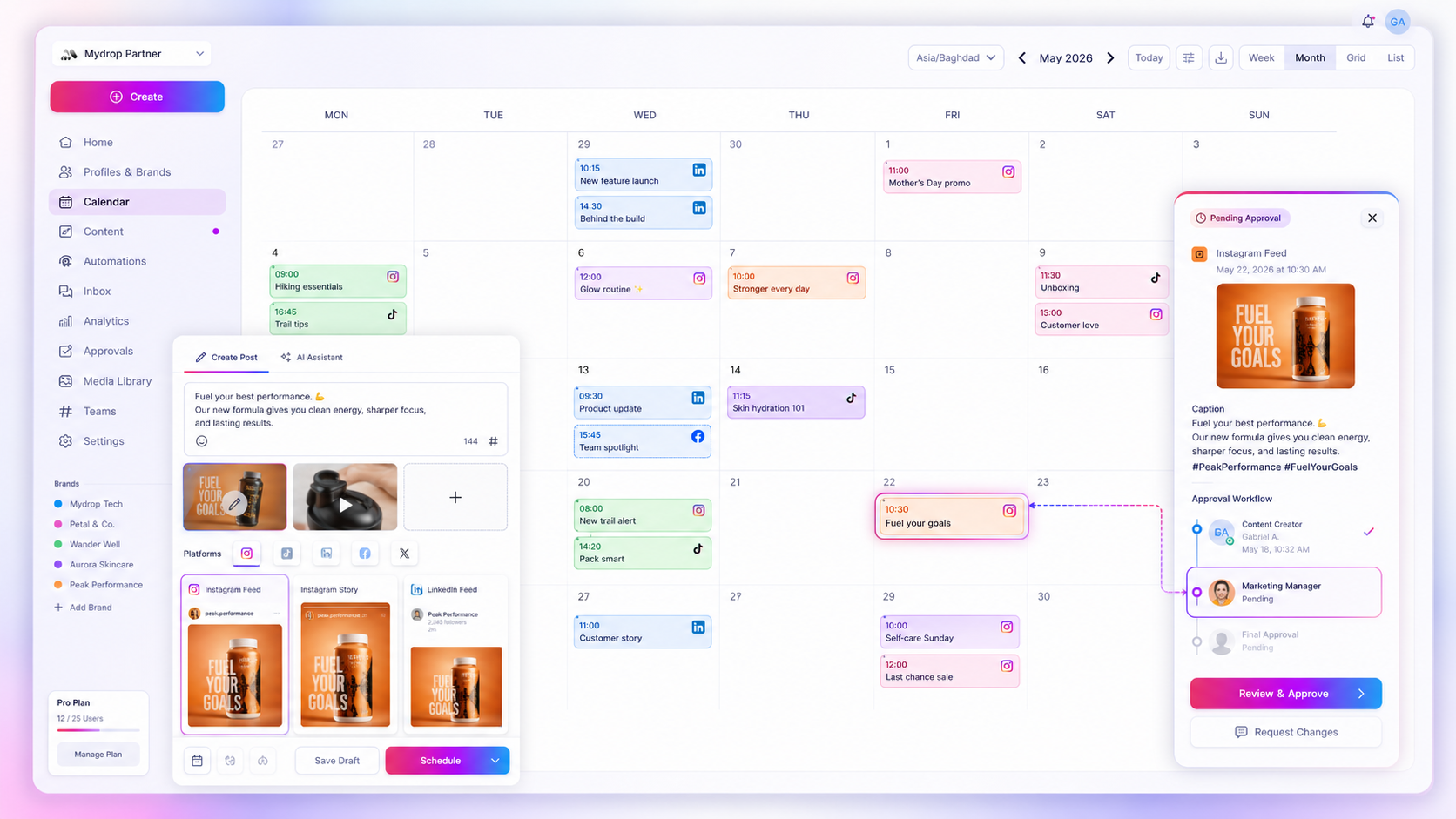
The best social media teams do not just track tasks; they anchor them. By embedding operational reminders directly into the posts, profiles, and media they support, high-performing teams eliminate the task-context gap that causes campaigns to derail during execution. Most managers treat their to-do lists as separate, static documents. This forces them to constantly hunt for the "where," "why," and "who" behind every assignment. When your planning tool does not actually know which post or media asset a task belongs to, you are not managing a campaign; you are just managing a list of distractions.
We get it. You are juggling dozens of channels, hundreds of assets, and a calendar that never stops. Your team is moving fast, and the to-do list always seems to drift away from the content you are actually building. This friction is not a sign of poor discipline. It is a failure of your toolset to keep up with your workflow. The awkward truth is that most task managers are context-agnostic. They tell you what to do, but they don't know what it is for. That gap is where campaign details die and team frustration grows.
Moving away from siloed spreadsheets requires a Link-First Planning approach. Never create a task without an immediate, digital tether to the associated post, media, or profile.
What the best tools need to handle

When you are managing operations across multiple brand profiles and stakeholders, a generic checklist will eventually become a liability. You need an operational layer that treats reminders as dynamic campaign components rather than isolated notes.
Here is where teams usually get stuck: they choose tools that track "tasks" instead of tools that manage "campaign state." Your planning platform needs to pass a simple audit before you trust it with your production calendar.
Operational workflow audit: Siloed vs. Connected
| Friction Point | Siloed Task Approach | Connected Mydrop Approach |
|---|---|---|
| Asset Location | Searching Drive for the right file. | Reminders are linked directly to the media doc. |
| Status Updates | Manual ping in Slack or email. | Done state syncs automatically to the calendar. |
| Context Switching | Hunting for the post ID or URL. | Open reminder, see the attached post instantly. |
| Repetitive Work | Recreating tasks for every campaign. | Recurrence rules handle repeat operations. |
| Calendar View | Managing two separate windows. | All-day tasks and timed alerts live on one surface. |
Operator rule: If a task requires you to open more than one application to understand what you need to do, it is a debt-building exercise, not an operational workflow.
The best tools force this connection at the point of creation. When you create a reminder, the editor should prompt you to attach specific campaign objects-not just a text description. This ensures that when a stakeholder or creative lead opens a reminder, they see the associated post, the profile it is hitting, and the exact asset version that needs review.
Most teams do not have a content problem. They have a decision bottleneck. When your tasks are properly anchored to your campaign objects, that bottleneck finally has a name, a due date, and a direct path to the finish line.
Where basic tools start to break

Here is the awkward truth about your project management tool: it is context-agnostic. It knows you have a task labeled "Finalize copy for Q3 launch," but it has no idea which post, media asset, or brand profile that task is actually tethered to.
This creates a hidden tax on your team’s performance. When a notification pings you about a reminder, you stop what you are doing, open the task, realize you need to find the draft, hunt through your file storage or another app for the asset, and then-finally-you can act.
Across hundreds of posts, that five-minute context-switching loop isn't just an annoyance; it is a coordination debt that eventually cripples your output.
The Hidden Costs of Fragmented Planning
| Friction Point | The "Siloed" Reality | The "Connected" Benefit |
|---|---|---|
| Asset Discovery | Searching Slack/Drive for the right file version. | Task links directly to the specific media doc. |
| Status Sync | Manually updating the task when the post is ready. | Task state updates automatically with the post workflow. |
| Ghost Tasks | Reminders that linger after the post is live. | Reminders archive or complete alongside the campaign. |
| Stakeholder Loop | Copy-pasting post details into email updates. | Stakeholders see the linked asset within the reminder. |
When your planning tasks exist in a vacuum, you are essentially managing a list of distractions rather than a content machine. You spend more energy maintaining the list than you do managing the actual brand campaign.
The buying criteria that matter
If you are looking to upgrade your stack, do not just count features. Demand a workflow that bridges the gap between the calendar and the creative.
Your next tool must treat a planning reminder as a first-class citizen of the campaign itself, not as an external note attached to a calendar event.
- Native Object Tethering: Can you attach a post, a media file, or a specific brand profile to a reminder at the point of creation? If the answer is "no," you are still working in a silo.
- Contextual Awareness: When you open an operational reminder, does it show you the preview of the post and the linked assets without forcing you to open a second window?
- Automated State Sync: Does marking a task "Done" carry weight? In a mature system, an operational reminder should be able to trigger status changes across the team’s dashboard or sync those milestones back to your external calendar automatically.
- Recurrence Logic: High-volume teams need recurring tasks-think "weekly influencer outreach" or "monthly performance review"-that persist without you having to recreate the same reminder from scratch every time.
Decision check: Never create a task without an immediate, digital tether to the associated post, media, or profile. If the tool forces you to keep two windows open to track one asset, the tool is the problem, not your process.
At Mydrop, we built our reminder layer specifically to solve this disconnect. We saw too many teams managing dozens of channels where the "to-do" list was a separate, high-maintenance chore. By embedding operational tasks directly into the campaign objects, you shift the focus from "tracking work" to "executing strategy."
The goal is to stop being a project manager for your own team and start being a campaign strategist. When the tools handle the context, the team can handle the creative.
How Mydrop supports this workflow
At Mydrop, we built the reminders feature specifically to bridge the gap between your calendar and your campaign assets. Instead of treating tasks as generic list items, you anchor them directly to the reality of your content. When you create a reminder, you are not just setting an alert; you are creating a digital tether to the specific post, profile, or media asset that requires action.
If you are a manager overseeing dozens of channels, this changes how you view your week. You can link a recurring task-like "Monthly influencer outreach report"-directly to the specific profiles involved. When the reminder triggers, you are already where the work happens. You open the reminder, click the attached media or post, and you are ready to execute.
We also built in a done-state sync. When you mark a task as complete, that status reflects back to your Google Calendar. It keeps the "always-on" nature of campaign operations connected to the tools your wider team actually uses. By treating reminders as a structured task layer, you move from "chasing updates" to "verifying progress" because the tasks live in the same UI as the campaign itself.
A simple shortlist checklist
Before you commit to a new workflow, check your current process against this reality test. If you answer "no" to more than two of these, your coordination debt is likely higher than you realize.
| Audit Point | Why it matters |
|---|---|
| Asset Tethering | Can you jump directly from a task to the post asset? |
| Context Persistence | Does the task history stay with the post after it publishes? |
| Calendar Native | Do your stakeholders see these tasks on their actual calendars? |
| Recurring Logic | Can you automate repetitive tasks without re-creating them? |
| Done State Sync | Does a checkmark in your app update your team calendar? |
Workflow check: If a task takes more than three clicks to find the asset it relates to, it is not a task. It is a distraction.
Conclusion
The difference between a frantic team and a high-performing one usually comes down to how they handle the "small" things. It is rarely the strategy that fails; it is the execution of a thousand tiny, unlinked tasks that slip through the cracks when no one is looking.
Most teams do not have a content problem. They have a decision bottleneck caused by missing context. By anchoring your tasks to your campaign objects, you stop treating execution as a mystery and start treating it as a transparent, repeatable process.
Your goal is not to track more tasks. It is to make every task so tied to your output that it becomes impossible to ignore, lose, or forget. Stop managing lists, and start managing your campaign.