Stop forcing generic project management tools to handle content-ops. If your task system does not know what the post is, it is not helping you manage content. It is just helping you manage a to-do list while you are blind on campaign performance. Agencies need specialized content-operations tools that natively link to campaign assets because generic tools create costly context-switching and visibility gaps. We get it. Social media planning feels like a high-stakes relay race. When tasks are disconnected from the actual posts, profiles, and media, execution becomes a breeding ground for missed deadlines and lost context. Here is a framework to evaluate if your tool is scaling your output or just creating administrative overhead.
What the best tools need to handle

Content operations at an agency scale is not just about keeping a schedule. It is about maintaining coordination density across dozens of stakeholders, hundreds of brand profiles, and complex approval loops. When you have five markets running a product launch simultaneously, the primary failure mode is not a lack of ideas but a collapse of coordination.
For a task tool to be effective in this environment, it must treat content as its primary object, not as an afterthought or a link. Here is what you should expect from a tool built for this purpose:
- Native Asset Integration: A reminder or task must allow you to attach the specific post, media asset, or profile directly. If you are copying URLs from one tab to another, you have already lost the battle.
- Contextual Recurrence: Content cycles are rarely one-off events. You need tools that handle hourly, daily, or weekly cadence, specifically for things like community management check-ins or recurring editorial meetings.
- Global Visibility and Status: You need a single view where an operational task is clearly marked as "done" or "in-progress" across the entire team. If you have to click into a ticket to see if the work was finished, you are wasting time.
At Mydrop, we see teams struggle most when they treat every action as a standalone ticket. A reminder should act as a node in your campaign map. When you can mark an occurrence of a recurring reminder as done and see that status reflect automatically across shared views, you stop chasing updates and start executing campaigns.
Decision check: If you find your team spending more time updating the task tool than actually working on the content, you are likely suffering from the Task-Content Gap.
The best tools bridge the divide between planning and execution by ensuring that the task itself carries the context of the asset it supports. You should not have to manually sync your project management tool with your campaign calendar. It should be one and the same.
Where basic tools start to break

The real friction starts when your team hits scale. You might survive with a generic project management tool when you are juggling a handful of posts for one brand. But try managing a campaign across three platforms, two markets, and a dozen stakeholders, and the cracks appear fast.
The primary issue is the Task-Content Gap. When your task management system treats a post as just a URL in a description field, it is not actually managing content. It is managing a to-do list that is permanently out of sync with reality.
Think about the manual work involved. Every time a deadline shifts or a creative asset is updated, you are forced to perform double-entry data management. You update the post in your planning platform, then you hunt down the corresponding task in your project manager to manually update the date, link, or status. It is slow, it is prone to human error, and it is the definition of coordination debt.
When you spend two hours a week just ensuring your tasks match your actual content calendar, you are not being productive. You are being a manual data-synchronization engine.
The buying criteria that matter
Stop evaluating tools based on how pretty their Kanban boards are. You need a platform that understands your operational reality. If you are shopping for a tool to manage content-ops tasks, your evaluation should focus on workflow integration, not feature parity.
Here is a simple matrix to help your team decide if your current setup is helping or hindering your output.
| Feature | Generic PM Tool (Asana/Jira) | Content-Ops Tool (Mydrop) |
|---|---|---|
| Asset Linking | Manual / URL-based | Native (Posts/Profiles/Media) |
| Campaign Context | Disconnected | Integrated |
| Calendar Sync | Basic / Add-on | Deep (Google Calendar) |
| Content Ops Workflow | Too broad / Generalist | Built-in (Recurrence/Exceptions) |
When you are assessing options, run this quick Reality Check with your team:
- Does your task manager know what the post actually is, or is it just holding a URL to the post?
- Do you have to update a calendar event when a publish date changes in your project tool, or does it update automatically?
- Can you mark a recurring planning task as done for just this week without breaking the entire series or deleting the history?
If your answer to these questions is no, you are paying for administrative overhead, not operational efficiency.
At Mydrop, we designed the Reminders feature specifically to address this. We wanted to ensure that planning tasks live as nodes within your campaign map rather than standalone, disconnected tickets. When a reminder is natively linked to a post, profile, or media asset, it stays connected to the actual work throughout the entire execution phase.
If you find that your team spends more time updating task statuses than actually reviewing creative, you have outgrown your current toolset. Most teams do not have a content problem. They have a decision bottleneck. The right tool should remove that friction, not add another layer of manual logging to your day.
How Mydrop supports this workflow
If your planning feels disconnected, the solution isn't to build a better spreadsheet or add more automation. It's to stop the data from living in two places at once. At Mydrop, we designed the Reminders feature precisely to bridge that gap by treating tasks as part of the campaign architecture, not as standalone tickets.
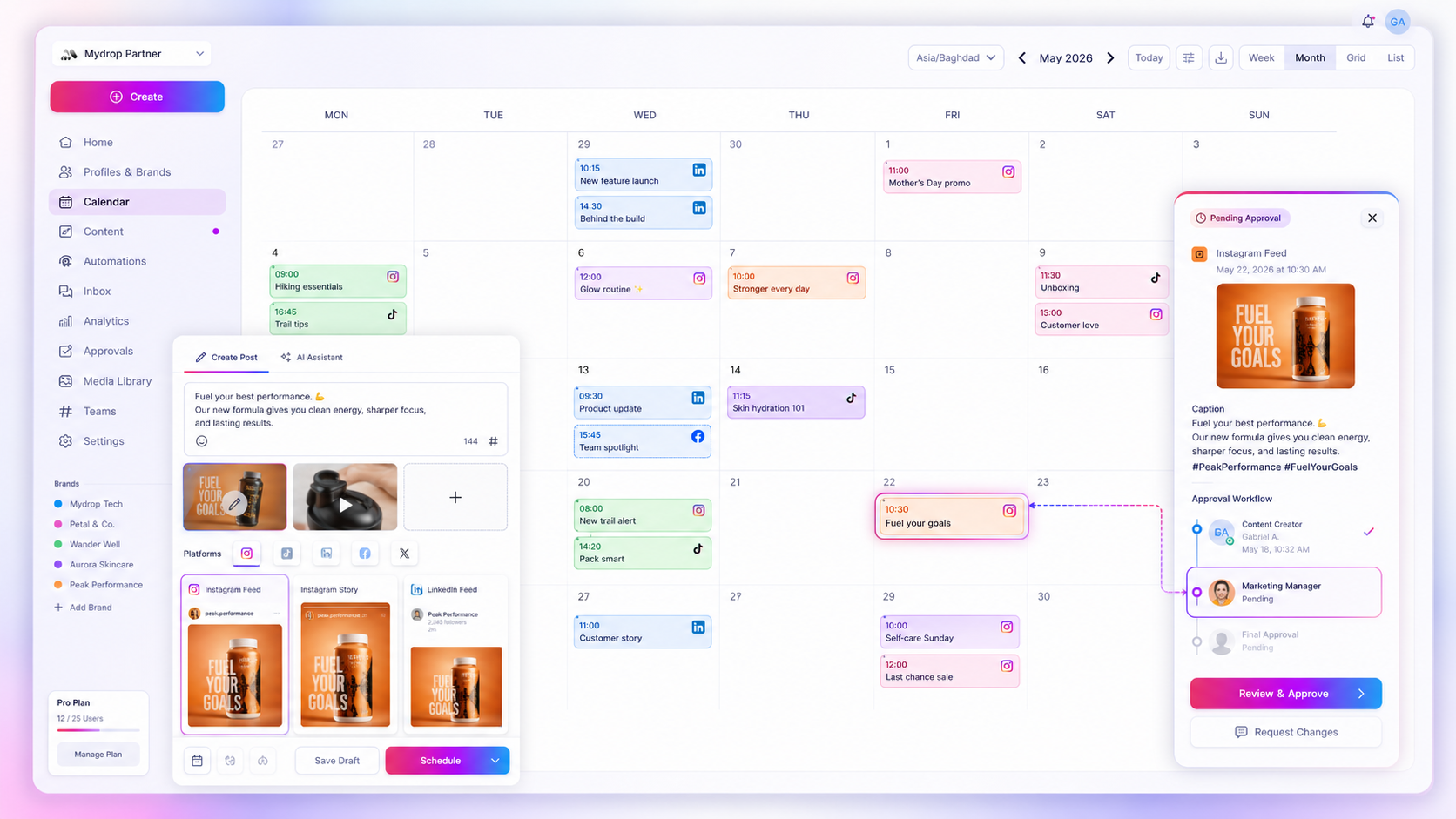
Instead of a generic tool where you manually create a task, paste a URL, and hope everyone clicks it, our reminders are natively linked to the posts, profiles, and media files they concern. When you need a content team member to review a video asset for a product launch, the reminder lives right there in the calendar, with the asset attached. They don't have to go digging; they just click and open.
This is exactly how Mydrop brings order to the chaos. Because reminders handle recurrence and exceptions-like a weekly community check-in that you occasionally need to skip for a holiday-you don't have to rebuild your calendar every month. When a task is marked done, that state is reflected across the entire team's view and synced instantly with Google Calendar. The team knows what's done because the tool actually knows. No more "Wait, did you check the spreadsheet?" at 5:00 PM.
You might ask, "What if we move the post date?" Our system accounts for that, keeping the task tethered to the content, not just a static date on a wall. It is not just a to-do list; it is a living campaign manifest.
A simple shortlist checklist
Before you commit to a new task management system or decide to overhaul your current one, use this checklist. If you cannot check off every item, your workflow is still at risk.
- Native Integration: Can I link this task directly to a specific post, profile, or media asset without manual URLs?
- Calendar Authority: Does this tool sync bi-directionally with our primary team calendar (like Google Calendar) so stakeholders see the same truth?
- Content Lifecycle Support: Can the tool handle repeating tasks (e.g., weekly approval cycles) and allow for quick, individual exceptions (e.g., skipping a week for a launch)?
- Visibility: Is the "done" state of a task visible to everyone who needs to see it, without requiring a manual update in a secondary status sheet?
Conclusion
The biggest threat to agency scaling isn't a lack of talent or even a lack of great ideas. It's coordination debt. Every minute your team spends manually syncing tasks, updating status trackers, or hunting for the "latest version" of a brief is a minute they aren't actually creating or optimizing.
If you find your team constantly fighting the tools, stop. You don't need another generic project management tool that treats your social media posts like generic tickets. You need a platform that understands that the task and the content are two sides of the same coin.
We have seen agency teams go from "we have no idea what is happening" to "we have total visibility" just by simplifying their stack and ensuring the tools talk to the assets, not just the users. The tools should work for the team, not the other way around.
Stop paying the tax of manual coordination. Switch to a workflow that makes the right thing the easy thing. If you aren't managing your social media operations as natively as you manage the social media content itself, you're not just working harder-you're working against yourself.