To stop missing content deadlines, stop creating isolated calendar events. Instead, anchor every content-planning task directly to the specific posts, profiles, and media files they involve. When you strip context away from your tasks, you are not just managing time; you are creating coordination debt that your team will eventually have to pay back with interest.
We have all been there. You open your calendar at 9 a.m. to see a reminder labeled "Post for Campaign X," but you have no idea which creative asset it refers to or which approval thread it belongs to. You spend ten minutes hunting through folders, email chains, and Slack messages just to figure out what you are supposed to be doing. By the time you find the context, the "quick" task has eaten half your morning. It is exhausting, and it is why content operations often feel heavier than they actually are.
The good news is that this is not a failure of your memory or your dedication. It is a structural failure of your tools. By anchoring tasks to the actual work objects, you turn static calendar entries into living components of your campaign.
The decision teams usually frame too broadly

Here is where teams usually get stuck: they treat content reminders as a simple notification problem. They look for apps that send more pings, louder alerts, or better push notifications. They think, "If I just get a better reminder, I won't miss the deadline."
But you do not need more pings. You need contextual integrity.
In our experience working with teams managing hundreds of brand profiles across multiple markets, the biggest source of missed deadlines is the separation of planning from execution. When your calendar lives in one tool and your creative assets live in another, you are essentially running a relay race where the baton is invisible.
Most teams treat reminders as "high-level planning" and posts as "execution." This is a false dichotomy. At Mydrop, we see the most successful teams treat reminders as the operational layer that holds the entire campaign together.
Operator rule: If a task does not have an attachment to a post, profile, or media asset, it is not an operational task; it is just a note that will eventually be ignored.
When you force your team to click into a reminder that has no connection to the work, you are paying a heavy context-switching tax. Every time someone has to look for the "what" or the "where," you lose a little more velocity. If the team has to ask "Which version of the video goes out today?" you have already lost.
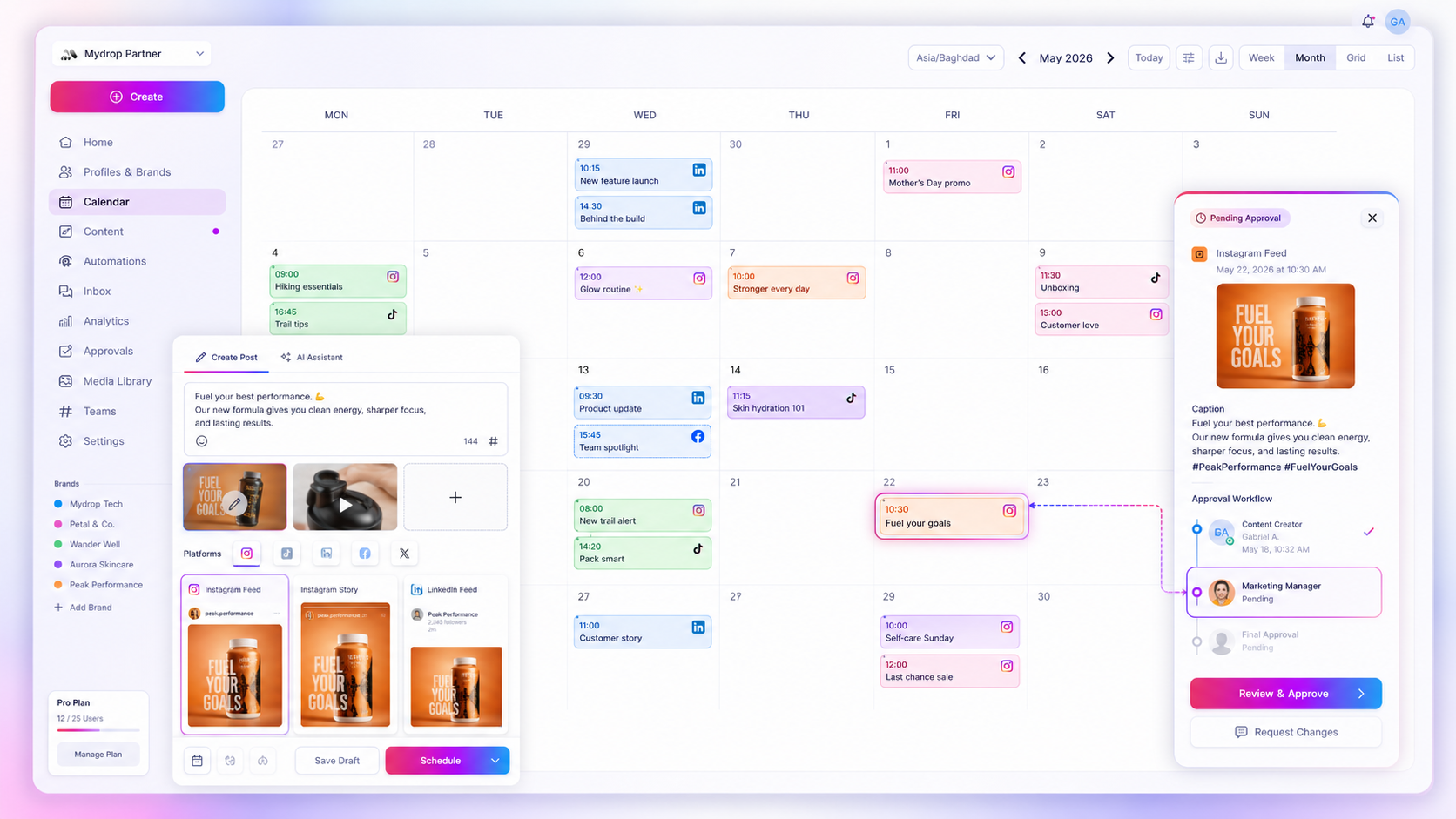
The fix is to stop creating "floating" reminders. Every reminder should be a container that carries its own history and links directly to the campaign objects. This moves the burden from the human to the system. You stop relying on people to remember to check a drive; the reminder itself acts as the source of truth, pointing directly to the final version of the asset.
What should stay manual and what can move faster

The biggest mistake we see teams make isn't forgetting to schedule a post; it is trying to automate the wrong things. When you attempt to turn every creative brainstorm or strategy pivot into a rigid system, you suffocate the very agility that makes social media work.
High-level strategy stays manual. If you are mapping out a new brand positioning, a delicate crisis response, or a highly experimental campaign launch, do not lean on automation. These moments require human intuition, nuance, and live, messy conversation. Keep these as high-level notes or collaborative documents. The danger here isn't the technology; it's the urge to "process-out" the humanity before the creative is even finished.
Operational hygiene moves to systems. This is where most teams lose their momentum. Recurring tasks like monthly asset audits, weekly report collection, or quarterly platform compliance checks are prime candidates for automation. If a task happens more than twice and follows a predictable cadence, it should never live in your head or a loose text file. By shifting these into a system that handles the recurrence and reminders, you stop paying the "coordination tax" on work that doesn't actually need your active thought every single time.
At Mydrop, we often tell teams that the goal of a good operational layer isn't to remove the human; it's to free them from the repetitive drudgery that makes them miss the big stuff.
The tradeoff matrix
Deciding whether a task deserves a dedicated operational reminder or should just remain a casual note is the difference between a team that runs like a machine and one that is constantly putting out fires.
Use this matrix to audit your current planning habit. If a task requires input from more than one person or relies on a specific creative asset, it belongs in the operational column.
| Task Type | Manual Note (Keep Simple) | Operational Reminder (Automate) |
|---|---|---|
| Cadence | Once or unknown | Recurring (Weekly/Monthly) |
| Dependencies | None | Linked to specific posts or assets |
| Visibility | Just for you | Team-wide sync |
| Outcome | Brainstorming | Executable task |
| Sync | None | External Calendar integration |
Decision check: If a task doesn't have an attachment (a post draft, a media file, or a profile handle), it isn't an operational task. It is just a note.
When you link a reminder directly to a core brand profile or a specific creative asset, the reminder becomes a portal, not just a calendar entry. You aren't just notified that "something is due"; you are presented with the exact object that needs attention. This eliminates the frantic search for files and prevents the most common source of "coordination debt": the moment where a team member opens a notification, stares at a vague title, and closes the app because they don't have the context to move forward.
By classifying your tasks this way, you move from "chasing down updates" to "validating completion." It’s the difference between managing the calendar and managing the campaign.
How to pilot the workflow safely
Don't try to overhaul your entire operation on a Tuesday morning. Instead, pick one high-frequency, low-risk recurring task-like your weekly content review or monthly platform analytics sync-and anchor it in your team calendar as a linked reminder in Mydrop.
The goal here isn't just to see a notification; it's to see the actual asset waiting for you when the reminder triggers.
Follow this three-step pilot to prove it works for your team:
- Pick the Pilot: Choose one recurring task that currently suffers from "lost context." This is usually a weekly social media report or a recurring brand asset update.
- Anchor the Object: In the Mydrop reminder editor, don't just type "Do report." Link the specific profile or post-collection you need to review.
- Set the Sync: Enable the Google Calendar sync so the task shows up where your team already lives.
When you get that first notification, you won't have to scramble to find the right file in a separate drive or message channel. Everything you need is already attached. If your team sees that one link saves them five minutes of hunting, the resistance to adopting this new "living task" habit will vanish.
The operating rule to keep
We have seen hundreds of teams struggle with "done" fatigue, where tasks are marked off simply to clear the calendar, regardless of whether the actual work moved forward. To stop this, we rely on a single, non-negotiable rule.
Workflow check: If a task does not have an active attachment-like a post, profile, or media doc-it is not an operational task; it is just a note that belongs in a scratchpad, not your calendar.
This rule forces you to distinguish between "thinking" (which is messy and belongs in a notebook) and "executing" (which is structured and belongs in Mydrop). If you can't attach an object to it, don't clutter your calendar with it. By keeping your operational layer focused only on actionable work, you ensure that when a notification hits, it demands action, not just attention.
Conclusion
Missing deadlines is rarely about a lack of discipline; it is about the quiet, daily erosion of context that happens when you separate your planning from your production. When your calendar entries are just text, they become invisible. When they are linked, living objects, they become the heartbeat of your campaign.
Stop fighting the friction of your current tools and start connecting your planning tasks to the assets they govern. You will find that when your team can see the why and the what in the same view as the when, the "deadline anxiety" starts to fade. Your calendar stops being a list of chores you are falling behind on and becomes a clear, structured map of your actual progress.