
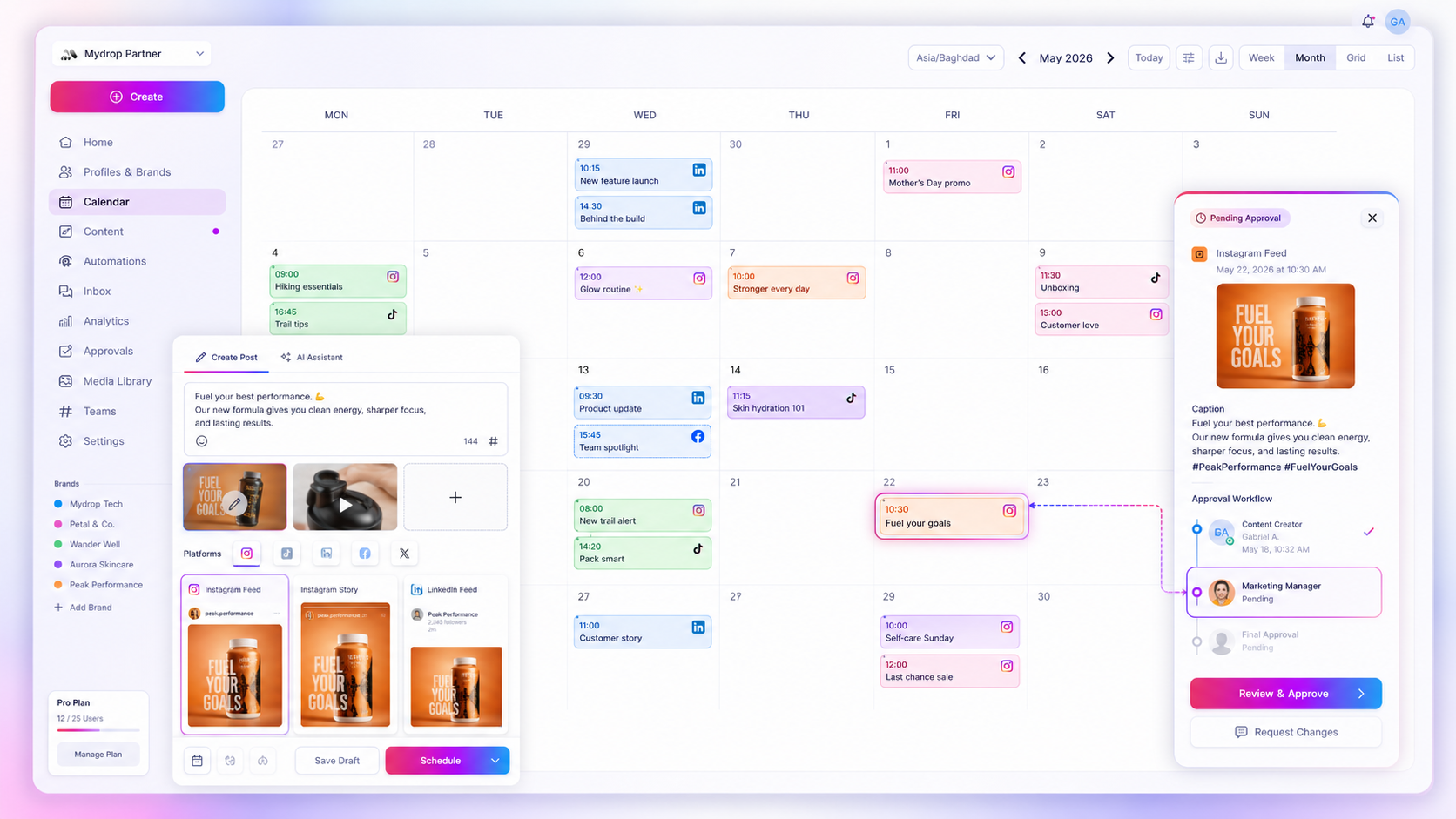
The fastest way to improve your content planning ROI is to stop measuring "time spent planning" and start tracking coordination debt. If your team’s weekly rhythm involves status meetings to verify what is actually hitting the feed, you aren't managing a campaign; you are managing a coordination bottleneck. By pulling your social schedule out of opaque spreadsheets and into the shared Google Calendars your team already uses, you convert "Are we ready?" emails into passive, real-time transparency.
We get it. The production phase often feels like a high-stakes game of telephone. You confirm a post, then the creative changes, then the platform settings shift, and by the time you reach the weekend, the "master sheet" is effectively a piece of historical fiction. It is exhausting, and it is entirely avoidable. The real payoff here isn't just saving a few minutes on an email-it is the shift from reactive status checking to proactive campaign execution.
The decision each metric should trigger

Data is useless if it doesn't force a change in behavior. When you move to a calendar-native visibility model, you aren't just tracking completion; you are monitoring the health of your operational pipeline. Each metric below should trigger a specific, non-negotiable team action.
| Metric | Threshold for Action | Required Operational Response |
|---|---|---|
| Sync Latency | > 15 minutes of update lag | Trigger a forced sync to clear cache or verify service token health. |
| Calendar Mismatch | Any delta between platform and calendar | Immediate cross-team review of the Google Calendar service settings to fix sync mode or profile selection. |
| Operational "No-Show" | Unsynced reminder event | Escalate to the content lead to identify if the task was skipped or if the webhook watch channel is disconnected. |
At Mydrop, we see teams managing dozens of brands that suffer from "information gravity"-the tendency for data to get stuck in the scheduling tool, effectively invisible to the rest of the org. When we use calendar-native planning to push posts and reminders directly to shared Google calendars, those teams stop holding status meetings to ask "what's live today." They simply look at the calendar.
Operator rule: If a team member has to ask for a status update that could be answered by looking at the shared calendar, your planning bridge is failing.
The decision loop is simple: if the calendar event doesn't match the campaign reality, stop the production cycle immediately. Don't waste time updating the spreadsheet; fix the integration. When you treat the calendar as the single source of truth, you stop chasing updates and start controlling outcomes.
The scorecard that keeps reporting useful

The best way to stop the "status update tax" is to make your reporting boring. When you rely on manually curated spreadsheets, status meetings become high-stakes performances. You are basically paying your team to recite data that should have been obvious to everyone hours ago.
If your content plan is not visible in the same place where the rest of the company lives, you are manufacturing debt. We have seen this across hundreds of brands: the moment you move status updates from an email chain to a shared calendar view, the "coordination debt" begins to collapse.
Here is a simple way to audit your current operation. Use this scorecard to see if your planning process is a functional bridge or a bottleneck.
| Metric | Manual Sync Cycles (Old Way) | Calendar-Native Visibility (New Way) |
|---|---|---|
| Status Verification | Weekly manual status call (1 hr) | Real-time calendar view (0 hr) |
| Update Latency | 24-48 hours (after edit) | Immediate (via automated push) |
| Stakeholder Ping Rate | High (5+ inquiries per week) | Near zero (self-service) |
| Context Switching | Constant (Tool A to Email to Calendar) | Low (Context lives in Calendar) |
How to calculate your "Debt Score": Add up the total hours your team spends every week manually updating calendars, drafting status emails, and answering "is this live?" questions. If that number is over three hours, you are officially in the red. By using Google Calendar Sync to push scheduled posts and reminders directly to your team’s shared view, you turn that overhead into pure operational time.
Decision check: If a stakeholder has to ping you to know what is scheduled, your tool stack is failing. Your calendar should act as the single source of truth that renders status meetings obsolete.
What to stop measuring by default
Most marketing leaders obsess over the wrong numbers. They track "time spent planning" as if it were a proxy for strategic depth. It is not. It is usually just a proxy for how many hours your team spent wrestling with a tool that does not want to cooperate.
Stop tracking these vanity metrics immediately:
- Total hours spent in planning meetings: This measures how much you are talking about work, not how much work you are moving. High numbers here usually indicate coordination failure, not strategic rigor.
- Number of status emails sent: Every email is a silent admission that your primary planning tool is invisible to the people who need it most.
- Manual entry speed: If you are measuring how fast your team can copy-paste from a social tool to a calendar, you have already lost. The only efficient speed is zero manual entry.
Instead, measure Alignment Drift. This is the delta between what is in your production pipeline and what shows up on your team’s shared calendar. If that drift is anything other than zero, your sync mechanism is broken.
At Mydrop, we see the most successful teams treat their content calendar like a live heartbeat. They do not "report" on their status; they simply let their team watch the calendar update in real time. When you remove the need for manual reporting, you give your team the only thing they actually want: the space to stop coordinating and start creating.
How to connect metrics to next actions
The data in your calendar isn't there to make you feel organized; it’s there to trigger an intervention when the machine stalls. If you are tracking coordination debt, you need clear thresholds for when to stop the press.
Every metric should lead to a specific management decision. If your sync audit shows a recurring gap between the planned calendar and the actual feed, don't just note it-investigate the approval loop.
- If a sync check fails: Trigger an immediate cross-team review. A failed sync is rarely a technical fluke; it’s usually a sign that a stakeholder moved a task in an offline spreadsheet, effectively creating a ghost schedule that the rest of the team cannot see.
- If "reminders" remain marked as unfinished: Re-evaluate your production capacity. When operational tasks linger on the calendar past their deadline, you are staring at a bottleneck in your creative or compliance pipeline.
- If calendar visibility is high but engagement is flat: You have a content-market fit issue, not a coordination issue. Stop tweaking the schedule and start testing the creative assets.
At Mydrop, we often see teams confuse "being busy" with "being effective." By forcing your operational tasks into a shared calendar view, you make it impossible to hide the work that actually generates value.
The review cadence that makes the model stick
A framework like this only survives if it becomes part of the weekly rhythm. If you check these metrics once a quarter, you aren't managing a workflow; you are auditing a graveyard.
Set up a monthly sync-audit to keep the model healthy. This isn't a meeting to discuss what to post next; it is a clinical review of where the coordination broke down in the last thirty days.
| Audit Focus | Action Threshold | Decision Rule |
|---|---|---|
| Sync Accuracy | > 10% mismatch | Flag for automated force-sync and identify stale metadata. |
| Reminder Velocity | < 80% completion | Escalate to resource reallocation or deadline adjustment. |
| Meeting Load | > 3 hours/week | Replace status calls with calendar-native comment review. |
Workflow check: If you need a meeting to confirm what is on the calendar, the calendar has already failed. Treat that meeting as a red-flag event that requires an immediate process change.
Conclusion
The goal of professional social operations is to build a system that works while you are asleep. When your content plan is trapped in a silo, you are forced to act as the human router for every update, approval, and missed deadline.
By shifting to a calendar-native model, you stop being a status reporter and start being an architect of your team's output. The technology exists to make your production schedule visible, shared, and automatically updated. All that remains is for you to stop accepting the "coordination tax" as a cost of doing business.
Take the next step this week: connect one brand profile to a shared Google Calendar, enable the sync, and see how much faster your team moves when they are finally looking at the same map.