When you manage fifty brands across twenty platforms, "Editor" and "Viewer" roles are not just insufficient, they are dangerous liabilities. Scaling requires shifting from managing people to managing action-based access.
We get it. You are caught between the need for speed and the constant, low-level anxiety that one wrong post, deleted asset, or unauthorized reply could ruin a client relationship. The work is inherently messy, and permissions should not be the bottleneck that makes it messier. Most tools force you into a "Role Bloat" trap, charging you for higher tiers that just add more complex, unmanageable silos instead of solving the core issue of permission granularity.
Operator rule: If your tool requires you to assign an "Admin" role just so someone can approve a single post, your security model is broken.
What the best tools need to handle

You should be able to ask a simple question for every team member: "Which specific actions can they perform on this specific resource?"
If you are limited by a fixed, top-down hierarchy (Owner, Admin, Editor, Contributor), you are already losing. You end up with "permission creep," where team members have broader access than necessary just to keep the workflow moving.
The alternative is the Resource-Action Map. This moves away from job titles and toward operational reality.
The Permission Audit Scorecard
Use this scorecard to pressure-test whether your current tool actually supports granular control or just hides the complexity.
| Evaluation Criteria | High-Flexibility (Target) | Rigid (Broken) |
|---|---|---|
| Scope | Per-resource (e.g., specific folder or post type) | Global role only |
| Granularity | Action-specific (e.g., Can read, but not delete) | All-or-nothing (e.g., Can delete) |
| Setup Effort | Low (Template-based invites) | High (Manual mapping per user) |
| Security Risk | Low (Least-privilege by default) | High (Over-privileged by default) |
Decision Rule: If you cannot restrict a user to "Create and Read" a draft post without granting them "Approve" authority, your tool is a bottleneck.
At Mydrop, we built our permission model around this concept. We saw that teams managing hundreds of brand profiles were not struggling because their team members lacked talent; they were struggling because their tools forced everyone into one-size-fits-all roles that created too much coordination debt.
Instead of forcing you to choose between speed and security, we treat the member-document as an arbitrary map of resources and actions. This lets you build bespoke access for each client or teammate without having to overhaul your entire account structure. The goal is to make the tool disappear into your workflow, letting your team move fast without the constant fear of breaking something important.
Where basic tools start to break

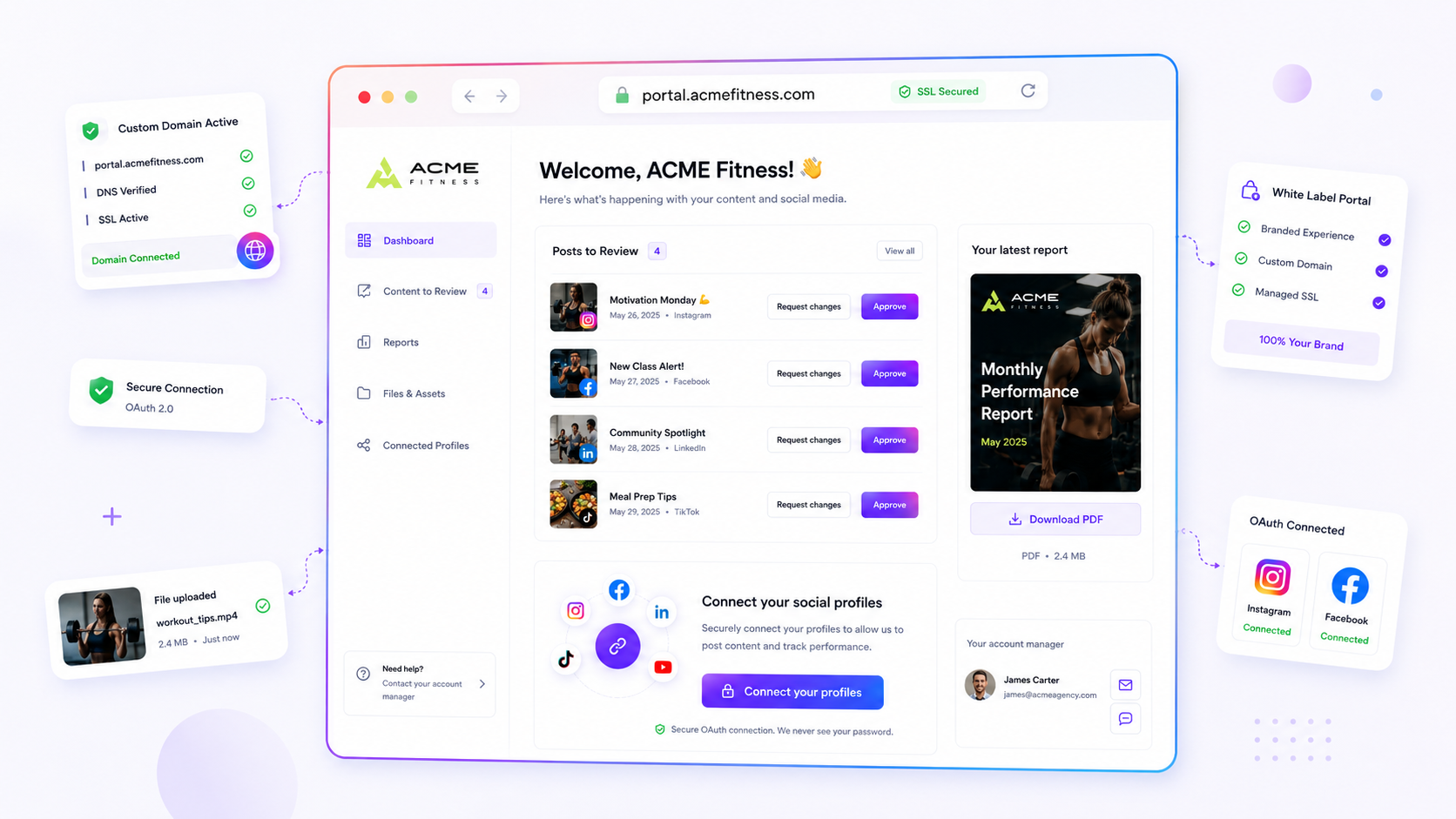
When your agency manages fifty brands across twenty platforms, the traditional "Admin-Editor-Viewer" hierarchy isn't just inefficient; it is a full-blown liability. You have likely seen this firsthand: a client wants a junior designer to only upload images, not publish them. Or perhaps a legal reviewer needs to read posts but must be strictly blocked from interacting with the inbox.
Basic tools force you to hack these needs together. You end up making the designer an "Admin" just so they can access the media library, and then praying they don't accidentally delete a campaign. This is the Role Bloat Trap. You aren't managing security; you are managing a spreadsheet of workarounds.
When the tool's permission model is rigid, your team's workflow becomes brittle. You inevitably create silos where people have more access than they need, or worse, they can't get their work done without pinging an actual Admin for every trivial change. That creates the silent killer of agency productivity: coordination debt. Every Slack message asking for a password, an approval, or an access change is a micro-failure of your software stack.
Decision check: If your team spends more than ten minutes a week talking about "who has access to what," your tool's permission architecture is actively costing you money.
The buying criteria that matter
Stop asking vendors if they have "custom roles." Of course they do. Ask instead: "Does your permission model allow me to map specific actions to specific resources for any user?"
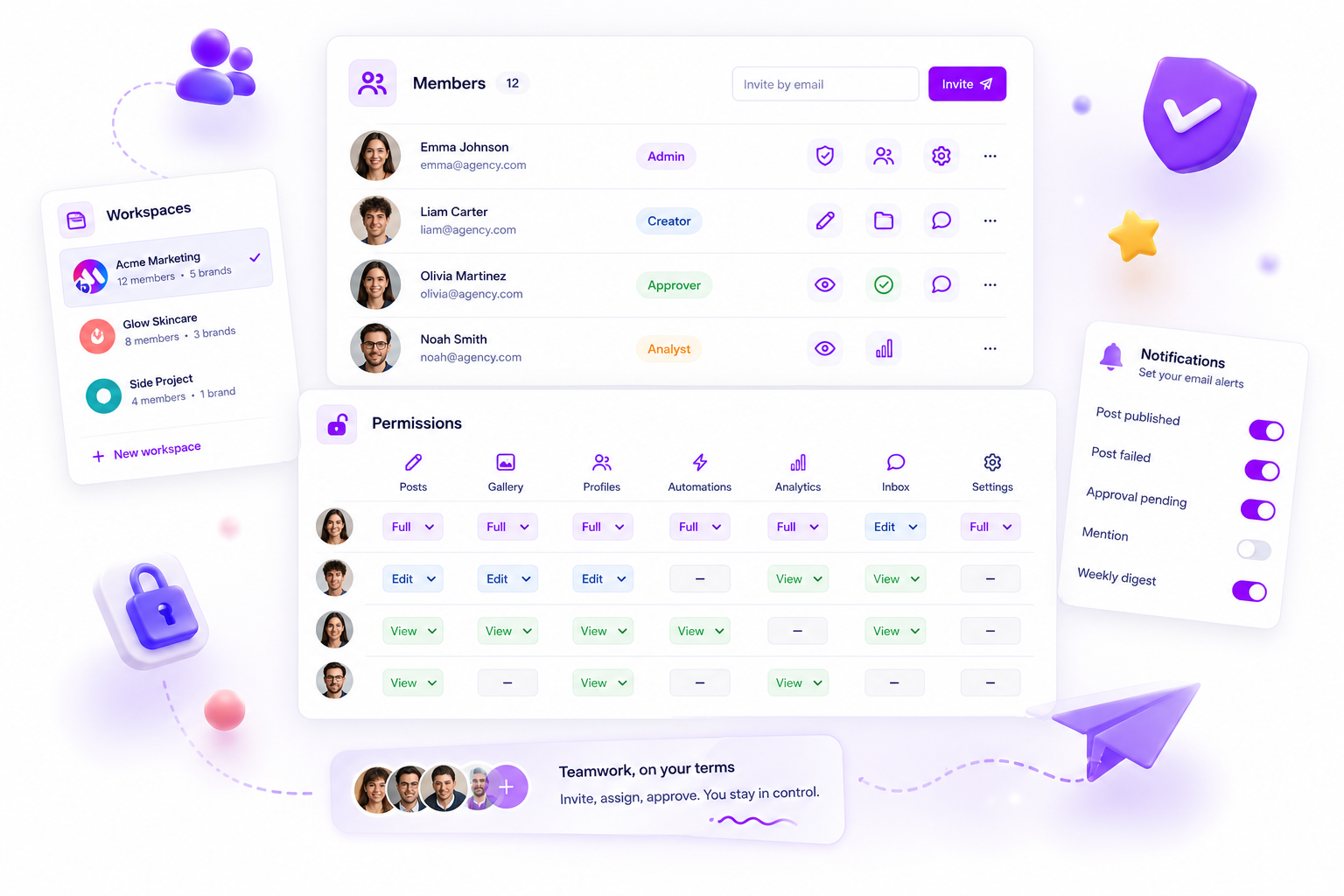
You need a system that treats every part of the application-posts, galleries, inbox threads, analytics, automations-as an independent resource with its own set of permitted actions. This is the only way to scale without sacrificing governance.
Use this scorecard to evaluate your next platform. If a tool doesn't hit these marks, you are just buying yourself another year of manual overhead.
| Criteria | Why it matters for scaling | Red flag to avoid |
|---|---|---|
| Granularity | Allows you to block delete on posts while allowing create and read. |
Only offers global "Editor" or "Contributor" tiers. |
| Per-Resource Scope | Enables client-specific access so they only see their brand's assets. | All-or-nothing access to the entire workspace. |
| Action Mapping | Decouples "roles" from "permissions" entirely. | Rigid role enums that you cannot modify. |
| Auditability | Makes it clear exactly who can perform sensitive actions. | No clear "Who can do what" overview for a specific user. |
At Mydrop, we ditched the concept of hard-coded roles entirely. We use an arbitrary member-document resource/action map, which means you aren't stuck with "Roles." You are simply defining what a person can do, whether they are an agency teammate, a freelance contractor, or a direct client stakeholder. You set the permissions, and the system enforces them at the API level. It's the difference between trying to fit a square peg in a round hole and having a peg that is already square.
The goal isn't to add more complex roles; the goal is to make roles irrelevant. You want a system that understands the nuance of your agency's actual work, not one that forces you to conform to its limited, built-in definitions of a "user."
How Mydrop supports this workflow
At Mydrop, we approach permissions not as a rigid hierarchy-like a ladder where you are stuck on a specific rung-but as a fluid, action-based map. We designed the platform to treat every teammate’s access as a unique, configurable object, letting you decide exactly who can touch what.
Instead of fighting to force a client manager into a predefined "Guest" role that doesn't quite fit, you simply open their member document and adjust their specific resource/action map. Need that client to approve posts but stay invisible to your internal analytics? You just flip the access key for posts:approve to true while leaving analytics:read as false.
It is about removing the friction of "access requests" that slow down your agency's momentum. By defining permissions at the resource level-think posts, gallery assets, inbox threads, and automations-you maintain governance without turning your workspace into an unmanageable bureaucratic maze. When you introduce a new client or a new project phase, you aren't stuck re-configuring global roles; you just apply the relevant permission template and your team is ready to move.
Workflow check: If a new team member needs to ask you for permission access more than once, your permission structure is too broad. It should be defined by the resource, not by their job title.
A simple shortlist checklist
Before you commit to a platform, run this quick audit against your current operational bottlenecks. If a tool cannot pass these three tests, it will likely become another source of coordination debt within six months.
| Decision Criteria | Goal | The "Red Flag" Answer |
|---|---|---|
| Granularity | Can you restrict actions per resource (e.g., only approve posts for Client X)? | "We only support broad roles (Admin/Editor)." |
| Bespoke Access | Can you set unique permissions for a single user without impacting others? | "Everyone with the 'Editor' role gets the same access." |
| Visibility Control | Can you hide specific resources (like internal notes or budgets) from clients? | "All workspace members see all workspace resources." |
The "Permission Bloat" Audit Checklist
Before you invite your next stakeholder, verify their access with this simple rubric to prevent over-privileged accounts:
- Scope Check: Does this user actually need workspace-wide access, or just one specific brand's folder?
- Action Check: Can they
createa post but notapproveit? (The classic "draft-only" safety valve). - Notification Check: Have you disabled their ability to receive alerts for workflows they don't manage?
- Lifecycle Check: Is there a scheduled date for when this user's access should be revoked or reviewed?
Conclusion
The messy reality of agency life is that the "perfect" structure for a high-velocity team is constantly evolving. Your tools should be flexible enough to handle that mess, not rigid enough to break under the pressure of a dozen simultaneous client campaigns. Stop managing people through global roles that never quite fit and start managing actions through granular, per-resource control. When you shift your focus from the hierarchy to the actual work being performed, you stop being a gatekeeper and start being an enabler for the talent you hired.