

When scaling social operations, the bottleneck is rarely the number of platforms you manage. It is the friction caused by static, one-size-fits-all access management. If your software forces your team into rigid "Editor" or "Admin" boxes, you are likely trading security for speed every single day. The best way to kill operational drag is to move toward a model where permissions map directly to the specific resources your team touches.
We get it. The work is messy enough without fighting your own tools. Between last-minute client requests and multi-regional campaign launches, nobody needs a "permission denied" error at 6:00 PM. You shouldn't have to choose between locking the keys away entirely or letting everyone into the engine room. You need a setup that works as hard as you do, without the constant back-and-forth of "can you approve this for me?"
Operator rule: If your managers are constantly "acting on behalf" of team members just to bypass a permissions error, your software is doing the work for you, not with you.
What the best tools need to handle

Social media isn't a static broadcast. It is a living, breathing cycle of intake, creation, feedback, and publishing. For an enterprise team, this means the software must understand that access is not a binary choice between "Can log in" and "Cannot log in."
Instead, a robust tool needs to manage the lifecycle of specific resources. Every action your team performs-creating a post, pulling an analytics report, inviting a new agency partner, or tweaking an automation-is a discrete permission point. When these are grouped into a single "role," you inevitably end up with either an over-privileged intern who can accidentally delete an entire workspace or a paralyzed manager who has to do everyone’s job for them.
The best platforms treat these resources as distinct objects that can be individually secured:
- Content Assets: Can the user create a draft, or are they only allowed to view and comment?
- Workflow Gates: Who has the authority to approve a post that goes live to a high-profile brand account?
- Intelligence: Can the analyst read your campaign results, or can they export raw data for their own reporting?
- System Integrity: Who can actually modify member settings, delete a workspace, or invite new collaborators?
When these are decoupled, you stop managing "users" and start managing "workflows." A designer might need create and read access to the gallery but zero access to your analytics. A regional manager might need approve rights for their specific local market accounts but have no business touching the global brand settings.
The goal is to align the tool to your actual organization chart, not force your organization to bend to the limits of a static role dropdown. If you can't control who sees what at this level of resolution, you aren't managing a team-you are just managing a mess.
Where basic tools start to break

The real trouble begins when your team grows beyond a single core unit. Standard social media tools were built for "social media managers," not the cross-functional beast that modern enterprise marketing has become. When you have regional teams, external agency partners, and legal stakeholders all trying to log into the same dashboard, you hit a wall.
This is the "Admin Trap."
You want your agency to draft posts, but you cannot give them "Admin" access because that would expose sensitive account credentials or internal analytics they have no business touching. But if you demote them to a generic "Contributor" role, they might be blocked from the very features they need to finish the job, like tagging local profiles or reviewing historical brand assets.
When the software cannot map permissions to a specific task, you end up with Coordination Debt. Managers are forced to become manual conduits-downloading drafts from a shared drive, uploading them into the platform themselves, waiting for a ping, and then finally hitting publish. It is not just inefficient; it is a high-risk game of telephone.
Common mistake: Granting "Admin" status to external collaborators just to bypass feature restrictions. This creates massive security exposure and audit gaps that you only realize are broken when a post goes live without a final compliance check.
The buying criteria that matter
Stop shopping for tools based on their "Role" tiers and start looking at their Permission Map. You need a system that treats your team as a collection of unique, granular capabilities rather than a list of job titles.
To decide if a platform can actually support your scale, run it through this scorecard. If a tool cannot check these four boxes, you are buying a bottleneck, not a solution.
Permission Scorecard for Enterprise Teams
| Capability | Why this matters for your workflow |
|---|---|
| Resource-Level Mapping | Can you give access to posts without exposing analytics? |
| Action-Level Control | Can you grant create permissions while restricting approve? |
| Template Propagation | Does a new team member inherit existing access rules automatically? |
| Auditability | Does the system log exactly who changed a permission and when? |
Operational rule: If the software requires you to open a support ticket or call your account manager to change a user's access, it is fundamentally incompatible with the speed of your social operations.
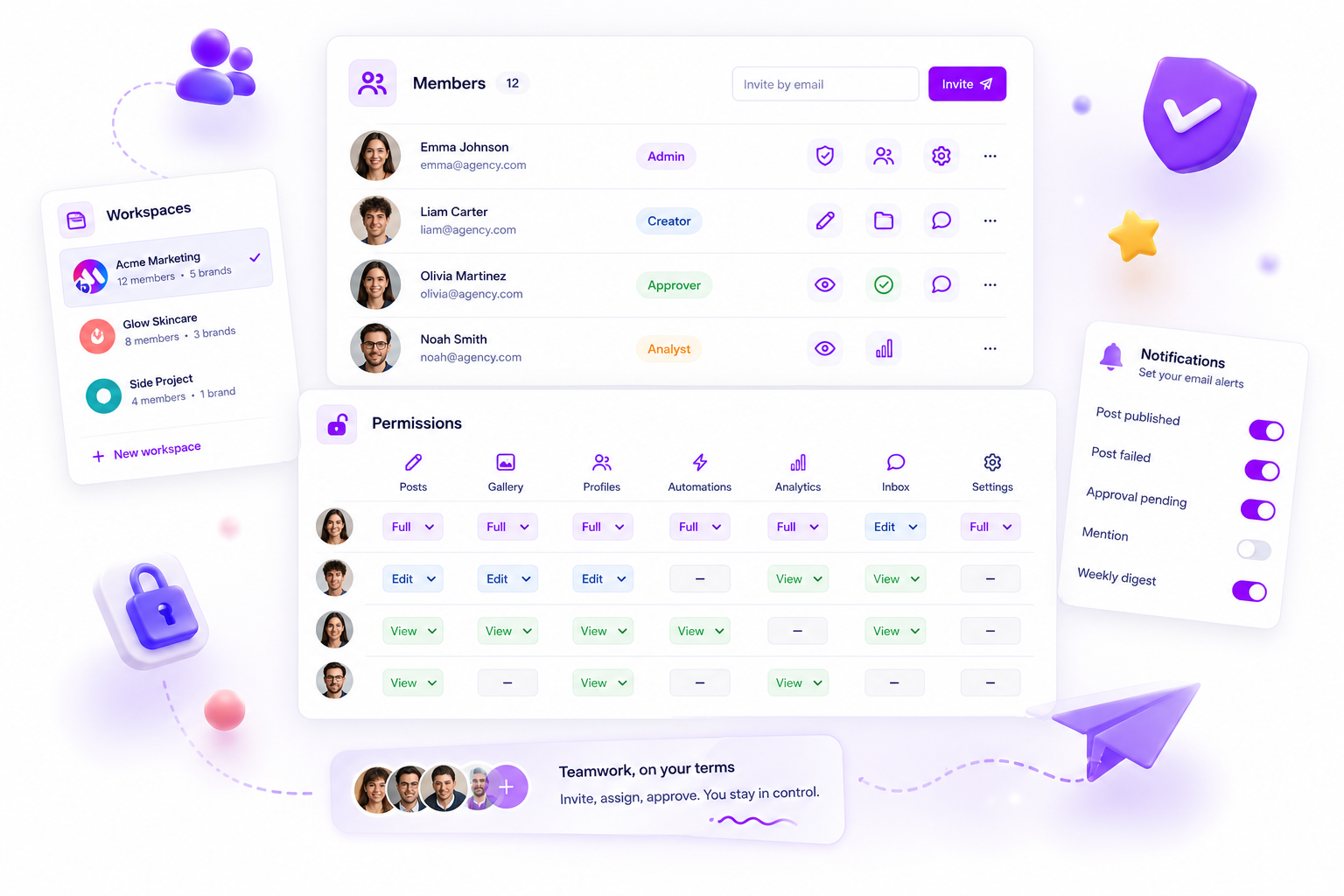
At Mydrop, we designed our member settings to move away from these rigid, binary roles. Instead of guessing if an "Editor" should see your monthly performance reports, you simply update the member's resource map. You assign them specific access to the posts gallery, allow them to create and read drafts, but keep the approve capability locked to your senior leads.
This approach flips the script on governance. It turns access management from a series of "permission denied" interruptions into an automated state. You set the guardrails once, and the platform handles the enforcement across every brand profile and channel. You stop managing the tool and start managing the output.
How Mydrop supports this workflow
At Mydrop, we built our permission architecture around the simple, uncomfortable reality that no two stakeholders need the same level of access. When we look at teams managing hundreds of brand profiles across multiple regions, we don't see a pyramid of generic "Editors" and "Admins." We see a map of responsibilities.
Our Member Management settings allow you to move past the "all or nothing" trap. Instead of guessing whether a user should have full workspace rights, you assign access based on the specific resources they touch.
If you need a legal advisor to review content but never publish it, you map their permissions to the posts resource with read and approve rights, but block create or delete actions. Your creative team gets create and read access for the gallery, but they stay out of the analytics and inbox modules. It is about removing the clutter so your team can focus on the work that actually keeps them busy.
Decision check: If a user’s job function doesn't require a specific resource, they should not have a UI element for it. Permissions are the first line of defense against both security risks and, more importantly, accidental deletion.
We also treat notification preferences as a first-class citizen. We know that the "inbox alert" that is vital for a community manager is just background noise for a brand strategist. By giving every user the ability to toggle their own operational events, you stop the flood of unnecessary pings that lead to notification fatigue.
A simple shortlist checklist
Before you commit to a platform or attempt a massive migration, run your current setup through this quick audit. If you answer "no" to more than two of these, your coordination debt is likely holding you back.
| Check | Capability | Why it matters |
|---|---|---|
| Granularity | Can you restrict an external user to one specific channel or brand? | Avoids cross-brand data leaks. |
| Logic | Do permissions map to actions (Create, Read, Delete) rather than roles? | Prevents "Editor" bloat. |
| Feedback | Can users opt-out of specific alerts (Inbox vs. Analytics) without muting everything? | Reduces notification burnout. |
| Scope | Does access persist if the user moves to a different brand or department? | Simplifies onboarding at scale. |
Conclusion
The bottleneck in your social media machine is rarely a lack of creative ideas or a shortfall in production speed. It is almost always coordination debt. Every time a manager has to manually intervene because a tool's permissions were too rigid to let a contributor finish a task, you pay a hidden tax.
Stop trying to force your team into static role definitions. When you align your platform access with the actual, granular reality of how your team works, you turn your management tool into an engine for growth rather than a gatekeeper. Your team deserves a workspace that stays out of their way, so they can get back to the work that actually builds your brand.
