The bottleneck in your reporting is not the analysis. It is the login screen, the broken link, and the IT gatekeeper blocking your client. When reviews stall because a client lost credentials or security flagged an attachment, your work becomes a chore.
You are chasing approvals at 6 p.m., but the report is locked behind a portal your client cannot open.
Here is the rule: Insight Accessibility equals Speed of Decision. Simpler access means faster approvals. To fix stalled reviews, stop forcing clients into your application. You need a secure, frictionless model that turns "unable to open" into feedback.
This is the "Access Tax." You pay it every time you force a stakeholder to authenticate, download, or navigate complex portals.
What the best tools need to handle

To fix stalled reviews, your reporting infrastructure must balance two opposing pressures: the speed your marketing team demands and the security constraints your enterprise IT team mandates. A tool that fails one will eventually fail both.
The best tools treat report delivery as a first-class feature, not an afterthought. They move beyond basic email attachments-which are notoriously insecure, unversioned, and easily flagged-toward a controlled, tokenized distribution model.
When auditing tools, evaluate them against this friction scorecard.
| Delivery Method | Friction Level | IT/Security Risk | Stakeholder Experience |
|---|---|---|---|
| Static Email PDF | Low | High | Poor (Large files, no versioning) |
| App-Based Portal | High | Low | Poor (Login hurdles, slow access) |
| Tokenized Public Link | Low | Low | Excellent (Secure, direct, revokable) |
Most basic tools treat a report as a static document, like a PDF you attach to an email and hope arrives safely. That is not a report delivery system; it is a file transfer gamble. In a mature social media operation, you cannot afford to have data stranded in an inbox or blocked by a firewall.
Your reporting tool should act as a secure bridge, not a silo. It needs to provide a controlled environment where a client or executive can open a link, authenticate if necessary, and interact with the data without needing an active, paid license for your primary management platform.
If a tool forces your clients into your own app workflow just to see a dashboard, you have already lost the attention battle. The goal is to minimize friction, not to maximize user logins. You need a secure, shareable, and revocable path to data. Most teams do not have a content problem; they have a decision bottleneck, and your delivery method is usually the primary culprit.
Where basic tools start to break

When you are managing cross-functional teams, your reporting process often hits a wall because the tool does not match the speed of the organization. The most common failures are not technological limitations, but rather workflow friction.
We have all been there. You spend hours pulling data, crafting the narrative, and designing a beautiful deck, only to have the entire review process grind to a halt because of a "Permission Denied" error.
Here is where the standard toolset usually fails:
- The Login Barrier: Forcing a client or stakeholder to create yet another account, navigate a complex portal, or remember a password they haven't used in three months is a recipe for delay. If they cannot access the insights within ten seconds, they will stop trying.
- The Attachment Trap: Emailing static files seems safe until the file is too large, it lands in a spam folder, or-worst of all-you need to update a single chart. Once that email is out, you lose control over versioning and security.
- The Static PDF Prison: A static PDF is a snapshot in time that cannot be revoked. Once it is on a client’s server or in an executive's inbox, you cannot retract it if the data was misinterpreted or if you need to update the findings based on new context.
The hidden cost here is not just the lost time; it is the erosion of trust. Every time a stakeholder struggles to access your analysis, it reinforces the perception that social media reporting is an administrative chore rather than a strategic asset.
The Cost of Friction: Delivery Method Comparison
| Delivery Method | Friction Level | Access Ease | Security Control | Revocability |
|---|---|---|---|---|
| Email Attachment | High | Low | None | Impossible |
| Private Portal | High | Lowest | High | Moderate |
| Public Link (No Security) | Low | High | None | Low |
| Tokenized Public Report | Minimal | Highest | High | Full |
The buying criteria that matter
When you are evaluating a tool, do not just look at how it builds the report; look at how it distributes it. A robust analytics reporting tool needs to balance the marketing need for speed with the IT mandate for security.
If you are currently evaluating your stack, prioritize tools that offer these four capabilities:
- Frictionless, Tokenized Access: Look for the ability to generate a secure, unique URL that grants access to a specific report without requiring the recipient to log in. This removes the "login barrier" while keeping the report behind a unique, non-guessable token.
- Granular Security Controls: Security should be configurable, not all-or-nothing. Ensure the tool allows for password protection on individual reports, link expiration dates, and the ability to toggle PDF downloads on or off. This allows you to manage the risk profile of every report you share.
- Active Revocation: The best reporting tools treat distribution as a live service, not a static file transfer. You should be able to disable a share link or expire a token instantly. At Mydrop, we see that the ability to simply toggle a link off-revoking access without deleting the underlying report-is essential for compliance and project management.
- Verified Delivery: Finally, look for integrated notification management. Whether it is email delivery or status alerts within your workspace, the tool should help you track who the report was sent to and provide a clear, professional way for them to open it.
Decision Check: If the tool asks for "Everyone in your organization" to be a paid user just to view a report, or if it lacks a simple "disable access" button, it will eventually become a bottleneck for your team. You are looking for a conduit that accelerates feedback, not a gatekeeper that demands an administrative tax for every view.
How Mydrop supports this workflow
At Mydrop, we built our report sharing around one core idea: remove the friction without losing the security. We saw too many teams struggling with the same problem, spending hours preparing insights only to have the entire review process grind to a halt because a client could not access the portal.
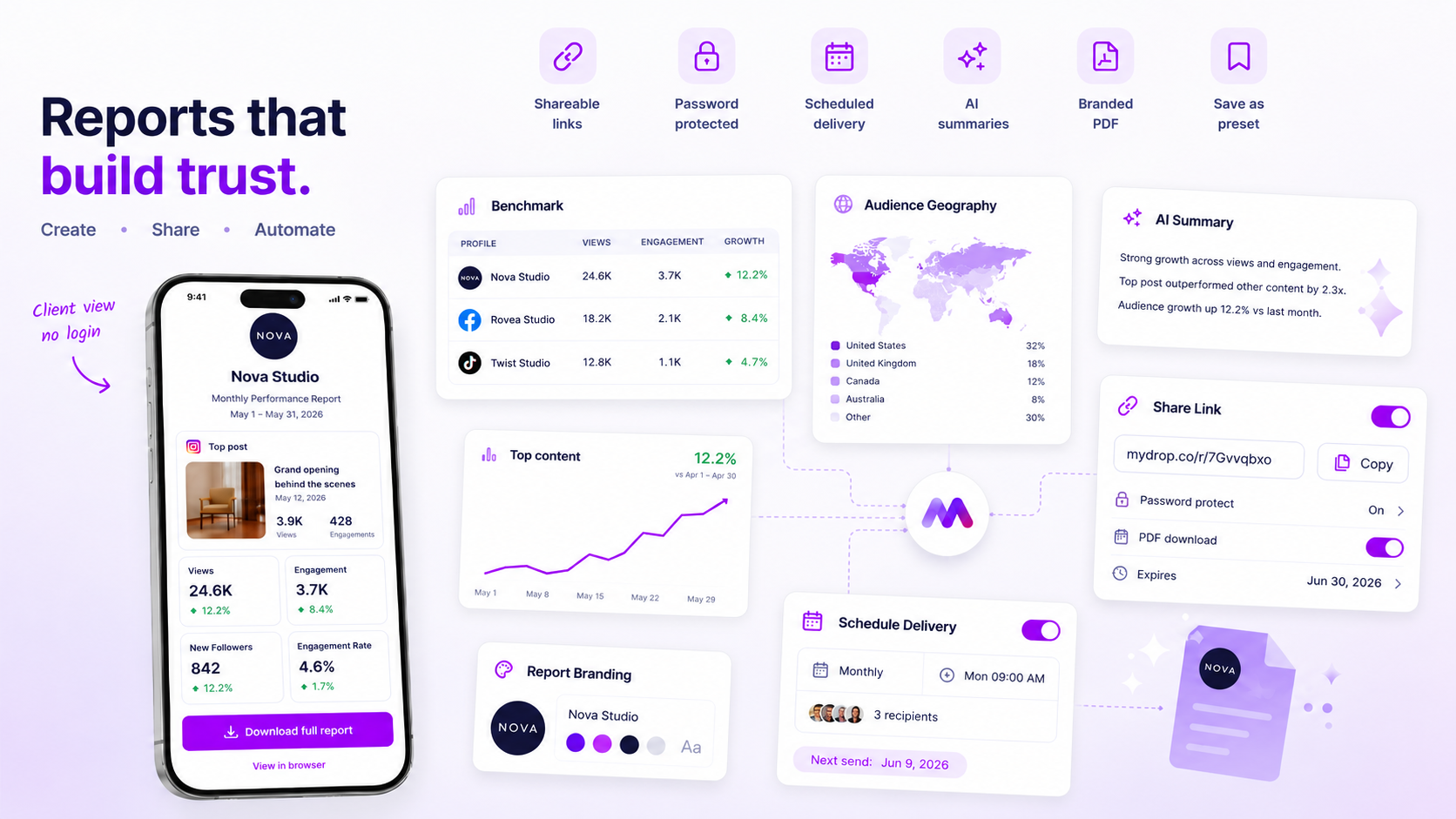
Our approach uses tokenized, public-facing report links. When you need to share a report, you generate a secure URL that lets stakeholders view the analytics directly in their browser without requiring a login or an account. It turns the report into a simple link you can drop into an email or a messaging app.
To keep your data secure, you have granular controls for every share link you create:
- Password Protection: If the data is sensitive, you can add a requirement for a password. The recipient enters it once, and they are in.
- Expiration Dates: You can set the link to expire after a certain number of days. This prevents old, potentially outdated reports from circulating indefinitely.
- Download Control: You decide whether the recipient can download the report as a PDF. Sometimes you want the viewer to interact with the web view, and other times you need them to have a static file for their records.
- Immediate Revocation: If you send a link to the wrong person or the project scope changes, you can disable the share link instantly. The report becomes unavailable to anyone using that URL.
This workflow means your clients spend their energy reviewing the strategy, not fighting with credentials. It also means you can send reports to stakeholders who are outside your primary brand management workspace, making it much easier to keep everyone aligned.
A simple shortlist checklist
When you are evaluating a tool to fix your reporting bottleneck, do not just look at the chart types or data sources. Look at the delivery. Here is a practical checklist to ensure you do not trade one set of problems for another.
- No-Login Access: Can stakeholders open a report link without creating an account? This is non-negotiable for busy clients.
- Granular Security: Does the tool offer both password protection and expiration dates? You need both to manage access effectively.
- Revocation Capabilities: Can you disable a link after it has been sent? If you cannot revoke access, you do not have true control.
- Flexible Delivery: Can you customize the delivery method, including email notifications and direct link sharing?
- Download Control: Can you selectively permit or restrict PDF downloads based on the recipient?
- Auditability: Does the tool show you which reports have active links, so you know who currently has access to what?
Conclusion
The real bottleneck in your reporting isn't the depth of the data or the quality of your insights. It is the amount of effort it takes for a stakeholder to actually see and interact with your work. Every barrier you put between the client and the analysis is a barrier you are also putting between yourself and approval.
If you are tired of chasing people for reviews or dealing with broken file links at the end of every campaign, stop optimizing the reports themselves and start optimizing the delivery. Move to a model where the report is easy to open, secure by design, and simple to manage. When you remove the access friction, you don't just speed up the review; you make it significantly more likely that your strategy gets the green light. The goal is to turn the reporting review into a quick, decisive conversation, not a tedious administrative task.