If your social media reports generate more "I can't access this" emails than actual strategy discussions, you aren't fighting a data problem; you're fighting a friction problem. When stakeholders face a mandatory login wall just to view a summary, they disengage. It's too many steps, too many forgotten passwords, and eventually, too much effort. The most overlooked failure mode in reporting isn't your data visualization; it is the friction of the delivery mechanism. To fix your review velocity, you need a delivery model that bypasses authentication, allowing stakeholders to view data instantly with zero barriers between them and the insights that drive your strategy.
We've all been there. You have spent hours aligning KPIs, then hit send, expecting productive discussion. Instead, you get silence or a request for a screenshot because the platform won't let them in.
What the best tools need to handle
The goal isn't just to share data; it's to guarantee the report is actually reviewed. When teams manage dozens of brand profiles and hundreds of stakeholders, the traditional "login and navigate" workflow becomes a major distribution bottleneck. The best tools recognize that a stakeholder's time is limited.
To truly eliminate delivery gaps, your reporting tool must handle security without sacrificing accessibility.
The Reporting Friction Audit
| Friction Point | Result | Impact |
|---|---|---|
| Mandatory Platform Login | User bounce | High engagement drop |
| Email Attachment (Static) | Version lag | No real-time interaction |
| Password-less Public Links | Security risk | Compliance failure |
| Tokenized Public Links | Seamless Review | High Engagement |
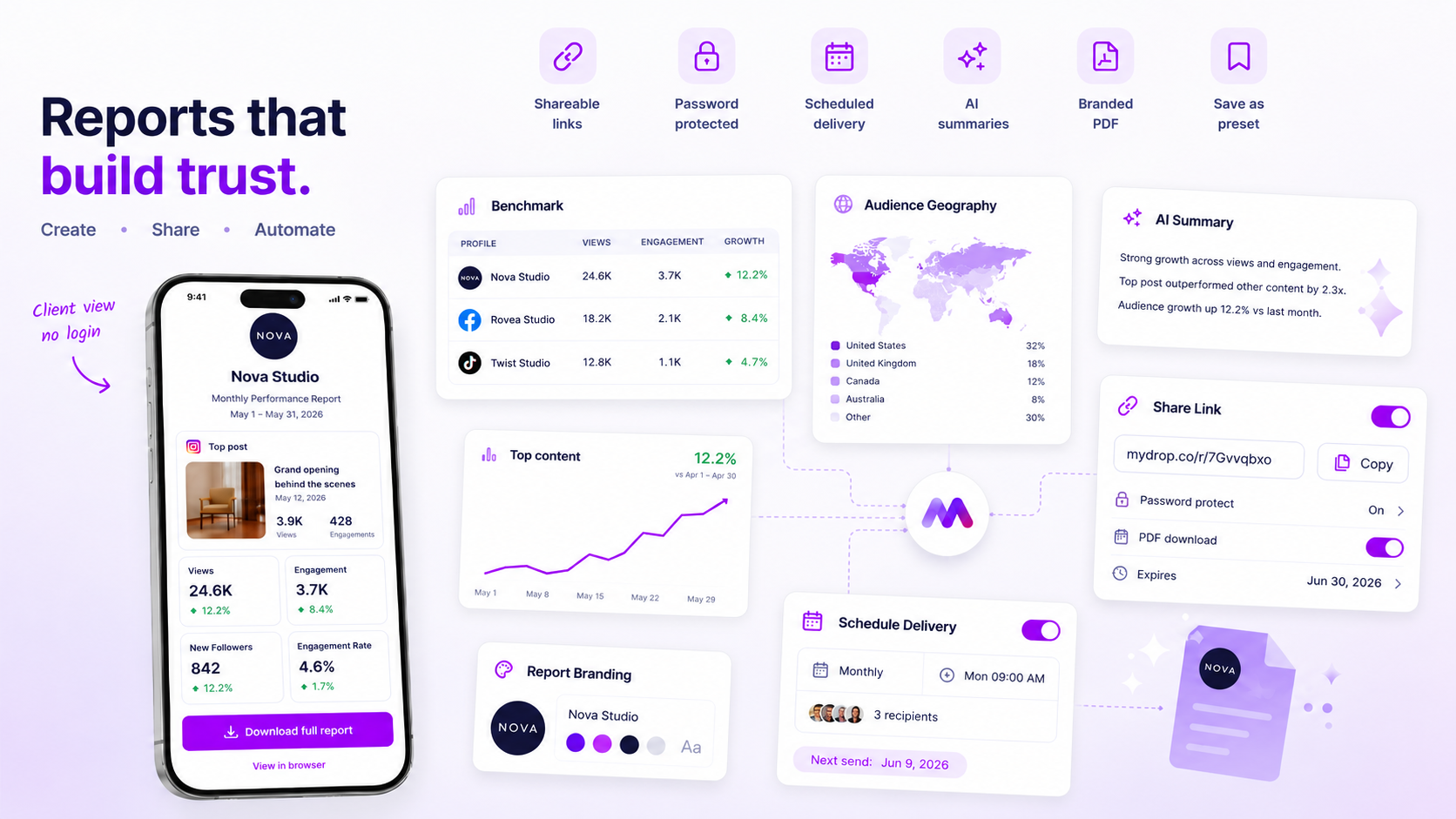
A robust tool provides secure, tokenized access that allows users to interact with report data without needing a seat in your primary management platform.
Operator Rule: If it takes more than one click to get from an email to the insights, you have already lost 40% of your audience.
The best reporting workflows provide granular controls, like password protection and link expiration, to keep data secure while still letting a client or manager review key metrics on their phone between meetings. At Mydrop, we see that teams utilizing these frictionless public share tokens don't just get more views-they get faster, more informed feedback loops, because the barrier to participation was removed entirely. When access is effortless, strategy conversations stop being about "how do I see this?" and start being about "what does this tell us?"
Where basic tools start to break

The login wall is the silent killer of engagement in social media reporting. When your stakeholders are forced to navigate a platform they only visit once a month, they rarely bother. They end up asking for a screenshot or a PDF, which forces you to manually extract the data. You are suddenly stuck in the business of manual report generation rather than strategic analysis.
This happens because basic reporting tools are designed around the producer of the data rather than the consumer. They prioritize platform security, admin controls, and user roles over the simple act of reading a chart. If your tool treats a high-level executive or a key client like a platform admin who needs a login and a complex navigation menu, you have already lost them. They have meetings, projects, and deadlines. A report that requires a password reset or a platform walkthrough will always be deferred.
At Mydrop, we often see teams hit this wall when they move from managing a few brand profiles to supporting dozens of stakeholders across different time zones. The coordination debt becomes impossible to pay off with manual exports and platform logins. You end up with "report drift," where the data is available, but the stakeholders are completely disconnected from the insights.
The buying criteria that matter
When evaluating reporting tools, you need to prioritize access velocity over depth of configuration. The best tool is the one that gets the data into the right hands with the lowest amount of friction. You should be looking for a platform that treats "shareability" as a core feature rather than an afterthought.
The most important differentiator is the ability to generate secure, public-facing links that bypass the authentication layer. This allows you to send a link in an email or chat, and the recipient can open it immediately in their browser to see the data exactly as it was intended.
| Feature | Basic Reporting | Frictionless Reporting |
|---|---|---|
| Stakeholder Access | Mandatory login required | Secure tokenized access |
| Delivery Method | Manual exports (CSV/PDF) | Automatic email delivery |
| Security Controls | All-or-nothing permissions | Passwords, expiry, download limits |
| Data Review | Platform-only interface | Browser-native, mobile-friendly |
| Revocation | None, once sent | Instantly disable link access |
When you are checking your shortlist, look for these three criteria to ensure the tool actually solves the delivery gap:
- Native Share Tokens: Can you create a unique, stable URL for a specific report? If the answer is "no," you are going to be stuck in email-attachment hell.
- Granular Public Access: Does the tool allow you to password-protect the link or set an expiration date? You need this to maintain compliance and control over sensitive data without adding the friction of a full user login.
- PDF-on-Demand: Can the recipient choose to download a PDF when they need it, without asking you? This is a critical convenience for stakeholders who need to archive or print reports for their own internal reviews.
This approach transforms the reporting workflow from a reactive, manual task into a proactive, self-service model. By using Mydrop’s public share tokens, you effectively remove the platform as a barrier between the insight and the person who needs it. When the barrier is gone, engagement follows, and strategy discussions finally take the place of access requests.
A simple rule helps here: if it takes more than one click for your stakeholder to see the data, you have introduced friction. Audit your process, look for the login wall, and prioritize the tools that get out of the way.
How Mydrop supports this workflow
The solution to the access friction problem is not better training or more emails; it is removing the barrier entirely. Your stakeholders need to see the data, not engage with your infrastructure. At Mydrop, we built report sharing specifically to bypass the login wall while keeping your data under control.
Instead of requiring an account, you generate a secure, tokenized URL for any analytics report. This link acts as a lightweight, read-only window into the campaign performance. Because the link is direct, the client or internal team member arrives at the data in one click-no onboarding, no forgotten passwords, no "request access" notifications interrupting your morning.
We also know that "public" does not mean "unsecured." You can layer on security with custom passwords and set expiration dates, so the report is only available for the review window you authorize. If the team needs to save the data for their own records, you can toggle PDF downloads on or off at the individual report level.
Decision check: If a stakeholder needs to log in to see a routine status report, they will eventually stop logging in. Friction is the enemy of engagement; automate the path to the insight, not the path to the interface.
A simple shortlist checklist
When you are evaluating tools, ignore the marketing fluff about "beautiful dashboards." Focus instead on the mechanics of delivery. Does the tool support these requirements?
| Requirement | Why it matters |
|---|---|
| No-Login Access | Eliminates the single biggest reason reports are ignored. |
| Tokenized URLs | Ensures secure, direct access without compromising platform integrity. |
| Granular Security | Password protection and link expiration are non-negotiable for enterprise compliance. |
| PDF Controls | Gives you control over how data leaves your ecosystem. |
| Automated Delivery | Reports should land in the stakeholder inbox, not wait for them to fetch them. |
If a platform lacks these capabilities, you are not really solving the analytics delivery gap; you are just moving it into a different menu. Mydrop's approach prioritizes this friction-free model because we recognize that reporting is not a document delivery service-it is a collaborative loop.
Conclusion
The bottleneck in your reporting process is likely not your data, nor is it the quality of your insights. It is the friction inherent in forcing busy people to navigate a platform they only visit once a month.
Stop treating analytics delivery as a chore and start treating it as a product. Your stakeholders have a job to do, and your data is the fuel for that job. When you make that fuel impossible to access, you are actively slowing down your own team's decision-making.
Auditing your reporting workflow might feel like an administrative task, but the payoff is substantial. When you remove the login wall, you trade "Where is the report?" emails for actual strategy discussions. You trade silence for action.
The best report is the one that gets read. Start there, and everything else-the engagement, the strategy, and the trust-tends to follow.