
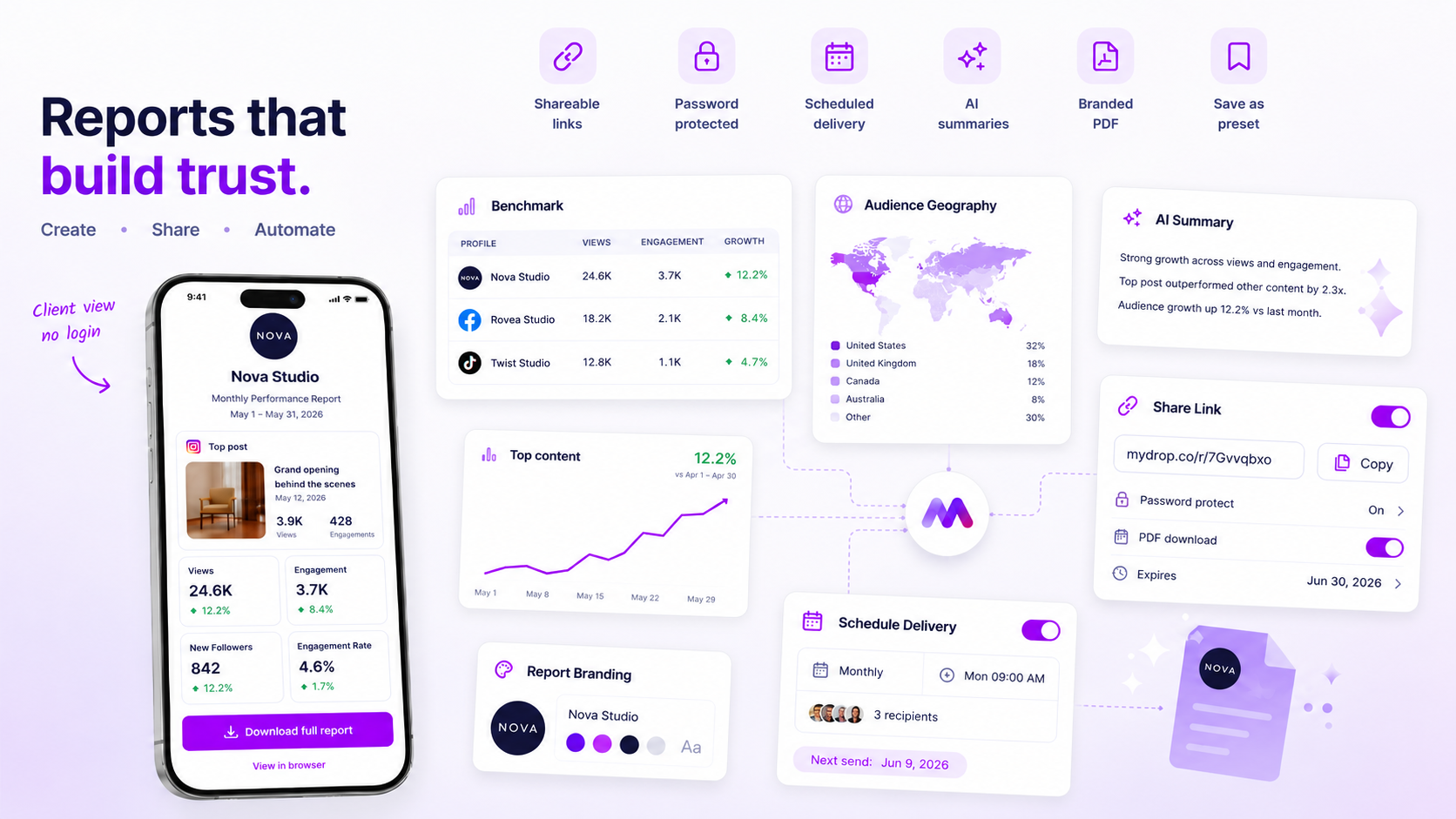
The best social media report tool for modern agencies is one that provides secure, tokenized public access. While traditional platforms force your clients through a tedious "Forgot Password" loop, a professional tool uses stable, encrypted share tokens that allow stakeholders to view live, interactive data instantly. This ensures your value is seen, not buried behind a login screen.
We have all been in that messy middle: you spend hours refining a monthly strategy, hit send, and three days later receive a "Hey, what is my password for the portal again?" email. It is demoralizing. It turns you into a tech support desk rather than a strategic lead. No one enjoys chasing approvals or explaining login procedures at 6 p.m. on a Friday when you should be heading home. We get it--reporting ROI is meaningless if the client never actually sees the report.
| Step | The Login Loop (Old Way) | The Tokenized Click (New Way) |
|---|---|---|
| Delivery | Email with a link to a portal. | Email with a unique, secure link. |
| Access | Client hunts for credentials or resets password. | Client clicks and views data immediately. |
| Experience | 3-5 minutes of friction before seeing a chart. | 2 seconds to reach the "Aha!" moment. |
| Friction | 100% (High drop-off rate). | 0% (High engagement). |
| Security | Shared logins or weak "remember me" cookies. | Encrypted tokens + optional password layer. |
What the best tools need to handle

Removing the login requirement does not mean throwing security out the window. In fact, it is the opposite. The "Security Paradox" in reporting is the false belief that forcing a login makes you look more professional. In reality, it is a hidden cost. True professionalism is delivering secure data without the chore.
To get this right, a tool needs to manage the Triple Threat of modern delivery: live interactive data, granular security controls, and sanitized views.
First, the report has to be alive. A static PDF is out of date the second it hits an inbox. The best tools provide a web-based view where a client can hover over data points or change date ranges without needing an account. At Mydrop, we have seen that when clients can "play" with the data, they ask fewer "wait, what does this mean?" questions because the answer is right there in the interface.
Second, you need surgical security. Sometimes a public link is too public. For enterprise brands or sensitive campaigns, you need the option to:
- Set an expiration date: The link self-destructs after the quarterly review.
- Add a password: One simple, shared password for the client team that does not require individual user management.
- Toggle PDF downloads: Decide if the client is allowed to take a hard copy or if they should only view the live dashboard.
Finally, the tool must sanitize the report. You do not want a client seeing internal workspace notes, your team's chat logs about a post, or specific backend metadata. A professional tool "strips" the internal view and presents a clean, branded experience that looks like a custom-built portal. It is about showing the growth you have generated, not the messy kitchen where you cooked the meal.
Where basic tools start to break

Basic reporting tools usually fail because they treat client delivery as an afterthought, not a core workflow. We have seen this across hundreds of agencies: you do the hard work of analysis, but the "last mile" of delivery is a mess. Most entry-level platforms fall into the Static PDF Trap. You spend hours formatting a 30-page document, hit send, and it is obsolete by the time the client opens it. If a campaign spikes or a crisis hits on Tuesday, your Monday report is a fossil.
The other massive fail point is the Global Login Loop. Many tools require you to invite a client as a user to your entire workspace just so they can see one dashboard. This is a security nightmare. Suddenly, a client might see your internal team comments, your profit margins on their ad spend, or even other client names in the sidebar. It is the digital equivalent of inviting a guest for dinner and accidentally leaving your open tax returns on the kitchen table.
Then there is the friction of the Authentication Wall. If your tool requires a password, you have already lost. Stakeholders at enterprise brands are buried in tabs. If they see a login screen, they will close the tab and wait for you to "just send a screenshot." At that point, your high-value reporting has been reduced to a grainy JPEG in a Slack thread.
The buying criteria that matter
When you are vetting a reporting tool for high-stakes accounts, ignore the flashy chart types for a second and look at the plumbing. The best tools focus on sanitized visibility. You want to show the wins without exposing the internal "sausage making" of your workspace.
Here is the scorecard we use to evaluate if a tool is built for professional delivery or if it is just a hobbyist dashboard.
The Reporting Delivery Scorecard
| Feature | The Bare Minimum | Enterprise Standard | Decision Rule |
|---|---|---|---|
| Link Security | Shared login or static URL | Encrypted Share Tokens | If the URL is guessable, your data is at risk. |
| Data Hygiene | Shows everything in the view | Sanitized Public Views | Must hide internal notes, costs, and team names. |
| Access Control | Login required or "public" | Optional Passwords + Expiry | Use passwords for sensitive IP; expiry for project-based work. |
| Format Flexibility | PDF only or Live only | Live View with PDF Toggle | Let clients explore the data, but give them a "Print" button. |
| Revocation | Delete the whole report | One-Click Link Disabling | You should be able to kill a link without nuking your internal data. |
Look for Token Stability. A good tool generates a stable, secure URL that stays the same even if you update the data in the background. You want a link you can bookmark in a shared client folder that always reflects the latest results.
At Mydrop, we built the sharing workflow specifically to avoid the "Hey, can you resend that report?" email. By using secure tokens, you can send one link that remains the single source of truth for the entire quarter. You get to control exactly what they see -- and what they don't -- with a simple set of toggles.
The real test of a tool is what happens when you disable a link. In a professional environment, you need the ability to revoke access instantly without deleting the underlying analytics run. If a contract ends or a stakeholder leaves, you shouldn't have to burn the house down to change the locks.
Your reporting should feel like a premium extension of your brand, not a technical hurdle your client has to jump over. When you remove the login friction, you stop being a "vendor who sends reports" and start being the team that provides the clarity they actually use.
How Mydrop supports this workflow
At Mydrop, we approach reporting as a delivery of trust, not just a data dump. We realized early on that agencies and enterprise teams were losing credibility every time a client had to ask for a password reset just to see their monthly growth. It turns a moment of celebration into a tech support ticket.
The Report Share Modal in Mydrop allows you to flip a switch and generate a stable, tokenized URL instantly. This isn't just a generic link. It is a secure, sanitized window into your results. When we say "sanitized," we mean the client sees the beautiful charts and hard-won metrics, but they don't see your internal workspace notes, draft posts, or team-only communication.
Mydrop also handles the messy security paradox that usually keeps legal teams awake at night. You can toggle optional password protection for high-compliance brands or set an expiration date for the link. If you are sending a one-off quarterly review, you probably do not want that link active three years from now. With one click, you can set the access to expire after 30 days, or revoke it manually if the contract ends.
One of the small human touches our teams appreciate is the PDF download control. Sometimes you want the client to stay in the live, interactive view so they can hover over data points. Other times, you know they need to save a copy for their internal board report. You can choose to enable or disable the PDF download button on the public page, giving you full control over how your intellectual property is distributed.
| Access Tier | Security Method | Best For | Operational Value |
|---|---|---|---|
| Open Public | Stable Token | Routine monthly check-ins | Zero friction, highest view rates |
| Protected | Password + Token | Sensitive campaign launches | Balanced security, no portal login |
| Time-Limited | Expiry + Token | One-off strategy audits | Prevents "link rot" and old data leaks |
| Restricted | Internal Only | Internal team prep | Safe workspace for drafting wins |
A simple shortlist checklist
If you are auditing a tool or refining your current process, use this five-point friction audit. If the tool forces a "Create Account" screen at any point in this workflow, it is likely costing you stakeholder attention.
- Token Stability: Can you update the data in the report without the URL changing? A broken link in a client's inbox is a trust killer.
- Sanitization Check: Does the public view automatically hide internal-only fields, costs, or "in-progress" comments?
- The PDF Toggle: Can the client generate their own PDF from the live link, or are you stuck manually emailing attachments?
- Expiration Governance: Can you set links to self-destruct after a specific date to maintain data hygiene?
- One-Click Revocation: If a client relationship changes, can you kill the public link immediately without deleting the underlying data?
Conclusion
Reporting is not just about the data you show. It is about how quickly you can get that data into a stakeholder's brain. When you remove the login screen, you aren't just "sharing a link." You are removing the final barrier between your hard work and their approval.
The best social media report tool is the one that stays out of the way. It should act as a quiet, professional conduit that presents your wins clearly and securely. Every second a client spends hunting for a password is a second they aren't looking at the growth you generated. Stop being a password manager and start being a strategic lead. Shift your delivery to tokenized, no-login access and watch your report engagement actually match the effort you put into building them. Friction is the enemy of ROI, so clear the path and let your results speak for themselves.