
Stop sending raw report links as if they were simple calendar invites. If your performance data touches anything proprietary or sensitive, you need to swap those open-access URLs for password-protected share tokens immediately.
We get it. You are juggling a dozen stakeholders across different time zones, and the pressure to deliver "just one more chart" by 6 p.m. is relentless. It is tempting to hit "share" on the first link you see, but that convenience is exactly how coordination debt piles up. When you leave analytics exposed to anyone with a browser, you aren't just risking a data leak; you’re eroding the trust your clients and internal leadership place in your team’s governance. You don't need a security clearance or a help desk ticket to share data safely, but you do need a consistent operating habit that matches the sensitivity of the metric to the security of the delivery.
The decision teams usually frame too broadly

Most teams fall into the trap of viewing "security" as a binary switch-either it is fully locked down behind a rigid SSO wall or it is completely open. That is a false choice that slows down your best people. The real decision isn't about blocking access; it is about choosing the right delivery friction for the audience at hand.
When we look at teams managing hundreds of social profiles across multiple brands, we see a clear pattern: the more you over-secure, the more people bypass your systems entirely. The goal is to move from "open-by-default" to "fit-for-purpose" sharing.
| Reporting Method | Best Used For | Security Level | Friction |
|---|---|---|---|
| Public Link | Low-stakes, high-level summaries | Baseline | Minimal |
| Password-Protected | Sensitive, proprietary performance trends | High | Low |
| Email Delivery | Direct, executive-level sign-off | Enterprise | Medium |
Operator rule: If you are sharing a report that includes half-finished analysis or proprietary trend lines, it should never have a static, unprotected URL.
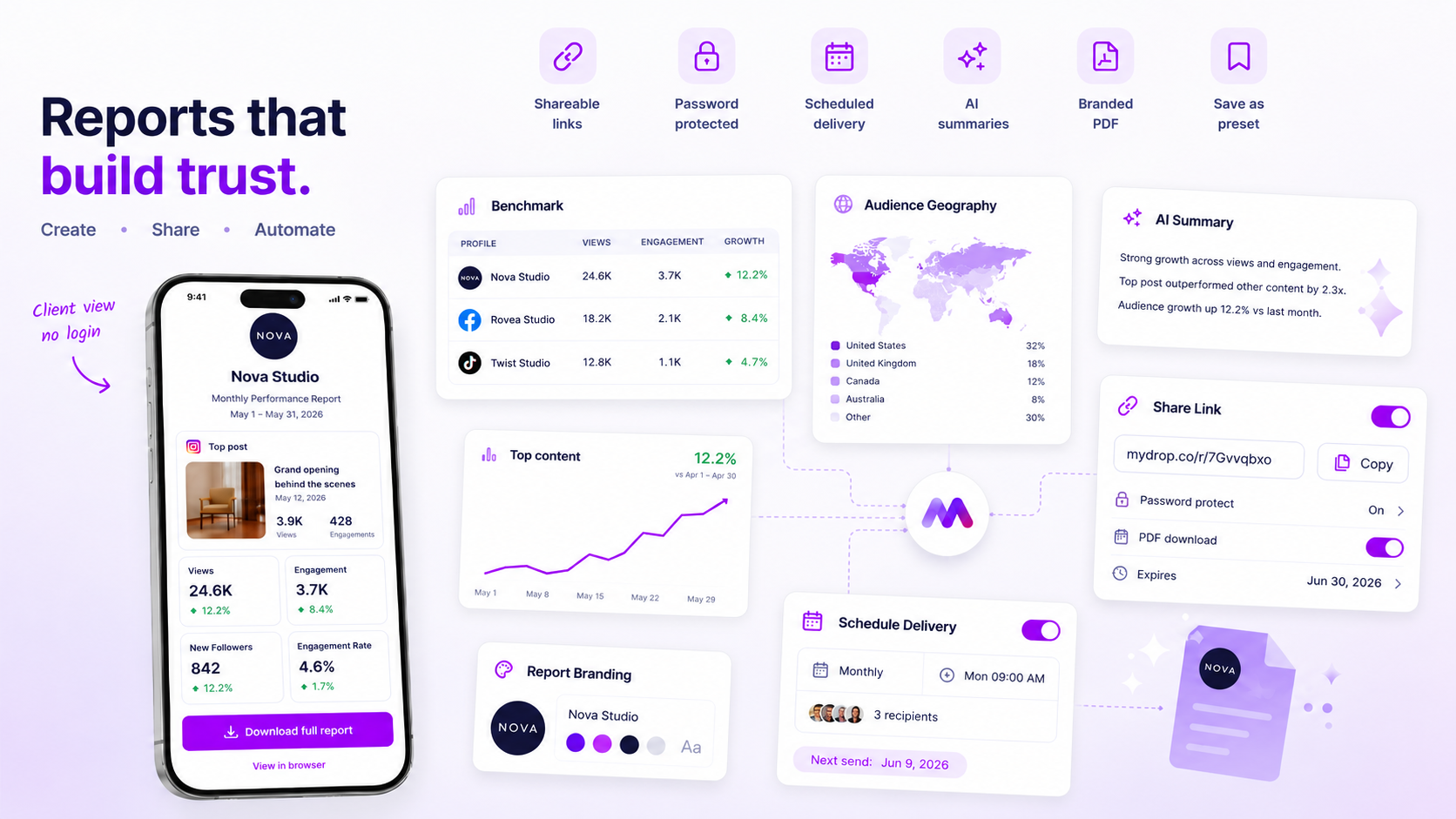
The most effective teams we know treat report sharing as a deliberate workflow. They use public links for quick, non-sensitive check-ins where the audience needs immediate context, but they pivot to password-protected views the moment a document contains data that wouldn't want to end up on a competitor's desk. At Mydrop, we designed our analytics report sharing specifically for this cadence. You can set expiration dates on these tokens or add a password on the fly, allowing you to provide a branded, no-login experience for your client without turning your workspace into a security liability. It is the difference between handing someone a folder of loose papers and handing them a locked briefcase that disappears when the project is done.
What should stay manual and what can move faster

Most teams get stuck because they try to treat every report the same way. They either over-automate, sending every single data dump to every stakeholder regardless of relevance, or they keep everything manual, creating an endless cycle of "Can you export that again?" emails.
The secret to moving faster is simple: Automate delivery for the pulse; keep the context manual.
If you are tracking standard weekly metrics-total reach, engagement rates, or follower growth-this is your pulse. It is repetitive, predictable, and should move through an automated email delivery workflow. At Mydrop, we see the most efficient teams setting these up to land in stakeholder inboxes on a set schedule with a clear, concise summary. It kills the manual request cycle instantly.
However, when you are sharing high-stakes, proprietary insights-like a strategy teardown for a new market launch or a sensitive comparison of three different competitor campaigns-stop hitting "send" on an automated email. This is where you need precision. Use a password-protected share link here. It forces a deliberate pause. You control access, you set an expiration date if the data is only relevant for a week, and you maintain a layer of security that ensures only the right eyes see the sensitive numbers.
Decision check: If the report contains data that could change your quarterly strategy, it never gets an open link. It gets a password.
The tradeoff matrix
The following matrix helps you map your current reporting needs to the right delivery method. Stop guessing where a report belongs and start using this framework to match the method to the weight of the data.
| Reporting Method | Best Used For | Security Level | Friction | Operating Logic |
|---|---|---|---|---|
| Public Link | Low-stakes, high-level summaries | Baseline | Minimal | No authentication; fast share for broad team updates. |
| Password-Protected | Sensitive, proprietary performance trends | High | Low | Requires key access; ideal for temporary campaign audits. |
| Email Delivery | Executive sign-off and routine status | Enterprise | Medium | Scheduled, direct, and creates a record of receipt. |
When you look at this table, don't just look at the columns. Look at the Operating Logic.
Teams managing dozens of brand profiles often fail because they treat an "urgent campaign audit" with the same lax security as a "monthly community growth" check-in. If you are sharing a file that includes a competitive analysis or early-stage performance metrics, you are holding the keys to the kingdom. Treat them like it.
If you aren't sure which path to choose, start with a safe-fail approach. Set your next report to be password-protected with a 48-hour expiration. If your client or stakeholder handles it well and doesn't get locked out, you have confirmed your security threshold. If they struggle, you have learned you need to either simplify the report's UI or invest 10 minutes in a quick onboarding screen share.
Moving faster isn't about removing all friction; it is about choosing the friction that actually protects your team's work.
How to pilot the workflow safely
You do not need to overhaul your entire reporting infrastructure in one afternoon. In fact, doing so usually triggers the exact chaos you are trying to avoid. Instead, pick a single, low-stakes report-like a monthly internal performance summary or a routine update for a trusted partner-and run a pilot.
At Mydrop, we suggest starting with the "One-Link Audit." Before you send your next batch of performance metrics, spend five minutes in your report settings to apply these three guardrails:
- Set an expiry date: If the report only needs to be relevant for the next week, set the link to expire automatically after that window. This is your best defense against "stale data leakage."
- Toggle the PDF control: Be deliberate about whether you want the recipient to download a static version. If you want them to always have the latest, most accurate data, consider keeping the PDF download disabled.
- Use a password for the "grey-area" stakeholders: If you are unsure if the link might be forwarded to someone outside the immediate project scope, add a simple, shared password.
Operational Check: Before you hit send, ask yourself: "If this URL ends up on a public Slack channel or a shared drive, would I be comfortable with that?" If the answer is "no," the password field is no longer optional.
Once you have done this once, the workflow becomes invisible. Your team stops treating every report as a high-security emergency and starts treating it as a standard, repeatable process.
The operating rule to keep
If there is one principle that separates high-performing teams from those drowning in coordination debt, it is this: Access is not a one-time grant.
You should treat access to your analytics exactly like you treat access to your cloud assets or your internal brand library. It requires governance. Just because you shared a report with a client last quarter does not mean they need access to this quarter’s updated metrics, especially if the team structure has shifted.
Workflow check: If it's shared, it's secured.
When you use Mydrop to manage these report delivery links, you have a centralized place to monitor, audit, and-crucially-revoke access. If a project wraps up, you don't hunt through email threads to see who has what; you simply disable the share token. It is an immediate, global "off" switch that ensures your sensitive performance trends stay within the right circles, regardless of how many times a link was forwarded or saved.
Conclusion
The goal of your reporting pipeline should be to build trust, not to build obstacles. When you lean into a flexible, protected delivery model, you stop being the "gatekeeper" of data and start being a partner who is proactively providing the right insights at the right time.
Start with that one pilot report. Once you see how much cleaner your communication becomes, you will wonder why you ever lived with the risks of open, unmonitored links. Your data is your strategy-treat it with the same level of care you apply to the creative work itself.