When campaign calendars stall, the culprit is often buried deep in the settings menu. If adding a new strategist or inviting a client creates a cascade of "access denied" requests or, conversely, over-exposed data, your software is actively fighting your team's velocity. We have seen this across dozens of agencies: you have the creative, the strategy is set, but you are stuck in an email chain trying to get the right person the right access. It is messy, frustrating, and kills your flow. You should be launching, not troubleshooting user roles. Access should be instantaneous, but security must be absolute. If you cannot grant precise permissions in seconds without risking the integrity of your workspace, your tool is the bottleneck.
What the best tools need to handle

The difference between a tool that scales and one that creates constant friction comes down to how it manages coordination debt. When onboarding a new member, the goal is to shift from manual, "permission-by-email" requests to a predictable, resource-based model. A robust system does not just manage users; it treats access as a dynamic mapping of roles to specific assets.
Top-tier software avoids hard-coded, rigid roles that force administrators into an impossible choice: either grant full access to everything or waste time micromanaging every single action. Instead, look for platforms that allow you to define what each person can do within specific resource containers like campaigns, approval queues, or analytics dashboards.
| Capability | Why It Fixes Onboarding |
|---|---|
| Granular Action Maps | Restricts actions (e.g., draft vs. publish) per asset, removing the "all-or-nothing" admin trap. |
| Template-Based Roles | Allows instant provisioning based on predefined responsibility, not custom setups for every new joiner. |
| Resource-Level Control | Gives access to specific brand assets only, preventing data over-exposure across multi-brand environments. |
| Self-Serve Preferences | Empowers members to manage their own notifications, reducing the noise burden on busy admins. |
When these features are missing, onboarding becomes an administrative chore. If your current platform requires you to open a support ticket or ping engineering just to update a teammate's role, you are already losing campaign momentum. The best tools handle this natively through a clear interface that lets you invite, assign, and customize in a single, fluid session. It should feel like a background administrative process, not a strategic hurdle. If you find your team constantly asking, "Who has access to the Q3 analytics dashboard?" or "Why can the intern approve posts?", the tool is doing more to obstruct your workflow than to facilitate it.
Where basic tools start to break

Many teams settle for simple software early on, but these eventually turn into administrative jails. When your platform offers only a handful of hard-coded roles-like Admin, Editor, and Viewer-you are immediately forced to make a compromise. Either you over-provision access, hoping people do not accidentally delete a campaign, or you create a bottleneck where every minor edit requires an admin approval.
This is not just annoying; it is a scalability ceiling. We have seen teams managing hundreds of brand profiles where a single content change takes 48 hours simply because the person doing the work lacked the specific, restricted permission to edit that one resource.
The real failure is not the team; it is role rigidity. When you cannot define permissions at the resource level-differentiating between creating a draft, reading analytics, and approving a final post-you are essentially operating in the dark.
Common mistake: Granting broad Admin roles to bypass workflow delays instead of configuring granular permissions. This creates a compliance risk and makes it impossible to track who actually changed what.
The buying criteria that matter
To break through these bottlenecks, you need to shift from a role-based mindset to a resource-based one. Stop asking "What should this user be?" and start asking "Which specific actions can they take on which specific assets?"
The best software treats permissions as a dynamic map rather than a static badge. You need the ability to define exactly who can create drafts, who can publish, and who can view sensitive reports, all without escalating them to full workspace management.
Flexibility is the antidote to coordination debt. When you can build permission templates that assign these rights in bulk, onboarding a new agency partner or a regional strategist happens in seconds, not days.
To help you audit your current setup, use this maturity model to see where your team stands.
| Maturity Level | Access Definition | Onboarding Speed | Administrative Burden |
|---|---|---|---|
| Low | Global roles only (Admin/Member) | Slow (Requires admin action for every task) | High (Constant bottleneck) |
| Medium | Limited role groups (e.g., Contributor) | Moderate (Requires some role tweaking) | Medium (Periodic cleanup needed) |
| High | Granular, per-resource mapping | Instant (Template-based assignment) | Low (Self-service workflow) |
If you are currently stuck in the Low or Medium categories, your software is actively limiting your team's velocity. At Mydrop, we built our permission model around granular resource mapping because we have seen too many campaigns lose momentum while waiting for an admin to wake up and click approve.
Most teams do not have a content problem; they have a decision bottleneck. If your software does not allow you to distribute the authority to act alongside the responsibility to execute, you will always be chasing approvals.
How Mydrop supports this workflow
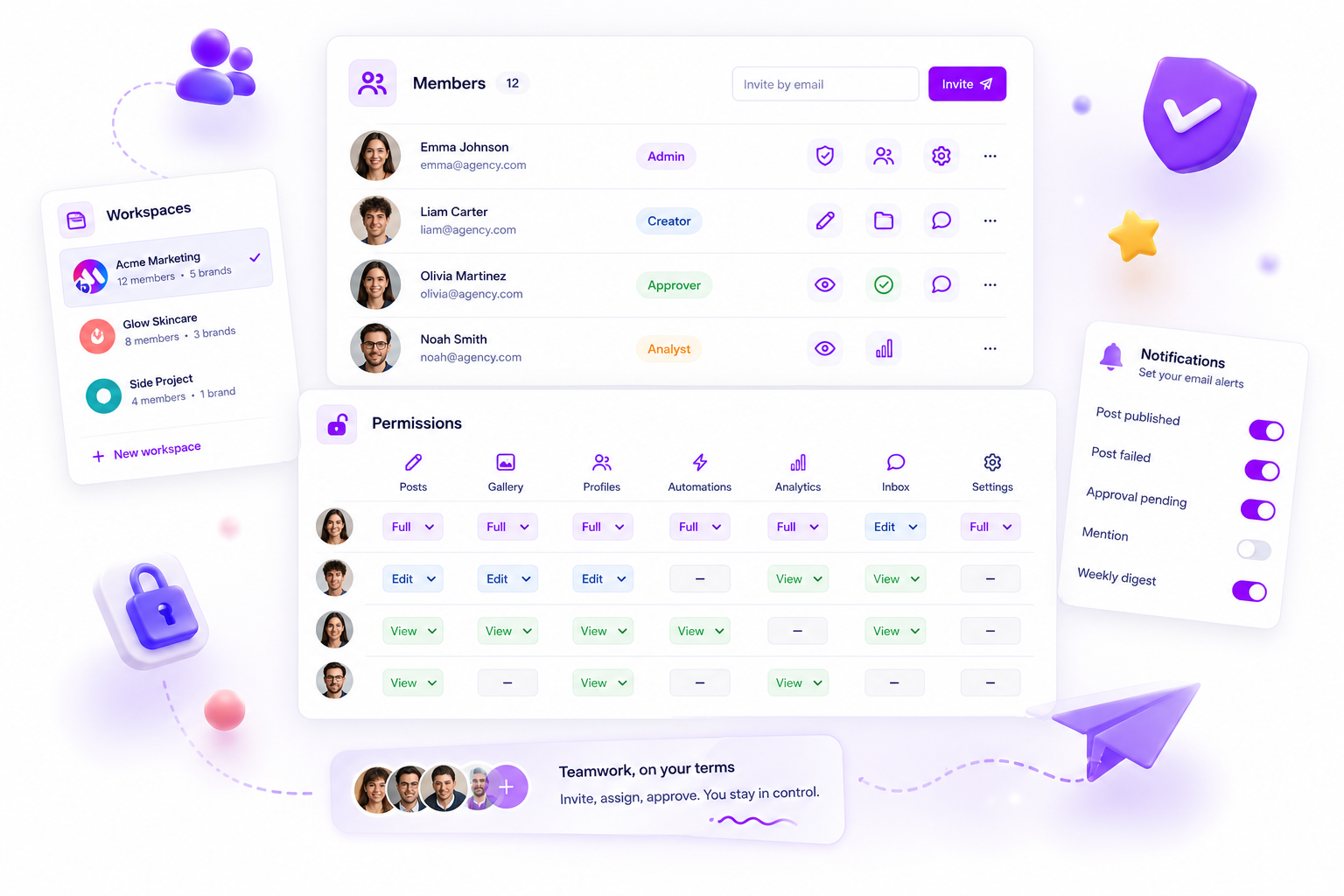
When we built the member management system in Mydrop, we didn't just want another list of users with checkboxes. We wanted to eliminate the administrative friction that forces managers into doing manual IT work every time a new creative joins the team.
In many platforms, you are stuck with hard-coded roles. You get an Admin, an Editor, and a Viewer, and that is it. If your Editor needs to approve drafts but not delete profiles, you are often stuck giving them more access than they should have, or bothering an admin to do it for them.
In Mydrop, we use a granular resource-based map. You can grant access to exactly what a person needs-say, creating drafts for a specific brand without touching live analytics, or managing groups without seeing the financial reports. You set the permissions, invite the person, and they are up and running in seconds. It is about eliminating the wait, not just changing settings.
And for the constant noise of operational emails? We let people toggle their own alerts. A strategist might need notifications for draft approvals, but not for every single inbox thread comment. By giving team members control over their own notification preferences, we ensure they stay in the loop on what actually matters for their role, without getting buried under a mountain of irrelevant inbox activity.
This is the shift that matters: you move from managing people one-by-one to managing permissions as a scalable system. When onboarding takes seconds instead of days, your team stops waiting for access and starts hitting deadlines.
A simple shortlist checklist
Before you sign a contract for a new social media management platform, run your current or prospective tool through this sanity test. If a tool cannot check these boxes, it is not helping you scale; it is just adding administrative weight to your already busy week.
| Feature Area | Must-Have Capability | Why it Matters |
|---|---|---|
| Role Flexibility | Custom roles beyond hard-coded Admin/Editor/Viewer. | Prevents over-provisioning and ensures security. |
| Resource Granularity | Per-action control (e.g., create vs. approve vs. delete). | Keeps junior staff safe while enabling productivity. |
| Onboarding Speed | Invitation workflow that assigns roles in a single step. | Stops the "access denied" email chain immediately. |
| Bulk/Template Action | Ability to apply roles to groups or via templates. | Essential for agencies or multi-brand teams. |
| User Notifications | Self-serve preference toggles for operational emails. | Reduces noise and prevents inbox fatigue. |
Decision check: If you have to ask a support agent or file a ticket to change a user's permissions, the software is acting as a bottleneck. True enterprise tools put the control in your hands, not behind a service desk.
Conclusion
At the end of the day, your software should be the silent engine behind your team, not the one constantly requesting permission to run. If your team is stuck in a loop of administrative busywork, you are not fighting a creative problem-you are fighting a coordination bottleneck.
The moment you shift your mindset from "who can access what" to "how can we enable everyone securely," your onboarding delays start to disappear. You stop chasing approvals at 6 p.m. and start trusting the system to handle the access while you handle the strategy. The goal is to reach a point where your campaign momentum finally starts to reflect your team's actual potential, not the limitations of your settings menu.